This Moment

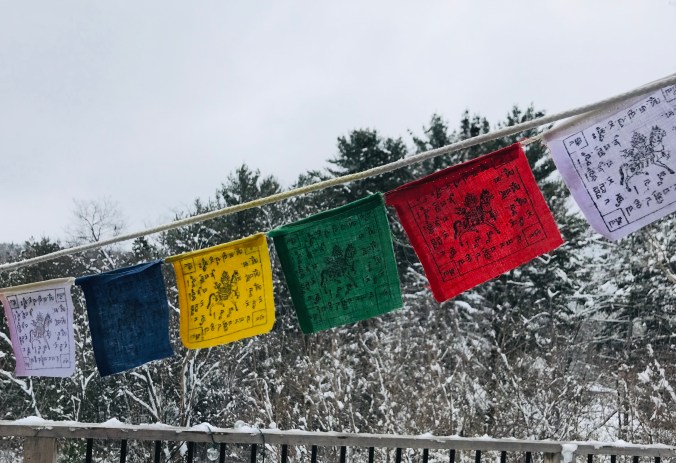
April 1. 19 years ago we had a such a large snowstorm that we had to carry our 2-year-old daughter outside. The snow was too deep for her to walk until we had shoveled paths from doors to driveway to woodpile.

Not so, this year. Only patches of snow remain. No longer needing winter boots, I walk behind my thawing garden and through the cemetery, where last year’s faded plastic flowers push up through remains of ice, behind the abandoned playground and empty school. The town is closed up, too, the food co-op staff barricaded behind locked doors — phone in your orders — no one lingers in the post office, the sidewalks are empty.

April will bring chattering peepers, spring ephemerals, the tiny blue squill around our house. Like those long, long winters, this isolation will pass, too, inevitably. Who knows what lies on the other side — what May 1 will bring — but greenery is certain.

Tender shoots of garden peas.

Flocks of migrating songbirds in warming skies.

The sun was warm but the wind was chill.
You know how it is with an April day.

— Robert Frost

IMG_7495

Yes

In the grocery store checkout line — six feet at least apart from everyone — the man in front of me starts in on a rant about Boeing and the proposed bailout. I set down the gallon vinegar and my bag of purchases I’m sure our family utterly needs in a pandemic, like masa harina, and assure the stranger I’m with him.

In this utterly strange world — far apart but suddenly socially unleashed — I ask him question after question. A Vietnam Vet, he and his wife are sewing masks for medical workers. He raises a cardboard box of wire ties the grocery store donated to aid their efforts.

I don’t know if those masks will impede the virus or not. I’ll probably never see this stranger again, who lifted the box just before he left, while I cheered him on and thanked him.

Yes, it snowed nine inches in Vermont. Yes, we’re under a Stay Home order, the governor’s distinctively less-alarmist version of shelter-in-place with your arms over your head. Yes, the governor’s on the radio every day, assuring Vermonters we will endure. And, yes, this, too, will pass.

In the long run, we shape our lives, and we shape ourselves. The process never ends until we die. And the choices we make are ultimately our own responsibility.

Eleanor Roosevelt

IMG_7438

Strength Lies in Vulnerability

When my daughter heads to work yesterday morning, I stand on the kitchen step, listening to rain on the porch roof.

As a writer for a Vermont magazine, I’m ordered to stay home, and my intention is to drink coffee and work at the kitchen table. All day.

But my daughter, my 21-year-old, works on the front lines of this unknown illness. All day, she texts me periodically. Hours later, when I’m listening to the governor declare a state of emergency in Vermont, she walks in wearing jeans and a pretty blouse, her scrubs bundled in a plastic bag and left outside on the porch. While eating beef stew, she shares her day.

I’ve spent much of the afternoon reading about the history of poverty in Vermont, about Roosevelt’s relief programs and the story of social welfare, for an article I’m writing about wages in Vermont. Listening to my daughter who’s embraced this beginning of her working life with such gung-ho enthusiasm, doing difficult things, pulling her own weight with a busy medical team, I keep thinking about time and place. In the manuscript I just finished, I wrote that individual qualities of courage and cowardliness, of persistence and dishonesty, shape and alter our lives. But, likewise, so does our historical time and place.

Our conversation inevitably shifts to our family, as we figure out the possible economic pieces of our household, bracing for far harder days. This responsibility, too, this young woman steps into seamlessly, accepting her responsibility in her father’s absence as a given. Later, as we head out for a walk in the evening’s dark, I think back to that governor’s speech — so different from the current commander-in-chief’s remarks. I remind myself what I once believed was impossible — strength grows in vulnerability.

Competition has been shown to be useful up to a certain point and no further, but cooperation, which is the thing we must strive for today, begins where competition leaves off.

Franklin D. Roosevelt

IMG_7311

Not the Rose Garden in bloom. Hardwick, VT, in March.

Capitalism and Commodification

Everyone’s late to dinner last night, except the cats, who are never late to dinner, so I lie on the floor and finish reading Edward E. Baptist’s The Half Has Never Been Told: Slavery and the Making of American Capitalism. Spoiler alert: there’s no laugh-aloud sections in this lengthy book.

Although I consider myself at least mediocrely educated, the book was a revelation to me — a enormous swathe of history, like Hemingway’s submerged iceberg, still mightily driving along our society.

Here’s a two-line excerpt.

The idea that the commodification and suffering and forced labor of African Americans is what made the United States powerful and rich is not an idea that people necessarily are happy to hear. Yet it is the truth.

IMG_6621

Meanwhile, little pumpkins in Vermont.


And the Bands Beat On….

My daughter plays clarinet in the band. Her school’s so small the band is both middle and high school, younger kids mixed in with the kids who are driving and working jobs and on the cusp of grownupness. It reflects the small town kind of world we live in, that, by the nature of its size, encourages acceptance. I linked up with a woman I’ve known since our oldest kids were nursing babies, 20 years ago.

Twenty school bands from all over the state played in a parade last night in Montpelier. As I walked around the high school, looking for my daughter, the evening sun in my eyes, I followed the tunes from one band to another. So much live music! So many kids!

For that brief time — the best of parenting. Laughter and silliness in the heady May evening, beneath trees just barely beginning to leaf out. I drove my hungry kid home, listening to her, as we drove through the dusk tumbling down, back to our house and the cats at the door, mewling for affection.

IMG_5326.jpg

Money and Community — and More

As Woodbury’s town librarian (population 888), my wages are paid directly by the townspeoples’ property taxes, a few donations, and Woodbury Pie Breakfast. Now the main yearly event in town, nearly 300 people showed up at the town’s little elementary school, trudging up the stairs to the second floor gymnasium, to eat pie yesterday morning.

Friday evening — and this is my most beloved part of pie breakfast — people arrive with covered dishes, explaining this is pumpkin and maple or bacon and sausage with a little dill. 

Late last fall, Vermont’s State Board of Education mandated that Woodbury’s elementary school merge with two other local schools — one school much larger. After a winter of endless adult meetings about how to keep Woodbury’s school and library open, what pleasure — and relief — to fill the school with live music, the redolence of warming quiche, laughing kids — and adults in need of coffee.

IMG_4928

Of all my photos, this is my favorite: the little girl waiting for pie to be served, while adults do adult things….