One Word.

Yesterday, I kept remembering when we took our youngest camping beside a pond when she was two. She pointed to a purple flower growing in the water and learned to say pickerel. For days, she practiced that word, pick-er-el, saying it slowly and carefully, over and over.

Fourteen years later, she’s mastered that name and much more, working for days last spring at what appeared to me to be pages of math. She won’t remember one bit of that trip, but it’s in her, still.

In the evening, my daughters disappear to go running. I wash up dishes, then sit outside near the garden and where the wilderness edges up behind our world, with milkweed and raspberry brambles. As the dusk filters in, I read. The late summer crickets chirp their songs, and the world keeps moving on and on at what it does.

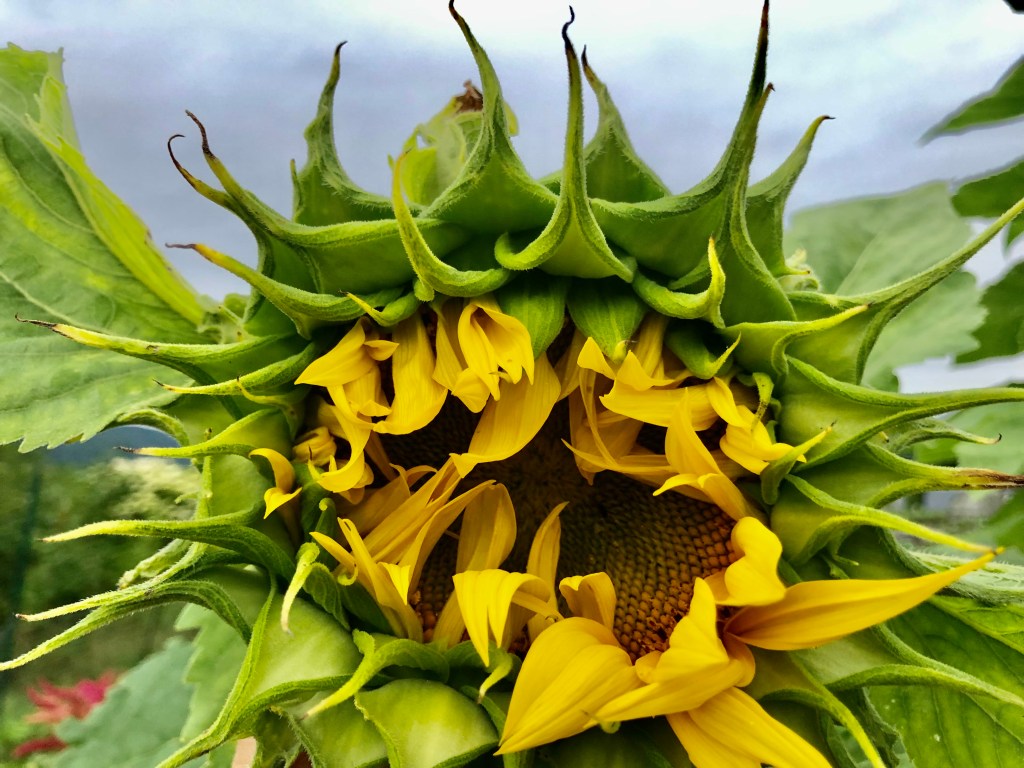
Sunflowers. Japanese beetles in the green beans. Tomatoes red on the vine. The rich scent of the promise of rain moving in.

Come

Let us dine on barley grain

On a journey nowhere

— Bashō

Night Driving.

I had dinner with six other adults last night at a restaurant beneath a tent. Across the table from me, one man said he didn’t think he’d eaten with that number of people in, well, what seemed like forever.

Ditto, me.

I’d driven down I-91 along the Connecticut River to meet the team at Steerforth Press and talk about my book Unstitched that will be published in a month.

On my way home, I drove out of New Hampshire in the dark that had fallen while we were talking and telling stories. I drove away from the congestion of Dartmouth, and then north again, into the deepness of Vermont. The day was still humid and sticky with summer, and I left the windows open, while I listened to The New Yorker‘s Atul Gawande talk about the Delta Variant.

I remembered driving in the dark in my mid-twenties, alone, over the Continental Divide. At the top, I parked and stretched. Although it was summer then, too, the elevation’s chill made me shiver in my t-shirt and shorts. In the women’s room, drying my hands under a stream of hot air, I chatted with an elderly woman. Where she was going, and what she was doing, I’ve long since forgotten, but I remember stepping outside the little building with her and admiring the stars.

So many years later, I sped through the warm and velvety night.

At home, my daughters had left the little string of lights on in the living room, and the back porch lamp glowed. Our house, freshly painted white, glimmered a little as the clapboards rose above the woodpile and purple echinacea. The cats sat at the door, watching moths, or maybe waiting for me.

A few minutes early to New Hampshire yesterday, I walked through a park and discovered a community garden devoted almost exclusively to flowers. A woman and her dog paused and watched me admire the blossoms. The poodle suddenly stood up on its hind legs and barked a hello. I laughed. The woman nodded. Then she went her way, and I went mine.

On the Move.

Council Bluffs, Iowa, comes up randomly in conversation at work, and I remark idly that I’ve been there. A coworker asks why, and I answer vaguely that my family was passing through.

I haven’t driven around the country since I was in my twenties, and the country seems even larger and more unknown these days. In Vermont, again this summer, we see plenty of license plates from distant places — Tennessee, Missouri, Oregon — people on the move, for all kinds of reasons. There’s plenty of jobs, but nowhere to live.

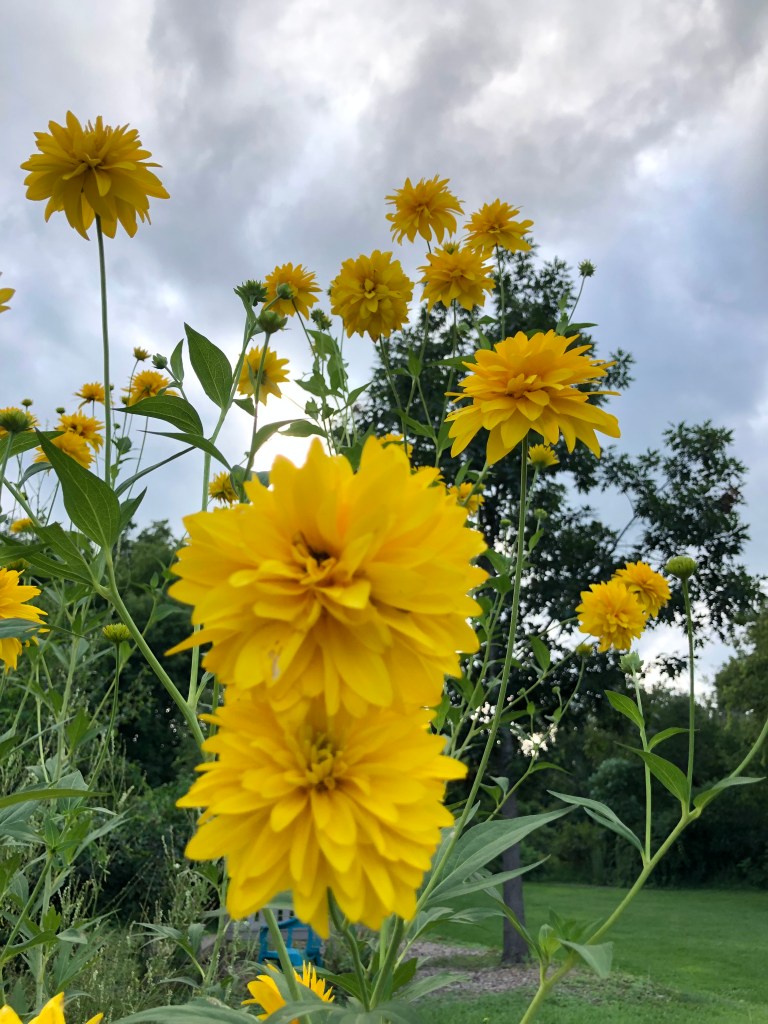
Swimming at dusk, the water ripples before me, fracturing the raspberry sherbet sky into broken curves. August is the month when the peas are finished, and the rudbeckia blooms wildly.

Friday afternoon, I wash the screens and leave the windows open. The cicada sings, and my youngest teases me, You know what that sound means…. Our neighbor’s little boy pushes his toy mower across their grass, back and forth, serious about his work, in his own private world. Sunlight falls through the maple leaves fall above his head, the green fading toward gold, even this early in August.

Muddy water is best cleared by leaving it alone.

— Alan Watts

Sweet August…

August. On a run after work, I remind myself August would be a good month to step away from work and the revolving paddlewheel of our daily lives. I’ve pretty much always failed at vacations, but I fold that idea somewhere away in my memory. As I walk home and cut across a little league field, I have a sudden memory of eating grass as a young child. I remember pulling long, slightly sharp-edged blades and nibbling on these, like a goat or a cow, eating straight from the earth.

In my garden, green beans are fattening on the vines in force. We eat those in the sunlight, straight from the vine. Cucumbers. Tomatoes. Wild blackberries and the few lingering raspberries we’ll find as stragglers for weeks yet.

August is good eating.

And a few lines from poet Hayden Carruth…

“The sky

is hot dark summer, neither

moon nor stars, air unstirring,

darkness complete; and the brook

sounds low, a discourse fumbling

among obstinate stones…”

— Hayden Carruth, “August First”

Burlington, Vermont

Wildflowers.

Last summer, my neighbors put a Black Lives Matter sign in their front yard. The sign was stolen. They purchased another. The second sign was stolen. The patten repeated. Our neighbors brought the sign in at night. They placed the sign between our two houses. They kept at it.

Earlier this summer, I noticed a sign had appeared on their lawn again, above a tarp spread out near the sidewalk. I didn’t note much of that. It’s a way I don’t usually walk in the non-snowy months. I nearly always cut through the cemetery or take a different side street.

But last night, walking home in a faint rain, I saw they had planted a row of wildflowers where that tarp had been. The flowers are about knee-high, festooned with delicate blooms. Their sign remains.

Hardwick, Vermont

Dumpling Quest.

I stop into the Friday Hardwick Farmers Market to buy dumplings for my daughters. Waiting in line, I chat with an acquaintance from a nearby town who tells me his wife’s sister unexpectedly passed away in spring, and left a house full of things and no children to clean out the house. I’ve known this man and his wife for years. They’re amicable and pleasant, with a far more relaxed view towards the world than my own, seriously Type A, ‘get a plan’ attitude.’ I find them incredibly pleasant and refreshing.

He buys chicken curry and mentions to me that if I ever hear of free vinyl records, he’d be interested.

A chilly wind blows across the market field, and the vendor grabs his paper boxes. ‘Feels like September,’ he says. ‘Summer’s disappearing, and I haven’t even enjoyed it yet.’

I hand him ten dollar bill and step out into the sunlight. In the pavilion, a young woman sings while another fiddles. For a moment, time splinters, and I’m back at the Stowe Farmers Market where I sold our maple syrup for over a decade. For many of those years, I had a baby or small child on my back. Cloud shadows skitter over the field, and the wind blows dust into my eyes.

The dumpling man says, ‘Take more sauce,’ and I do.

I know what coming back to America from a war zone is like because I’ve done it so many times. First there is a kind of shock at the level of comfort and affluence that we enjoy, but that is followed by the dismal realization that we live in a society that is basically at war with itself. People speak with incredible contempt about – depending on their views – the rich, the poor, the educated, the foreign-born, the president, or the entire US government… People who speak with contempt for one another will probably not remain united for long.” 

— Sebastian Junger