Not Going Broke.

Sunday afternoon, the board of the local food co-op hosted a meeting, posing the question: buy a building a few blocks down and encumber the co-op with a million-dollar debt, or stay in the tiny, owned-outright space? Philosophically and financially, the debate was heated.

I leaned against the pavilion’s post, listening, drinking my tea. Around us, fallen leaves rustled across the grass. My cheeks burned with windburn from that morning’s hike with my daughters. We climbed to a cliff and looked down at a glacial lake, the surface choppy with white caps. On our way home, we stopped at the beach of this enchanting lake, mountains rising steeply on either side. A bald eagle dove into the wind, its head and tail whiter than snow.

Before the meeting ended, I packed up my knitting and headed home, still thinking about that eagle.

From one of my childhood favorite reads — and from a paperback still on my shelf…

The maple tree in front of the doorstep burned like a gigantic red torch. The oaks along the roadway glowed yellow and bronze. The fields stretched like a carpet of jewels, emerald and topaz and garnet. Everywhere she walked the color shouted and sang around her … In October any wonderful unexpected thing might be possible.”

— Elizabeth George Speare, The Witch of Blackbird Pond
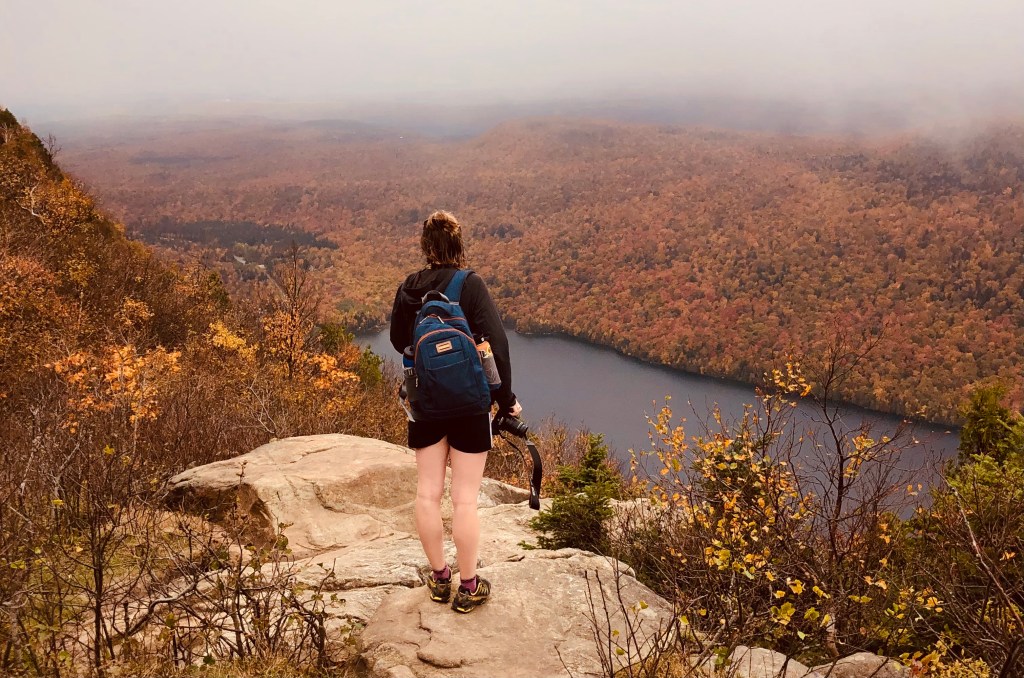
Lake Willoughby, Vermont

Dinner Conversation

These Vermont days unfold one after one, exceptionally warm for this time of year. Mornings, I write on our back deck. By dinner time, the air has cooled, so we eat in our little dining room, while the dark descends around our house.

Over dumplings, my teen shares stories of high school, and we chew over the school’s new open campus policy. She talks and talks. Listening, I realize so much of the past year and a half was this strange virtual world. Her stories are mesmerizing with intrigue and merriment, but also laced through with all kinds of complicated things.

No parenting advice here. While I’m on the phone Friday morning in our glassed-in second story porch, pitching a story, I see a Subaru dash into my driveway. My daughter and her friend leap out, laughing. Before I finish my call, they’ve disappeared, deep in their own narratives. They’re serious students, with long thought-out lists of goals. How glad I am to see them together, cackling. Before I head back to work, I brew another pot of coffee and stand on the back porch, listening to the crickets.

Be well, I think. Be happy. Be very careful driving and keep your eyes open. And return and tell me, some at least, of your world.

…. I bought my friend the newest Mary Lawson novel, A Town Called Solace. She’s loaned it back to me.

He’d assumed that you went to school because you had to learn things, starting off with the easy stuff and moving on to the bigger issues, and once you’d learned them that was it, the way ahead opened up and thereafter life was simple and straightforward. What a joke. The older he got, the more complicated and obscure everything became. ” 

— Mary Lawson
Greensboro, Vermont

A House You Can See Through

On my way home from work last night, I stop by a house in town to drop off a borrowed survey (another long strange story…)

I’d never been to the end of that narrow one-lane road built on a ridge over a lake. The owner’s car is a Subaru the color of mine, but years older. As I walk towards the house, I realize I can see right through the house. The walls from driveway to lake are all nearly all windows.

A breeze moves through the trees. Down the hillside, the lake washes against the rocky shore. He invites me into the open house, where everything is wood and glass, not at all slick and polished, but clean and well-used. The house was built just after World War II by his family, and it’s been loved dearly. He’s on his way back to Europe, and I wish him safe travels.

When I leave, I keep thinking of this house where the sunlight washes right through. I can’t help but wonder if that’s perhaps why he’s so calm. Maybe it’s nothing more than coincidence. But living in a house of wood built by your grandfather, where the sunlight streams in all day, surely would round off anyone’s corners. It’s a good, bright spot — this quiet place.

Hardwick, Vermont

Two, Not-So-Random Visitors

A young AmeriCorps worker stops by looking for information about how small town Vermont government works and brings a crabapple pie he baked.

The pie is deep-dish, about the size of a dinner plate. He’s tall and cheerful and tells me about his dog named Mindy. Eventually, I give him a paper map and tell him to drive around town. I highlight one section of the map in yellow. Here, I tell him, is one especially beautiful stretch of dirt road, high above a lake. He’s driving his grandmother’s hand-me-down Toyota Corolla.

Good luck, I say as he leaves.

When he’s gone, a friend stops in, looking for town info, too. The sunlight comes through the windows. I offer her a piece of pie. We talk and talk. She finally says, I feel like I haven’t seen anyone in so long.

The strange thing is, I feel that way, too. We keep eating pie. The young baker has peeled the crabapples, one by one, to sweeten the pie. We eat the whole thing, and then I wash up the plates and forks.

There was earth inside them, and they dug.”

— Paul Celan
Hurray for autumn garden.

September 1.

Geese are bunching together and flying south. They’re hightailing it out of Vermont, following their instinctive, ancient pathways.

My youngest and I eat dinner on the back porch — chard and carrots dumped into noodles, stirred with spoonfuls of a chili garlic sauce. I ask about her first days as a high school junior. As I listen, our littlest cat pushes his nose against the screen. It’s growing late, and there isn’t much daylight remaining. When she leaves for a walk, I wash up our few dishes, listening to a podcast my father emailed.

How utterly complex this world is.

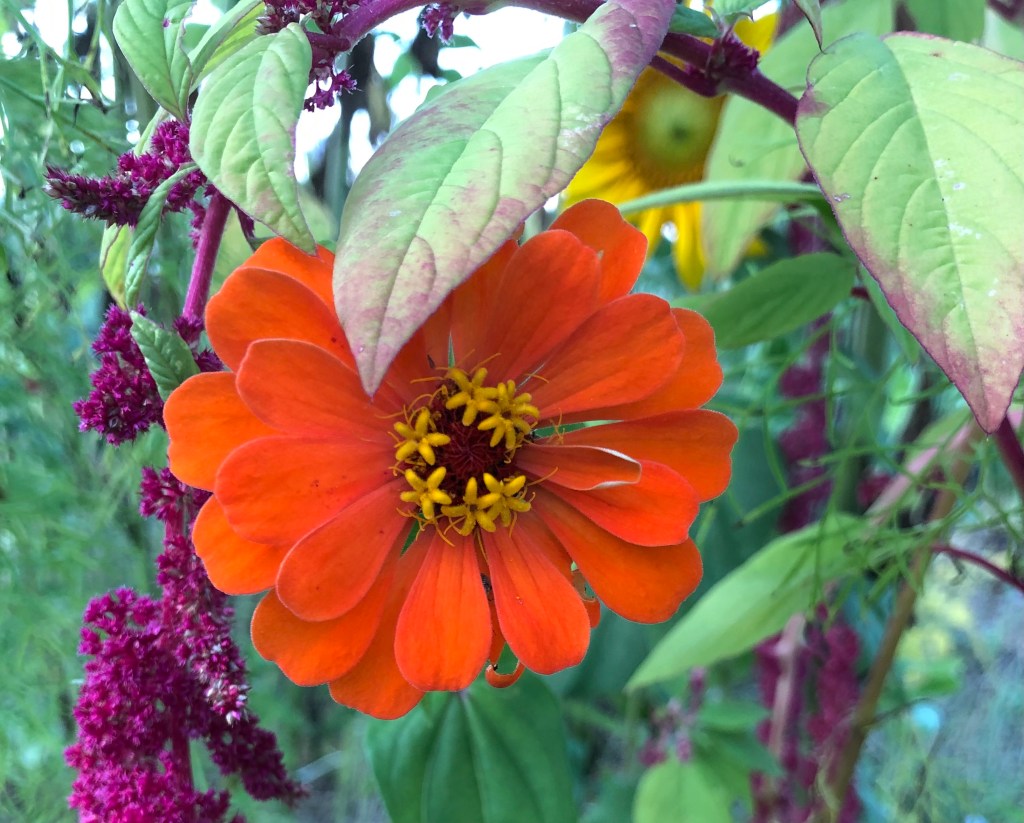
Afterwards, I wander out with the compost bucket and then stand in the garden. The sunflowers are crazy tall this year. Also, utterly amazing.

“The greatest sources of our suffering are the lies we tell ourselves.” 

― Bessel A. van der Kolk, The Body Keeps the Score: Brain, Mind, and Body in the Healing of Trauma

Garden, Hardwick, Vermont

Poetry, For Now.

Talking with friends by the side of a road, I notice a flock of Canada geese in the field across the road.

My friends tell me hunting season is just a few days away. The geese should move along.

My friends leave, too, one by one, and I linger with one woman, talking about farming in Vermont, an acquaintance we believe may have gone down the rat hole of QAnon, our elderly parents who live thousands of miles away. We branch into motherhood and gardening.

At the end of August, my youngest starts 11th grade today. The cats and I are up long before dawn this morning, the days dwindling at each end rapidly now. Next spring, with its promises of coltsfoot and trilliums seems forever away. I stand at our kitchen counter, drinking coffee, reading the New York Times.

Here’s a poem, not offered as an antidote to so many families, all over the globe, just solidarity.

Hope has holes

in its pockets. 

It leaves little

crumb trails

so that we, 

when anxious,

can follow it.

Hope’s secret: 

it doesn’t know

the destination–

it knows only

that all roads

begin with one 

foot in front

of the other.”

–Rosemerry Wahtola Trommer
Hardwick, Vermont