The repair of the world might, indeed, be impossible…

In a gray drizzle/not quite drizzle, I stop outside the co-op to talk, my hands full with peaches, mozzarella, and Clif bars for my daughter’s hike the next day. The prediction is for temps at high elevation in the thirties.

My conversation companion is a woman I run into randomly, usually on the sidewalk, and inevitably we jump right into talking. It’s August and dreary with wildfire smoke and a sudden cold rain. My hands are full with those peaches and sweets, so I’m blinking in the misting rain. I’m laughing a little, because why not? but I sharpened up quickly as she’s not laughing at all. The strange thing is she’s listing some things that have been rattling around in my mind for months now – the collective frustration that bends dialogue to anger or sarcasm, the way the town’s Center Road is so unkempt grass grows through its middle, and the recent property tax bills that are are you kidding me?

And even though my daughter is at home waiting for the cheese for that pizza we’ll make from onions and basil and tomatoes I’ll snag from the garden, I leave my few groceries in my Subaru and follow my companion through the damp woody patch behind the co-op. We stand at the river’s edge. She leans far out over the water. Look, she says.

It’s drizzling, and even though I’d gone running just before stopping in for what I thought would be a few minutes’ worth of shopping I’m starting to shiver a little. But I have this sudden vision of what’s happening with this town where I live, how the river threatens to wash away this downtown of brick and granite and asphalt, trees and roses. Years ago I realized that brokenness is never one thing; all these unfixable things – climate swings and decades (centuries?) of ill-use and reliance on the Feds to fund these fixes, when that amorphous federal government… well, why say more there?

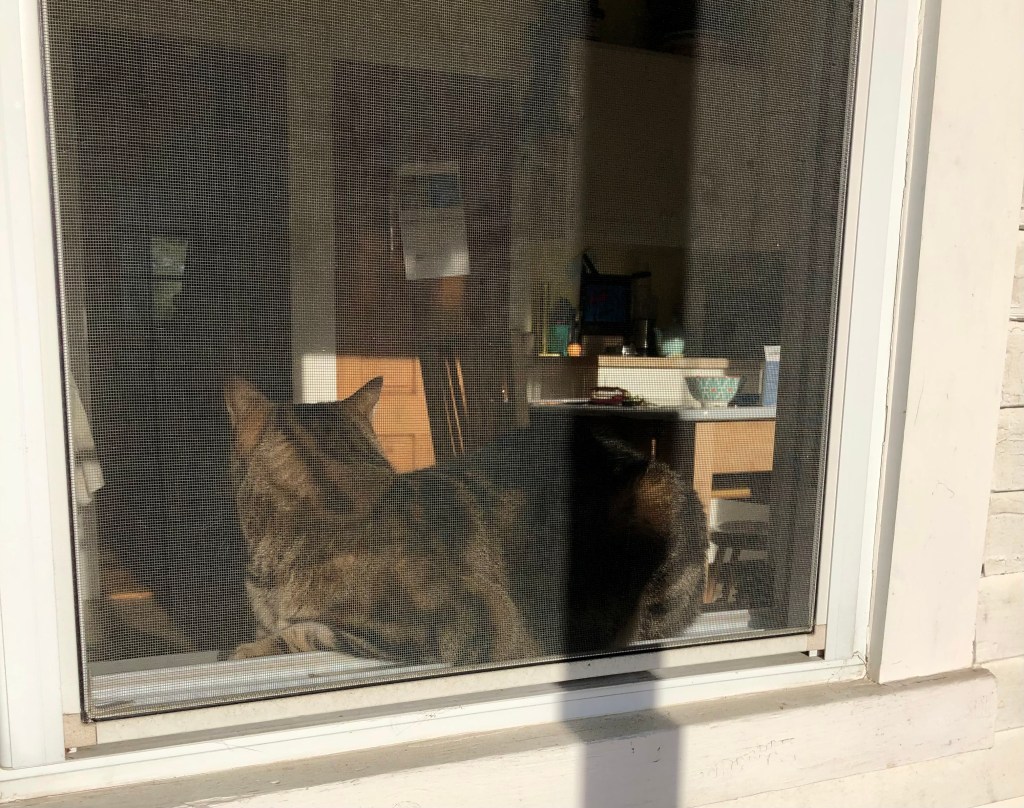
A few years back, I interviewed a well-known writer who advised me that a writer should always acknowledge her time and place. The rain’s fattening. The repair of the world might, indeed, be impossible. At home, our kitchen is warm and bright, and the cats are half-sleeping as cats do on the rug before the kitchen sink. I’ve always believed in domesticity as the antidote to the world’s inevitable callousness. Later, I wander over to the neighbor’s house and lean in her doorway for a bit. We talk randomly about nothing much at all, catbirds and rose thorns, no repair, but a strengthening of heart, surely.

Late August, given heavy rain and sun
For a full week, the blackberries would ripen.
At first, just one, a glossy purple clot
Among others, red, green, hard as a knot.
You ate that first one and its flesh was sweet
Like thickened wine: summer’s blood was in it….

“Blackberry-Picking” by Seamus Heaney

Water, Water.

These days, I’m working in a town clerk’s office, Greensboro, Vermont, population approximately 827. With summer folks, the population swells to three times.

Yesterday, the phone rang all day. We propped the door open, and people wandered in with questions.

Can I get to Craftsbury? Which roads are out? I have a dump truck; want me to haul fill? I’ve lost everything; do you have extra clothes, shoes, blankets?

Selectboard members set up a triage system to patch roads where anyone was stuck. Farm roads were prioritized for milk trucks. All day long, Vermont Public Radio updated us. Montpelier, beloved capital city, is underwater, threatened by a dam where waters rose precipitously.

Late afternoon, the selectboard chair rummaged for leftover potato chips from the July 4th celebration. By then, the sun had emerged. The July day was hot, redolent with blooming roses. I had my own petty worries: my car was low on gas, and I’ve kicked a front brake repair too far down the road, and I’ll need to find a mechanic stat, and who I’ll find isn’t yet clear to me. Later, I’ll call my brother and talk about my parents while weeding my neglected garden. For some time, though, we stood in the parking lot, breathing in sunlight, waiting for a contractor to look at one of the town’s paved roads that’s severed in multiple places, the asphalt broken into multiple chunks. When could he get here with an excavator and put that back together?

A friend drove up and told us about mutual friends in a nearby town. They had been out in the stormy night. Travelers on I-89 had been diverted off the interstate and wound up driving through the backroads of a rural town they didn’t know. By flashlight and headlamp, in a driving rain, water roaring down hillsides, the residents directed the strangers to a safe haven, where they weathered the night.

Vermont Floods.

Remains of the Inn by the River, Hardwick, VT

My friend who lives near a dam takes shelter with us. While she gathers her things in her house, I wait in my car, staring up through the closed sunroof in my Subaru, mesmerized by the rain, the rain, the rain.

Shortly before nightfall, we walk downtown where the water flows around houses, through the community gardens, and drowns the t-ball field. A crowd gathers beside the Lamoille River. At first, I think the storm has turned to thunder, a booming and smashing, and then I realize the roiling river is filled with boulders and tree trunks. I’ve been following and watching the rise and fall of rivers for years now, lived on back roads that have washed out, cautioned my daughters never to drive over running water.

But this.

The river is alive. The river rises like a wave, brown and frothy, taking precisely and entirely what it wants.

Home again, safe in our house on the hill, the rain pours down. Hope you’re all well and safe out there, too…. More info about my state can be found on VTDigger.

The 10,000 Things.

The last night I am in New Mexico, I can’t sleep, so I slip on my sandals and walk. The moon hangs over my parents’ house, luminescent as a giant drop from a sun-shot waterfall. It’s dark yet, a cool-nearly-cold breeze stirring the desert. No human wanders at this early hour. It’s just me and the singing crickets and birds, the sun pushing a golden curve over the black mountains, the desert stirring in a language I have no words for: the rush of lizards and hustle of rabbits, the sharp-eyed coyote and fox, the wild sunflowers silently bending towards the rising light.

So many pieces to this journey — from the shuttle driver who happily counsels a passenger not to rush as “we’re in the Land of Mañana,” to the flight to Chicago where the Brandeis student beside me whispers about her fear of flying, to the stunningly beautiful flight over the Great Lakes through voluminous white clouds. I keep thinking how unworldly, but that word is ill-chosen. Better said would be of this world. Then the brilliance ends as we fly into the soot of the Canadian wildfires. All through this day, I read Lily Brooks-Dalton’s The Light Pirate (the novel Ben Hewitt told me read), this novel about a family and the collapse of our world, and the brutal irony doesn’t escape me for one moment that as I’m mourning and fearing those sooty clouds I’m entirely part of this 21st century….

In Vermont, my daughters greet me with their 10,000 stories and cheerfully announce I’ve missed the two good kayak days through the lily pads. The humid night air stinks of diesel exhaust. In the parking garage, I strip off my leggings. My youngest drives out of Burlington, along the river through the Winooski Valley, and through the state capital. The girls tell me sunflowers are blooming around the statehouse, and my daughter’s dog fell off a dock into a lake (what clumsy dog does that?) and the swimming has been stunning in Caspian, the water perfectly clear.

My youngest tells me about exploring Burlington with her sister. She says she can’t believe how lucky she is to move there this fall.

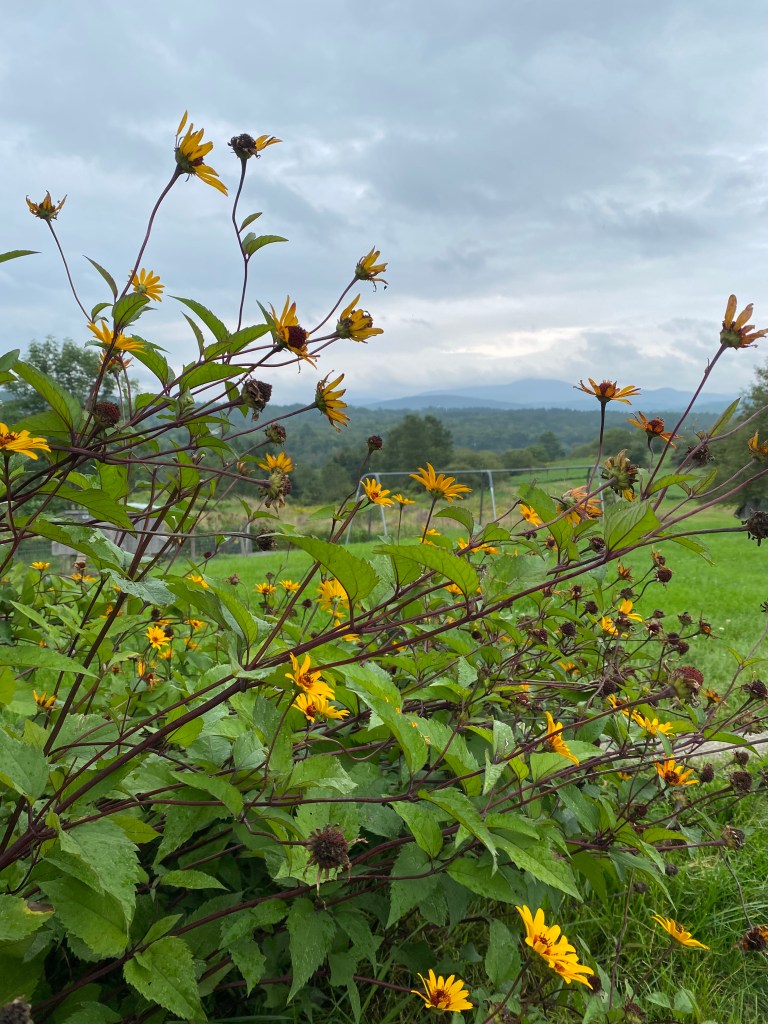
In this dew-soaked morning, I realize I haven’t missed the hollyhocks’ bloom. Lucky.

…. Seriously, can’t recommend The Light Pirate enough.

Because everything is changing…. We should all be curious about it, because the way we live has to change, too.

— Lily Brooks-Dalton

No Going Back.

July 1: I’m driving on a back road to a nearby town where there’ll be the traditional New England small town Independence Day festivities, when I suddenly realize I can no longer see the road before me. The road dips down and then rises up. I know this, because I’ve driven this road so many times. I know precisely where to swerve around the persistent pothole where the stream runs under the lowest point of the road. But the rise is hidden in smoke.

The day marks a line for me, a place I won’t forget. I’ve been here before; this is familiar territory. I remember the precise afternoon I knew I would severe my marriage. Likewise, today, it’s clear to me that this smoke, in what will likely be one unimaginable variation after another, will remain.

Nonetheless, I go on into the day, watch the parade with an old acquaintance and we catch up about kids, ruminate about our old college days. I talk to a woman who’s built a house of cans and bottles and tires. She asks me to stop by sometime. Heck, who could pass that up? Of course I will.

Then I’m back home again, working, working, on this third book, taking it apart, sewing it back together, phrase by phrase. I wind in how it feels to walk along the edge of a lake that may not be frozen and thread through the Himalayan blue poppy, a child’s nightgown, pebbles under a clear running stream. I’m after those same old things: how to salvage order and beauty from chaos and destruction and despair. A river of sadness is not the torrents of despair.

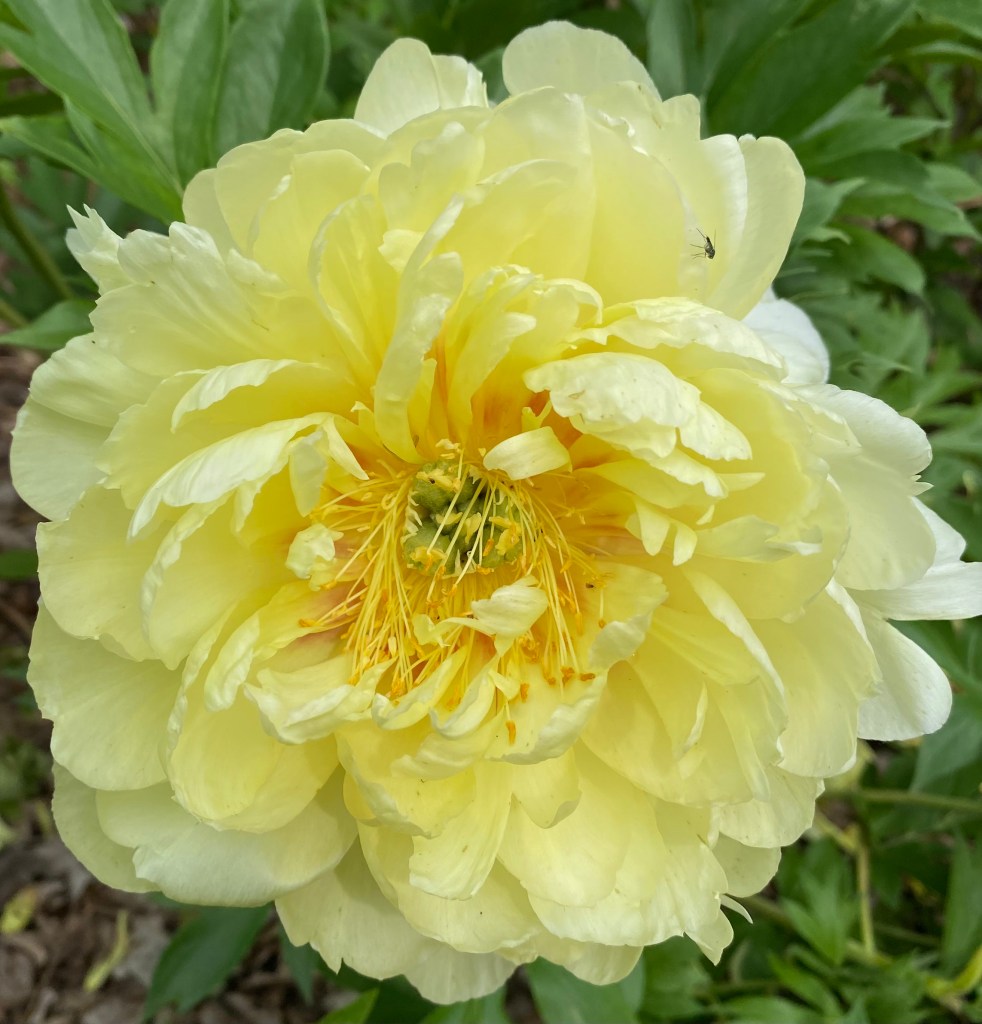
Swim. Bartzella peonies. My neighbor leaning out her door, green curlers in her hair, saying hello.

Time Out of Mind.

On the town forest trails, I spy two deer. Across the fallen leaves, now brown and dry, we eye each other. If I hadn’t seen a flicker of white tail, I would have kept running. But I have seen them, and so I determine to wait. I’m in shorts and a t-shirt; it’s so freakishly warm for November that people seem to be in a tizzy of utter delight tinged with dawning horror that this climate change thing, it’s really moving along. Nonetheless, these days are sweet.

The deer nearer me turns her? his? head just over one shoulder, checking in perhaps with the companion. Then they turn together and run. At the top of the hill, white tails bouncing, the creatures stop and look back at me, perhaps in nothing but curiosity. They vanish into the woods.

This is a November when I let the fire extinguish in the woodstove, hang the laundry outside, open the windows and make my cats happy. I chop apples into halves and quarters and eighths and throw the pieces into muffin batter, as if the world can measured and understood by rudimentary math, by counting two eggs and a quarter-cup of milk. In the afternoon, I abandon my thoughtful list of chores and lie in the weeds behind our house, reading Maggie O’Farrell, journeying imaginatively back in time to a Duchess’s life. It’s the same question that’s mesmerized me for years: how much of our lives do we determine and how much is dumb fate?

In the sunlight, I sleep and then wake breathing the complex scents of warm, humusy soil and spicy green leaves, and around all the dry crumbles of what this year’s frost has already bitten. In the cemetery behind my house, a man and a boy fly red kites, the long tails fluttering like ribbons.