Potato Digging at the Schoolhouse

At a meeting tonight about the future of my daughter’s little elementary school, a parent spoke about the importance of the schoolhouse, built a hundred years ago, by the town of Woodbury, Vermont. Until I went to a tiny college (also in Vermont), I never attended school in a building that had not only beauty in spades but also soul. The Woodbury schoolhouse has both.

This afternoon, a little thirdgrader showed me the dirt on her clothes from working in the garden. The children had been digging potatoes, and she showed me with her hands the size of the largest potatoes. Sometimes, she told me, my fingers got stuck around the potatoes and they were hard to pull out. She laughed, and I could see a sprinkling of dirt over her cheeks.

Too much of our world now is placeless – grab your i-phone and laptop and head out for new territory, but where we live and work matters; it matters who builds our homes and schools; it matters who opens the door to your child’s schoolhouse each morning. And on a sunny and windy October afternoon, it matters that someone shows a child to bury her hands to the wrists in black soil and extract an apple of the earth.

For the meaning of life differs from man to man, from day to day and from hour to hour. What matters, therefore, is not the meaning of life in general but rather the specific meaning of a person’s life at a given moment.

–– Viktor Frankl
IMG_0160

Other Gods

At the dinner table the other night, my older daughter had some questions about the ten commandments. Although she attends a secular public high school, apparently the commandments surfaced in a health class discussion. Transported back to my few elementary school years in Sunday School, I remembered crayoning two suspiciously tombstone-like tablets and a mighty Moses figure. I assured my girls honoring their mother was a key commandment.

But the commandment that stumped her was the second:  Thou shalt have no other god. What the heck could that mean?

We were eating bacon-traded-for-our-syrup from a friend’s pig, an enormous porcine wonder once named Douglass. I had fried the thick fat golden crunchy on the outside, creamy and savory-smoked on the inside. The frost hadn’t yet gotten to my peppers, and with the bacon fat I had sautéed poblanos with my garden onions and garlic and nearly the last of the tomatoes. My younger daughter tore pieces of crusty bread and laid these on our plates.

I suggested: think about what fills your life. What if your life was consumed with the desire to win an Olympic figure skating medal, or insatiably to earn money? Or what if your life was filled with cultivating thousands of acres of commercial corn? Overseeing a small town library? Teaching kindergarten? Or suffused with a quest for something else: gambling, anorexia, heroin? What about Vermeer and his eleven children, the unpaid bakery bill at his death, and the two paintings his wife hocked in exchange for that debt? For better or for worse, isn’t what you fill your life with, and what you pursue, precisely what you kneel before?

There’s an upper window in our kitchen, and at this time of year, sunlight falls down in the late afternoons on our table. Years ago, my parents gave us this table from my girlhood home. The butcher block has held up all these years.

Oh, little girl,
my stringbean,
how do you grow?
You grow this way.

— Anne Sexton

IMG_0083

Montpelier, Vermont

We are Our Own Stories

Part of this day I spent rewriting an essay on myth, beginning:

The first day of eleventh grade, my daughter returned in the afternoon, dropped her backpack on the floor and sprawled at the kitchen table, her upper lip curled in that dissatisfied way I recognize as disgust for the adult world. We’re doing myth this year in English class. Myth, she repeated, who needs that old junk?

Rewriting this essay made me realize, again, how fundamental is logos – story – to us. My ten-year-old daughter is busily creating the story of her child life these days:  lacing up new high tops, the adventure books she reads and swaps with her friends, an attack of flying insects the other afternoon, soccer practice and watermelon for snack and what, exactly, her big sister is doing. Her life is imbued with meaning, her Story of Being Ten writ real and lovely. The old junk is us; but it took me years to realize that the word made flesh wasn’t just a poetic line, that we are, in fact, our own stories.

Eat, drink, be happy.
Accept the miracle.
Accept, too, each spoken word
spoken with love.

–– Mary OliverIMG_8999

Summer: Sing Like the Sea

Day by day, this sweet August season winds down. Next week, I’ll walk with my girls down the driveway to the bus stop, where we’ll kick around the fallen apples from the wild trees along the road, looking through the misty fall mornings for the bright yellow bus. Our summer has been packed with all kinds of things: hiking and friends and art camps, not enough swimming, countless s’mores with the cousins.

We spent a lot of miles with my older daughter at the steering wheel, me with my knitting in the front seat, the three younger kids in the backseat, everyone talking sometimes all at the same time. Near the end of the cousins’ stay, late one afternoon we drove up the winding dirt road towards home, everyone hot and hungry, miserable and crabby all the way around. Without thinking, I put both my bare feet out the window and waved my soles at the passing trees. The children shouted, What are you doing? and because I started laughing, they all started laughing, even the teenager in the driver’s seat who does not approve of such undignified behavior, not at all, although she graciously tolerates my foolishness.

Silly? Completely. But in the face of things that are not humorous–words that none of us even want to say, like cancer for instance–why not occasionally throw your feet up and rally to the grubby children in the backseat? Say: I don’t want to hear bickering; just hang with me for a little bit in this golden summer, with all of you so near?

Driving to work today, I thought of these kids of mine and that afternoon, and the last stanza of one of my most beloved poems, “Fern Hill.” I’d always considered the final words tragically bittersweet, but I wonder perhaps now if I misunderstood these lines. Perhaps this poem is about acceptance of our mortality, and simultaneously an exhortation to sing like the sea, rage on against the dying light, laugh in the face of despair. Write beautifully in this good world.

Nothing I cared, in the lamb white days, that time would
take me
Up to the swallow thronged loft by the shadow of my hand,
In the moon that is always rising,
Nor that riding to sleep
I should hear him fly with the high fields
And wake to the farm forever fled from the childless land.
Oh as I was young and easy in the mercy of his means,
Time held me green and dying
Though I sang in my chains like the sea.

–– Dylan Thomas

IMG_7430

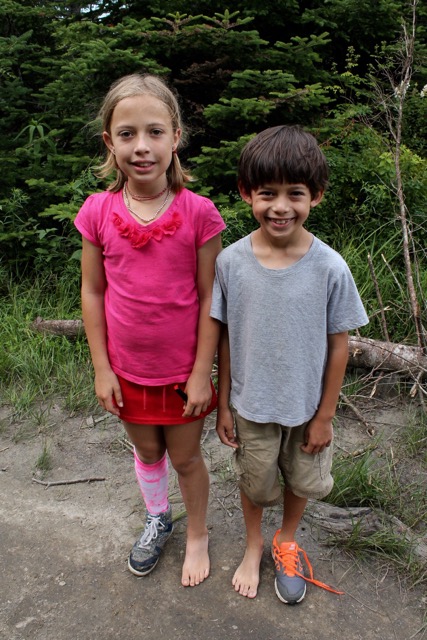
Photo by Molly S. Gabriela and Kaz, Sterling Pond

Long Pond Cape Cod

Ten-year-old Gabriela Stanciu is a guest blogger today. She loves to eat watermelon and read Harry Potter.

I was on a vacation at Cape Cod a few days ago and we had just gone swimming in the ocean so we thought we should wash the salt water off by swimming in a fresh water pond. We went to Long Pond. It is a Pond in Wellfleet Cape Cod. so we showed up and parked. Me, my Grandparents, and my dad got out of the car. When we got in it was really warm compared to the ocean. It was a beautiful lake. The water was crystal clear all the way through. And it was really shallow. When I got like a third of the way out into the lake it was only like five feet deep. The sand at the bottom was really soft and there wasn’t any rocks. Like 15 minutes later my sister and aunt showed up. My sister didn’t want to go swimming but my aunt did. When my aunt got in she got in over my head so I hopped on my dad’s back since I can’t swim very well. We swam for a little more and then got out.

Next we went to this store that we call the floatie place even tho we have never been there. Well, it has a ton of giant floaties all over the building. They probably have any floatie you can think of in that place but we did not go there to get a floatie we went there to get a life jacket so I could float around in the sea. My favorite floaty was the giant flip flop but it probably wouldn’t fit in our car. But what we did get did fit in our car.

GetAttachment-1.aspx

Inner Life

A number of years ago, visiting an elementary school with my daughter, I asked the teacher about the school’s philosophy. He told me every child has been brought into the world for some particular, unknown destiny, and so the whole child needs to be educated to fulfill that destiny.

Destiny and children? When my first daughter was a baby, even then I believed a rich inner life was invaluable. I’m not the kind of mother who bought stocks or purchased a life insurance policy.

Today, I drove through New Hampshire. In the backseat, my younger child worked mightily at her inner life by reading Harry Potter. My nephew, at 11, leaned forward between the front seats, and we passed the time by talking about being present. We are here, he said, and even when we’re up there, ahead, we’re still here. If you think about it, we’re always only here. Only my father enjoys this trend of conversation, so we talked about him, too.

In the mirror, I looked at my daughter with her sun-streaked hair, her tiny blue earrings, so immersed in this book, the first book she’s carried all day, the first I’ve seen her enraptured in pages, deep in the world of imagination.

That’s something, my nephew said, this always hereness. I like it.

A summer river being crossed
how pleasing
with sandals in my hands!

– Buson

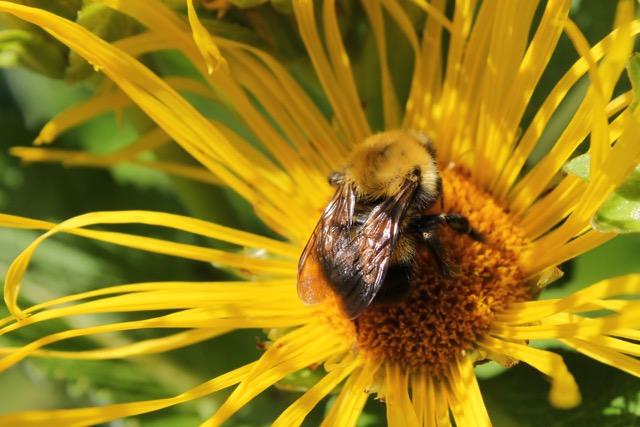
Bee on elecampane by Molly S.

Bee pursing its destiny on elecampane by Molly S.