Deja Vu

My younger daughter told me a story last night of a dream she had years ago where a stranger appeared. Months later, she was studying someone she had just met, and she realized that man was the stranger. How was that? she asked. My dream was the past and the future….. She was mesmerized.

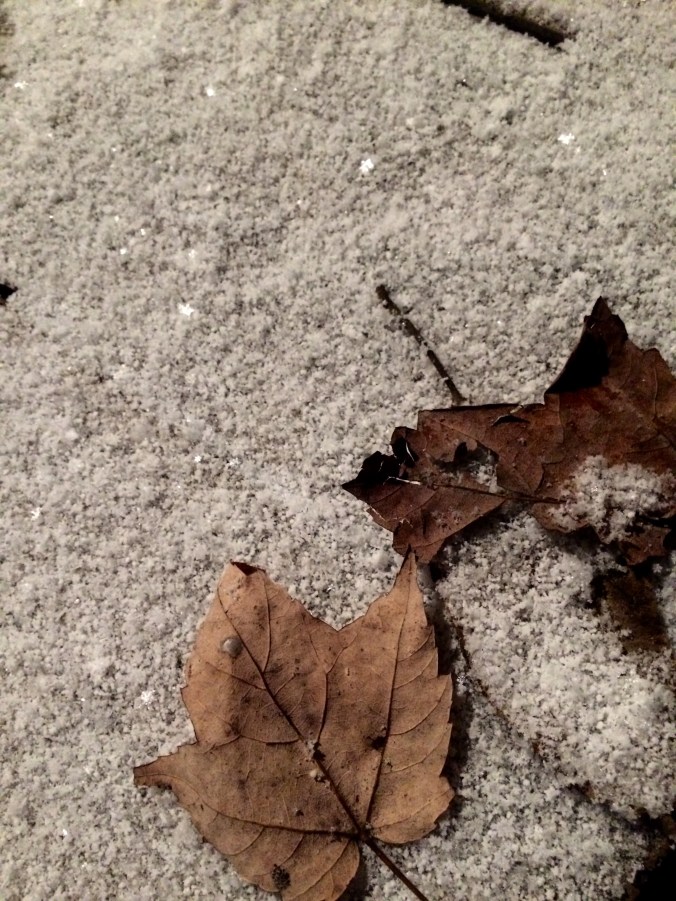
Today, the first of the snow, just a sprinkle, like a white variation of the cinnamon I spilled over my sweater at the co-op this afternoon. The first of the snow signals the settling in of the long, long season, and yet, the first flakes are always breathtaking, always brief and fleeting, and always stunningly lovely. It’s that same deja vu, back in the beginning of winter again, the days dim and short, the children bickering or not bickering, the hearth glowing….

The boy and the dog
Stand in stillness on the waiting road.
Night’s embrace cloaks them in darkness
no less than invisibility.
They face north
And feel the first cobweb kiss of snowflakes
Borne on feathered air.
He will always remember this;
The boy, with his dog,
Standing there.

Nomad Omnia
FullSizeRender

Photo by Molly S.


Laughter…. Levity….

Now that we’ve reached the time of year in Vermont when it’s dark pretty much all the time, in a variation of that Platonic cave, the game season has fully opened in our house. We began this years ago, in an attempt to stave off the mad-as-hatters element of northern winters. After a few rounds of Battleship, the kids relented and played an art history trivial pursuit card game. (Up front, I’d like to acknowledge I stacked the deck against myself, and I lost).

About halfway through, my older daughter read a card with the word bar cue. I asked her to repeat the word, and then I asked if the word had an O in the middle and maybe a Q.

Baroque? I asked.

She admitted it might be baroque, and then asked who he was.

I write this only because she laughed so hard, so truly cheerful about whether this might be bar cue or baroque, or maybe even barbecue. Whatever, she laughed, genuinely nonplussed. This is not her way of knowing the world. But what is her innate gift is a profound sense of balance and color and proportion. She spends hours drawing, her creativity flowing from a well whose depths are pure and lovely, hardly yet tested. How humorously this daughter reminds me that my own hard vision of who this baroque fellow may or may have been could use some not so serious jostling at times…

To say that it is impossible to communicate is false; one always can. To refuse to communicate is a failing; we are biologically and socially predisposed to communication…

— Primo Levi, The Drowned and the Saved
IMG_0285

SHIMMERING LIGHTS

Gabriela is a ten-year-old guest blogger.

One afternoon me and my mom went to get lights at the store. So we just got some normal ones. Well, that’s what my mom thought. So we got some snowflake ones, too. So we go home do some stuff. The next day my mom goes to work and and leaves me and my sister a list of chores to do. One of the things we have to do is put up the lights. So we plug them in to make sure they work, and I say, “why doesn’t that one work? wait that one just flickered.” My sister said, “I don’t know, let’s put them up to see them a little better.” So we wind them around the beams and plug them in and look at them. Some of them are blinking I say. My sister says, “yeah that really bugs me. Let’s look at the package” so we look at the package and it says shimmering. My sister says, “Mom probably didn’t read the package.” I say, “I have to agree.” So when my mom came home from work, she said “I kind of like it.” I agreed with her. So we kept the lights because everyone liked them.
IMG_0295

Photo by Gabriela Jean

The Gloaming

At this point in my life, some things I can easily do – create a meal from a handful of ingredients and a hopeful smile. Here, I think, the making of this is enough. I can passably braid a child’s hair, weed a vegetable bed, paint a wall, read a novel, stack wood. All these, at varying points of my life, I put real thought and energy into accomplishing.

I’m sometimes tagged as a writer who has a “sense of place” – a phrase I’ve more or less taken for granted. Sure, I have a feel for Vermont, a love for my state, and I’ve shed my share of sweat and blood in agriculture. But the longer I remain in one place, the greater my love of this place deepens in complexity. My garden this year was infested with cabbage root maggots; the brassica seedlings I planted withered within a week of planting. A year ago, I had 80 kale plants; this year, none.

The dynamic, however, is one of the key beauties of this place. Working outside in the dusk, my daughter and I stacked wood this afternoon. The twilight inched in, shade by shade, taking its own sweet timeSo much of American life exhorts homogeny: the same food chains, grocery and hardware stores, clothes and electronics, even the same education for our children. To love a place deeply demands knowing that place in all its vicissitudes, even the raw dark of rainy November or the frost that might have stomped in early and quashed your cucumbers. As my child and I lingered in the gloaming, I reminded myself that these in-between places are fertile, too, imbued with mystery.

“In the Gloaming” by Meta Orred

In the gloaming, oh, my darling,
When the lights are dim and low,
And the quiet shadows falling,
Softly come, and softly go…

IMG_9531

Morristown, Vermont/photo by Molly S.

Children Laughing

A number of years ago, we were having dinner with friends in our kitchen, laughing and talking, when suddenly one of us ordered the others to be quiet. Our friend held up his hand. I had recently laid my baby in her crib upstairs, in that rosy end-of-the-day glow. She lay there babbling her echolalia, singing away happily in her own baby world. Our friend, whose children were older then, insisted we listen. Our own clamorous adult chatting ceased, and from the open room just above, we listened to the baby’s talk.

This morning, I sat on the couch and ceased my own work for a moment. My ten-year-old daughter and her friend were whispering in the bunk bed they had slept in together, giggling and planning their day off from school. Like a brook, their laughter tumbled to me, clear and sweet.

…Laugh at the night,
at the day, at the moon,
laugh at the twisted
streets of the island,
laugh at this clumsy
boy who loves you,
but when I open
my eyes and close them,
when my steps go,
when my steps return,
deny me bread, air,
light, spring,
but never your laughter
for I would die.

— Pablo Neruda

IMG_9507

Photo by Molly S.

Fear of the Dark

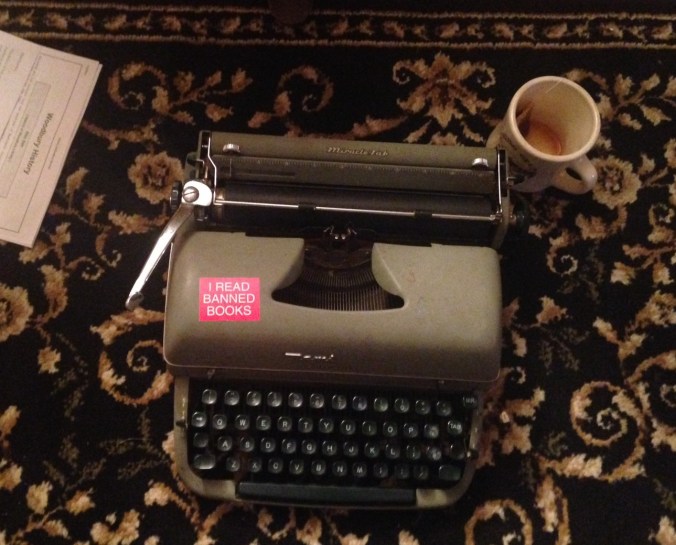
I wrote my novel Hidden View in bits and pieces, in notebooks, on a computer, in endless rewrites on the back of printed pages. I began this book during my daughter’s nap time, those golden hours when I could sit down and breathe creativity in the solitude writing demands. I wrote for no one but the novel itself: to write as well and truly as I could.

This book has joined the world. It’s out there, for the taking and reading. When I think about what made this book, I took what I had at hand: a ball of yarn, imaginary rabbits, Vermont’s exquisite and desolate winter, a house both a solace and a menace. But equally driving the book are three forces. One of these is mothering. Like the ceaseless gritty wind in a canyon, my children have formed and hewn me, in a multitude of ways I never could have imagined. My children are my anchor, the physical weight that has pinned me to this soil and forced me to know the world in an expanse I never could have imagined.

When my older daughter was a baby, my husband left the state for work, and the baby and I remained. On a 100 acres, our house is surrounded by woods. At that time, I was afraid of the dark. When the baby slept at night, I had to walk down to the unlit sugarhouse in the dark, by only the thin light of a flashlight and the stars overhead. Those months were late fall then, around this time of year, and the nights were cold. The rural dark in Vermont is so profound I have held my hand inches before my face and yet been blind to my own flesh. I forced myself to go out in the dark, because I knew every journey would lessen my fear. And I knew I could not mother this baby, in this house, in this agricultural life, if I feared the dark.

Of the dark, at least, I am no longer afraid.

The true self seeks release, not constraint. It doesn’t want to be corseted in a sonnet or made to learn a system of musical notations. It wants liberation, which is why very often it fastens on the novel, for the novel seems spacious, undefined, free.

–– Rachel Cusk

IMG_0262

Milkweed Seed/Morrisville, Vermont/Photo by Molly S.

Child’s Starry Point of View

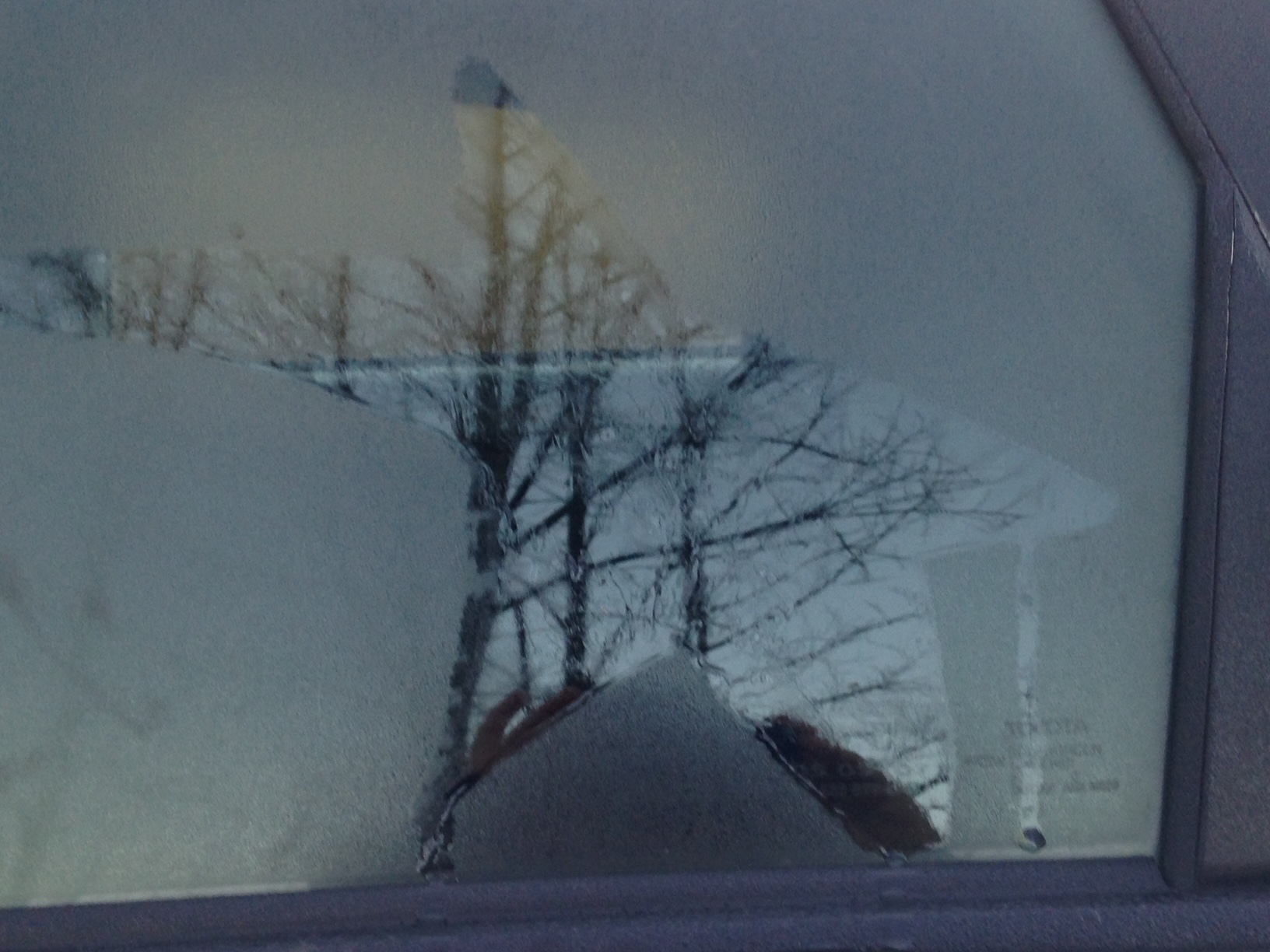
This November morning, stepping out on the porch in the early light, the air was balmy, that tender place of a nascent day. In the dew on the car’s back window, my younger daughter rubbed a five-pointed figure. So I can look out through a star, she told me.

From the clear day on our hillside, we drove down into the thick fog along the Lamoille River, and then up through the Woodbury gulch, where the clouds thinned and abruptly ceased. When we got to school, she gathered her things, then stood for a moment outside the car, looking at the window where the star had disappeared, leaving no trace.

She tipped her head to one side and pressed her hand over the glass. I asked her name.

She shrugged and laughed, then went into school to begin her day. Overhead, a heron winged its silent way to the wetlands.

If gold has been prized because it is the most inert element, changeless and incorruptible, water is prized for the opposite reason — its fluidity, mobility, changeability that make it a necessity and a metaphor for life itself. To value gold over water is to value economy over ecology, that which can be locked up over that which connects all things.

— Rebecca Solnit

IMG_0223