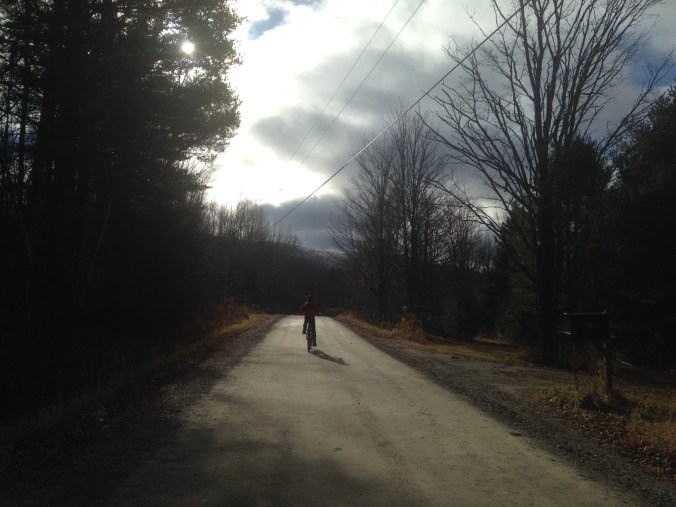
Midwinter Hunger

A sizable deer appeared in my garden this morning among the bean stalks I never pulled, lifting its head, listening. In the woods around our small field, a flock of wild turkeys comes and goes, bent over dark creatures who remind me of Puritan old women dressed in black, crouched at their work. In the kitchen, my daughters mix pork, scallions, garlic, vinegar, for soup dumplings.

This stillness of winter is a false cliche; overhead, the crow flies for its meal. Squirrels run rampart over the compost. Even the wood stove devours. The children, asleep in their beds, dream of journeys. In the morning, sleepy at breakfast, they appear to have grown in those dark hours.

When we eat a steak, we build its proteins into our bodies and become part cow. Eat an artichoke, become part artichoke. Drink a glass of orange juice, become part orange tree. Everything eventually corrupts: from our first draft of milk, we are corrupted, the world is corruption, time is corruption, and we are forever hungering for more.

–– Anthony Doerr, Four Seasons in Rome
FullSizeRender

West Woodbury, Vermont


The Better Part of a Day…Kid Land

Driving to pick up my daughter at basketball practice today, I kept thinking about David Lipsky’s book about David Foster Wallace, and Infinite Jest, which I can’t wait to read. Am I nuts? When am I going to fit in a 1,000-page plus novel? And yet, David Foster Wallace is now my current favorite three-word combination.

At school,  pleasant and convivial as my fellow parents may be, the finer part of a day is not talk about how legislation winds down all the way into our kindergarten classes. So much of this adult world is talk, talk, while the deeper issues that lie in our lives are often poverty – material and spiritual.

After basketball practice, the girls discovered hidden doors under the stage and crawled deep into the dark underbelly of their school. I crouched before the open little door and listened to their voices, young and female, problem-solving, figuring out the lay of their land, navigating obstacles. This, I thought, is what the adult world needs: a way to the look at the familiar world and find a hidden door, to look at our own world in ways we’d never imagined, from deep down in its guts, to see what holds us together.

There are these two young fish swimming along and they happen to meet an older fish swimming the other way, who nods at them and says “Morning, boys. How’s the water?” And the two young fish swim on for a bit, and then eventually one of them looks over at the other and goes “What the hell is water?

David Foster Wallace

FullSizeRender

Hardwick, Vermont

Gnomon

When I was in high school, my father, sister, and I read Joyce’s short story, “The Sisters.” I was thinking of that story again today, in this kind of chilly and drab weather that intimates how I imagine Ireland. The opening paragraph is one of my most favorite in all literature. In the story’s opening lines are three words – paralysis, gnomon, simony – that are keys to understanding the story.

With my daughters today, we were talking about family, and patterns of behavior, and I began to wonder myself, What are the keys to understanding each of us? For one of my daughters, at the age of three, I would have used tricycle and rabbit as her own particular talisman; for my other child, the word sister.

We use language so easily, so freely, that we’re often careless with its power, misunderstanding and underestimating its capability, both for destruction and redemption – or as a key to see into deeper recesses of our inner lives.

THERE was no hope for him this time: it was the third stroke. Night after night I had passed the house (it was vacation time) and studied the lighted square of window: and night after night I had found it lighted in the same way, faintly and evenly. If he was dead, I thought, I would see the reflection of candles on the darkened blind for I knew that two candles must be set at the head of a corpse. He had often said to me: “I am not long for this world,” and I had thought his words idle. Now I knew they were true. Every night as I gazed up at the window I said softly to myself the word paralysis. It had always sounded strangely in my ears, like the word gnomon in the Euclid and the word simony in the Catechism. But now it sounded to me like the name of some maleficent and sinful being. It filled me with fear, and yet I longed to be nearer to it and to look upon its deadly work.

– James Joyce

IMG_9725

Photo by Molly S./North Bennington, Vermont


January Thaw & Rural Safety

When I carried out the stove ashes this morning, the air was balmy, almost sweet, redolent with that peculiar scent of woodsmoke hanging low, with traces of mud and the wetness of tree bark. The ten-year-old girls played in the hoop house, climbing up the metal arches, while I restocked where the woodpile had fallen down into slushy puddles.

Later, the rain began to fall in earnest, and the little girls and I drank tea and talked about the river ice breaking up. We remembered snowshoeing on a pond last winter, and someone who had broken through the top crust, soaking his boot. He spread himself out on the ice, to even his weight.

In the cold of winter, we often skate on deep lakes with enormous pleasure. I reiterated how to skate with safety – how to love Vermont’s frozen waters with the bend of the sky overhead.

As we talked on and on this rainy, chatty day, I ended up telling my daughter and her friend about a visit I had made to Detroit when I was their age. My father bought food at a restaurant where money and food revolved through a bullet-proof revolving door. My siblings and I didn’t understand this at all; my father said, “We’re in Detroit, now, kids.”

Rule 1 if you break through the ice: don’t panic.

Crows

It is January, and there are crows
like black flowers on the snow.
While I watch they rise and float toward the frozen pond,
they have seen
Some streak of death on the dark ice.
They gather around it and consume everything, the strings
and the red music of that nameless body. Then they shout,
one hungry, blunt voice echoing another….

– Mary Oliver

FullSizeRender

Quiver of Arrow-Words

My daughter’s friend offered a solidarity sentence about her friend at lunch today: The friend was irate. There had been a squabble about seating, and the allegedly irate child sat with her back toward another. While I’m not a fan of children hurling ire at one another, I admired the girl’s satisfied ten-year-old pleasure in using this mighty word. I pictured this girl with a bow held tight between her hands, arrow strung tight and ready to fly.

What is it a girl might need in her quiver of arrow-words? A child will need tumble and sungold-tomatoes, milk, and mirth. A woman needs moxiewariness, appetite,
wonder, sorrow, and mirth.

No history books used in public school informed us (girls) about racial imperialism… No one mentioned mass murders of Native Americans as genocide, or the rape of Native American and African women as terrorism. No one discussed slavery as a foundation for the growth of capitalism. No one described the forced breeding of white wives to increase the white population as sexist oppression.

Ain’t I a Woman, bell hooks

FullSizeRender


Spinning Planet

Almost immediately after a children’s play at the Craftsbury Library tonight, my daughters ran outside. Was it the weirdly warm December weather? The joy of seeing a long-time friend? I sat on the back porch slouched in a rocking chair, watching the sun sink behind the Lowell ridge, listening to ten-year-old hysterical laughter.

My teenager appeared, and we were all crazed, wandering around the church, the gazebo, the war memorial. As the dusk steadily pressed down, the children raced across the Common. At the far end, I saw the white-painted fence, and nothing of the children but a smear of a red coat.

Spring fever? In December? In a world rapidly turning upside down? With my teenager, our conversation often seems one long meandering line of history, of the bloody business spanning centuries. But the world turned upside down is inescapable in this mud-season December, with my laundry hung out to dry on the clothesline.

The girls lay on the grass, and I teased them, Make snow angels. Christmas is coming! I pressed the toes of my boots against one of the girls’ feet. This same girl bequeathed me these boots a few years ago, when she had outgrown them. Having walked through some serious living in these boots, the sole under my right foot has split, a crack where water from the thawing earth bled up through my sock, soaking my skin.

In the twilight, she was laughing. How’s that for a composition? This glossy-eyed girl, giggling in the shifting bits of remaining light, ruddy-cheeked with gorgeous health, hair unraveling in a braid, her back and shoulders pressed into Vermont sod while overhead the constellations merge into view, and our planet spins steadily, on and on….

Out of the night that covers me,
Black as the Pit from pole to pole,
I thank whatever gods may be
For my unconquerable soul…

— Invictus

IMG_0374

Woodbury, Vermont