Launching, Laughing (and Learning)

Stronger than espresso, spring roars into Vermont this Sunday afternoon.

Busy, busy, those singing robins building their nests. Busy me, emptying ash buckets and raising mud-soaked pallets from a wood pile burned to cinders back in January.

But it’s the kids who are most fiercely passionate about their work: it’s the opening of the Trampoline Season, requiring a search under the basement stairs for a missing spring, socks with gripping marks dug from a drawer, a stepladder precariously sunk in a snowbank as a launching pad for jumping.

The kids intend to grow six inches taller this year. They have work to do. And they are out there, doing what needs to be done in the realm of childhood. Finally: spring is on board with their plans.

Here’s a few lines from my late-night reading:

Questions about happiness generally assume that we know what a happy life looks like. Happiness is often described as the result of having a great many ducks in a row – spouse, offspring, private property, erotic experiences – even though a millisecond of reflection will bring to mind countless people who have all those things and are still miserable.

– Rebecca Solnit, The Mother of All Questions


FullSizeRender

The Pleasures of Parenting

Standing in line at the DMV this afternoon, I recognized a local poet in the waiting room reading The New York Review of Books. As the line was long, I stood watching the poet and his teenage daughter converse about something in the Review. She wore high heeled red leather boots, laces neatly tied around her ankles.

Still waiting in line while my daughters walked around Montpelier in gently-falling snow, I remembered an article my own father had forwarded me about the name of the Buddha’s son: Rahula, which means fetter.

Like most parents I know, my life is intensely fettered, by some unnecessary things perhaps, but bound also by the everydayness of waiting in line for a license renewal, something on the surface overly simplistic and sometimes downright irritating. Yet when my girls walked across the marble floor of that office building, with snowflakes melting in their eyelashes, laughing at some joke between them they had no need to share to with me, I wouldn’t have traded these fetters for the moon.

It ought to make us feel ashamed when we talk like we know what we’re talking about when we talk about love.

– Raymond Carver, “What We Talk About When We Talk About Love”

IMG_0476

Here In Kid World

My daughter sends me a photo via email with the subject line “Awesomeness.” How cool is that?

Yesterday, home after work, with dinner not yet made, and the house messy with potential buyers expected the next morning, a litany of chores from unwashed breakfast dishes to a fish tank bubbler needing repair, I first opened the box with my laptop battery. A $15 replacement I’ve put off for months.

The heavy lithium battery lay in my hand, and I guiltily wondered what strangers had made this toxic thing.

My daughter held the plastic bubble wrap. “Can I pop this? Please?”

I put her off, wanting to know if I’d ordered the right-sized battery, not paying any attention to my child at all, still thinking of my afternoon with its entanglements of adult problems.

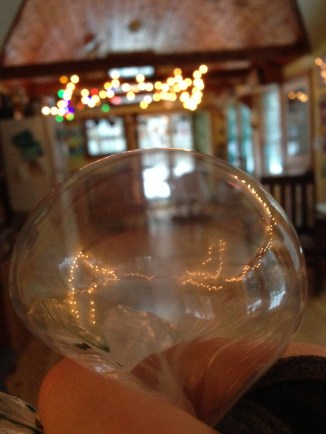
From the plastic, she squeezed a bubble and held it up to the little lights in the house. Look through this, she asked. And then I’m finally smart enough to lay aside my jumbled thoughts and peer through her vision.

Don’t judge each day by the harvest you reap but by the seeds that you plant.

R. L. Stevenson

IMG_0463

Photo by Gabriela

Squishy Season

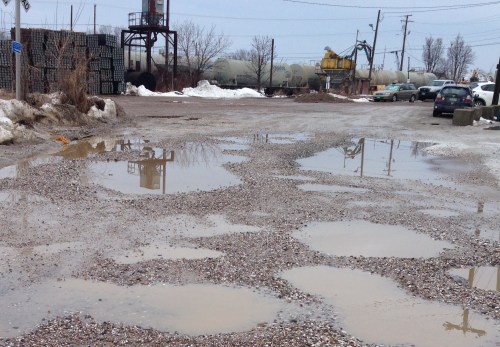
‘Tis the season of mud in Vermont. I once had a neighbor (now relocated back to an enormous city) who hated mud. Her daughter and my daughter were both little then, with rubber boots and pink raincoats decorated with kitties, and the girls adored splashing in March and April puddles, digging with sticks in the ditches along our roadsides, and baking mud cakes in kitchens they built with fallen branches, on carpeted floors of pine needles. Sweet days.

The girls spent many more hours at my house than at hers, shedding their filthy and soaked clothes on our porch and sprawling before the wood stove to warm up, eating popcorn and drinking honeyed tea and giggling. Sweet days.

Let us settle ourselves, and work and wedge our feet downwards through the mud and slush of opinion and tradition, and pride and prejudice, appearance and delusion, through the alluvium which covers the globe, through poetry and philosophy and religion, through church and state, through Paris and London, through New York and Boston and Concord, till we come to a hard bottom that rocks in place which we can call reality and say, “This is and no mistake.”

– Henry David Thoreau, Walden

FullSizeRender

Burlington, Vermont

Being a Child

Later in the summer, when the gardens are overrun with weeds, and cucumbers and string beans need to be picked from sagging vines, and the days are long with children swimming, and smoke hangs in the air from cooking outside, there’s often a point in the late afternoon when the world seems just a little much: that so-called witching hour mothers of babies know. We’ll move through that hour, through dinner and dishes, and washing up, and the cool leisure of evening comes in.

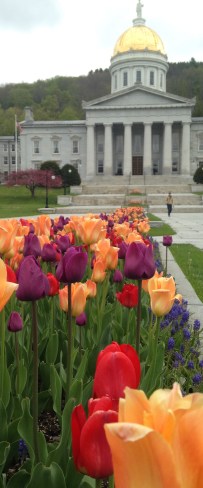
But now, in the spring, the world is yet at that new place. The weeds are nowhere near knee-high, and the warmth is as welcome as a novel in my hands I want to read.

I imagine this is how childhood should feel.

…And as I was green and carefree, famous among the barns
About the happy yard and singing as the farm was home,
In the sun that is young once only,
Time let me play and be
Golden in the mercy of his means,
And green and golden I was huntsman and herdsman, the calves
Sang to my horn, the foxes on the hills barked clear and
cold,
And the sabbath rang slowly
In the pebbles of the holy streams…

– Dylan Thomas, “Fern Hill”

FullSizeRender.jpg

Montpelier, Vermont

Icicles as Building Materials

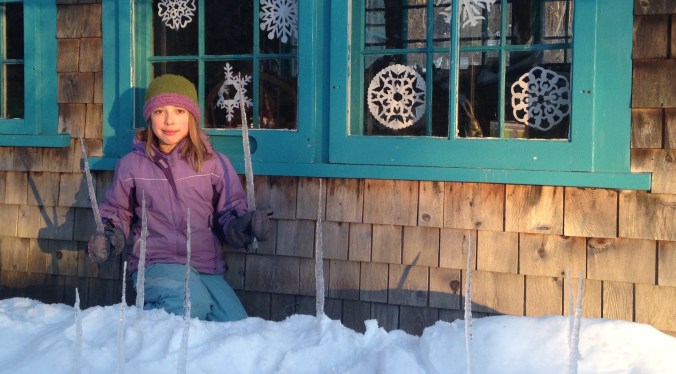
This afternoon, my 10-year-old daughter studiously collected all the icicles that she could reach from the house’s eaves. She then began her winter project of icicle house-building. The icicles have been slim pickings this year, and not for lack of interest. She cajoled her older sister, who had just returned from running, to stretch up and grab a few more.

Returning from a walk, I stood on the road, listening to my daughters at the house, discussing the different colors of ice. This weather, so pure and cold, reminded me of those long walks I took in those last few weeks before my first daughter was born. Every afternoon, I’d bundle up – me and the unborn baby I carried – and walk in what I remember as an especially sunny and cold winter. More than anything, I was most curious to meet this baby, to see this tiny person’s face: my child!

Our relationship has long since grooved into the varied terrain of mother and daughter relationships, far deeper, far richer, far more full than I ever could have imagined, sprawling beyond any cliched confines.

I have one daughter emerging into young adulthood, the other enmeshed deeply in the middle of her childhood. In the end? Who knows? How will these girls look back upon these years? But I hope they remember the loveliness of these ephemeral ice creations.

I do not miss childhood, but I miss the way I took pleasure in small things, even as greater things crumbled. I could not control the world I was in, could not walk away from things or people or moments that hurt, but I took joy in the things that made me happy.

–– Neil Gaiman, The Ocean at the End of the Lane


FullSizeRender

Mid-February, West Woodbury, Vermont