Refusal that the World is Random.

Cancer or not, the everyday world proceeds. I renegotiate the dullard car insurance (why would I pay to insure myself when I’m not driving?). This morning, the cat, seeking the milk jug on the counter, leaps on the kibble container I didn’t properly close. Kibble mounds over the kitchen floor. For the briefest moment, both cats stare, unable to process their astounding luck: a landslide of food.

Among minor domestic changes which involved a ridiculous amount of discussion: we swapped one washing machine for another. I posted the old one (a workhorse from the previous century) for free on the local digital bulletin board. While I was heating up the pot roast my friend dropped off, a young man I’ve known since he before he lost his milk teeth asked if the washing machine was available.

He arrived not long afterwards. We stood in the kitchen, talking about infected wisdom teeth (his, removed) and cancer (mine, in process of removal) and the medical system and capitalism. He asked if I knew what gave me the cancer, what empowered one gene to divide and divide again and again.

I have my theories, my guesses about this answer, nothing hard and set chiseled into stone. But isn’t it often the way that a sudden shift in events is triggered by multiple strands of actions, working seen or unseen? Leaning against the door, rose-cheeked with cold, he posits that nothing happens without a reason, that the universe is never capricious. I set my wooden spoon on the counter.

Here’s a thing: two months — 60 days — into the cancer world, with two rushed ER visits and two dodges of the grave, two chemo sessions, a complete upheaval of my life, my family’s, my colleagues’ — I woke early one recent morning and realized cancer will be with me until I cross into the next realm. But likewise, what I’ve labored hardest and most tenaciously and (often) most joyously will be with me, too. Raising babies into women, writing books, sobriety, cutting off a troubled marriage and recreating my life. But aren’t we all that way? Shouldering along with us the stones of our lives we’ve chosen, and the rain that’s fallen from the heavens and soaked us, too?

Here’s a Vermont Public Radio interview with Vermont Almanac editors Dave Mance and Patrick White, about this unique books and the non-cliché Vermont world.

A few lines from Dave Mance’s preamble to a book packed with plenty more….

…. seek out things that are real and hard…. Gravitate towards things that are beautiful. Lean in to things you cannot understand…. Tell stories where trees are protagonists. Look at the lines on your palm and see that, like wood, your skin has grain.

In-Between Season.

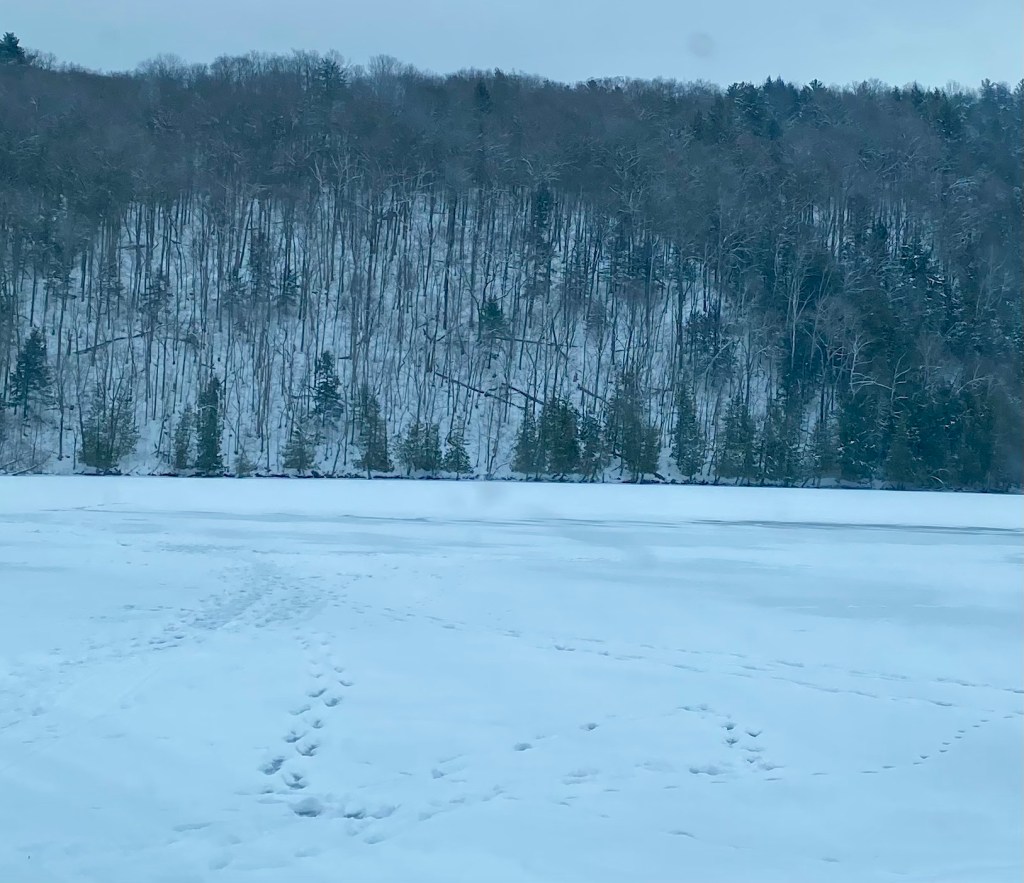
My daughter drives me to the high school where a few cars are parked, likely basketball players getting in a few extra workouts. We walk for a slow bit on the sidewalk and then drive north, up along the Black River towards Eligo Lake. At the boat launch, she turns off. We sit. Someone’s been out on the ice.

We are in the in-between season, neither Christmas nor New Year’s, 2024 finally spun down to nearly nothing, a whole new year, beginning with that wintry January looming large.

I am in the in-between season, too. Were it not for antibiotics and chemo, I would have passed from this world, or surely be heading that way. I am in the holding season, enduring, enduring, the chemo (and I’ll admit how terrifying chemo is, crimson red, fluorescent orange) destroying the lymphoma, draining my strength — and yet I’m still me, mellowed in many ways, stripped of patience with foolishness in other ways.

The December this daughter was two, snow fell every day. In January, the snow kept falling. The garden fence, the sugarhouse, the driveway and road, vanished in windswept white. This was before the age of internet. I stirred batch after batch of homemade play-doh. She had a doll stroller with a striped seat and pushed her babies around the house. Outside, I pulled her on a sled though the woods We looked for tracks, caught perfect snowflakes on our mittens. That winter seemed eternal, too, but it was not.

In the cancer world, or not, we’re always in the in-between season, life ebbing and rising, children growing, the snow pillowy but for a moment before settling to ice, washing away in rain.

Everything Is Made Of Labor
Farnaz Fatemi

The inchworm’s trajectory:
pulse of impulse. The worm
is tender. It won’t live
long. Its green glows.
It found a place to go.
Arrange us with meaning,
the words plead. Find the thread
through the dark.

Meeting the Red Devil.

In my foolish pre-cancer days, I pretty much covered up my ears when I heard about someone’s chemo treatment. That said, I’m not a complete jerk; my heart twinged, especially for parents of young children, and I offered sympathy, meals, a compassionate ear. But in some profoundly hidden place in my thinking, I tried to pretend that my garden squash and chard and those miles of walking would inoculate me. More likely, I was too cowardly to consider a possibility that hadn’t arrived.

This morning, I texted an acquaintance, I’ve now met the Red Devil, too. Looking forward to a long conversation over coffee this spring about your experience.

Yesterday, morning sunlight filled this Dartmouth-Hitchcock infusion room. Nuthatches and chickadees and juncos flitted around birdfeeders. Two wooden reindeer were linked by a red ribbon.

Without a port, the poison/healing infusion flowed into my vein. Remembering clearly my breathless and rigors! reaction to the rituximab, I burbled my fears to the nurse, who sought consult. She told me she only had good experiences with patients; I assured her I am a striving A+ patient. Then she worked her mojo and set up some black case that was never opened, assured me the nurses’ station was actually all of five feet where I was sitting, and then, drip, drip, drip, she released the poison that presumably will save my life into my vein. She stood talking to me and my daughter about the merits of studded snow tires and a recipe for gingerbread cookies, and then showed me that I was twenty minutes along with the rituximab. All was well.

Here’s the thing: there is no ease or comfort in this cancerland. The nurse is gowned and double-gloved to protect herself against these chemicals. I’ve read my chart thoroughly and know that innocuous word complications could rapidly spin my life into a dire Shackleton sea. And yet, in the warm rare-in-December sunlight, with my daughter and her stack of Christmas cards, my knitting, a novel I’d plucked from my shelf that I’d wanted to read, those downy birds flickering — a calm outside time’s relentlessness.

As for the Red Devil (the crimson of young Lucy’s magic potion in the Narnia books), the nurse injected a long fat vial into my arm. During this, she had me eat sherbet, pressing the icy substance against the roof of my mouth as the Red Devil would seek the tender places in my body and could erupt mouth sores. My daughter held the cup as I dug into the frozen substance. The nurse pushed the liquid slowly into arm, careful, careful not to burst the vein. The infusion would burn and destroy my arm, one of the nightmarish complications which would plague me for months, maybe years, to come. At the end, this confident nurse set down the empty vial and breathed deeply.

I thanked this woman for her steady hands.

Much later, 90 miles north by interstate and state roads, my daughter and her partner hold my hands as we walk up the path into my house. If I stumbled, I imagined them holding me between the two of them.

On the doorstep, my potter friend left a package with handmade yellow candles and a flower candle holder and a mug glazed the blue hues of the midsummer sky. So many happy days my kids spent in her studio — Mud Club, Clay Camp — and the cups of tea we’ve shared as mothers and crafters. A gift of light.

Losing hair, blue dawn, foreign objects in flesh.

Before dawn, brushing my hair I sing On the road again, just can’t wait to get on the road again, that old Willy Nelson song my mother loved. In the kitchen, making coffee, my daughter calls, Wait? You know that song? We played it everyday on our road trip last summer.

A thing to savor in this cancer: how my daughters and I discover these tiny things about each other.

My youngest cut the snarls from my hair that lingered from that hospital stay, when I couldn’t raise my arm to brush my long hair. Now, hanks of my hair slip out in my brush.

Outside, I stand for a moment, the waning moon hung over the neighbors’ roof, the emerging dawn a river-stone blue. A thaw’s set in, and the air is redolent with melting snow, a hint of loosening compost and soil. Raindrops hang from the three apple trees I planted.

We drive through the village, the coffee shop lit up where I’ve spent so many hours writing and talking, a young woman sweeping at the door. Colored lights string through the trees and over store windows. Out of town, day warms over farm fields and forests.

At the hospital, blood’s drawn for my chemo course this week. In my rudimentary cancer thinking, while doing the darnedest I can to forget about the orange fluids that will enter my body, I reckon that this week’s treatment means one third of the way through. If I can endure a third, I can endure half. If I can endure half, I can persevere to the finish. Talking with my daughter about December monochrome, I silently counsel myself to knock off my silly math. I’ve factored in no variables, and the variables are inviolate.

Before we leave, the nurse shows me a model of a port that may or may not be inserted in my chest. I hold the pad for needles, finger the plastic tube as she explains how it will lie under my chest. At the end, in the shape of a calla lily, is the opening that will drip the chemo beside my heart. The whole apparatus seems enormous to me, that plastic calla lily wider than my small finger. I hand it back to her. In the end, with the Good Doctor, how much of this will be my decision, and how much will be wisest course forward? In this age of truth/untruth, facts are powerful. I thank her, and we leave.

It’s a pleasure to be outside again, on this tiny road trip, my daughter at the wheel, drinking coffee. The fields and mountains and sky are layered quilt batting: blue and pearl and silver. Around the trees, rain’s pushed the snow away from the trunks, opening the earth again.

From Lauren Markham’s A Map of Future Ruins:

We don’t live steadily toward epiphany; our truest stories move back and forth in time, in space, in memory. Life is a mosaic, not a line.