Something Else.

About a year ago, a friend and I hung out laughing in her car beside Lake Champlain. Early November, by 6 p.m. it was dark as a buttoned-up pocket. The lake lapped against the shore. We joked about the pan I held of the worst cornbread I’d ever baked and the potluck we skipped, the polite and surely erudite chat we’d missed. Ah, whatever…. Twenty plus years ago, we were young mothers, driving around in my old car or her old car, our toddlers in carseats. The kids sometimes bickered if nap time neared, sometimes spun tales about Mopsy bunny driving a dump trunk or wondered aloud if maybe the mothers would relent for creemees.

My friend’s kids and my kids — they’re all grownup now. Are their stories more fun now than the cups of sand and lake water they used to serve us on the beach? Those countless gritty root beer floats.

So a year ago… a kind of throwback, this time without the kids. She ran a stop sign. I insisted we walk out to the ferry launch, and the bitter wind was dreadful. We stopped and bought Thai noodles and kale, and my friend ate like a normal person, while I stared at her and wondered what on earth was wrong with me. I was convinced I had mold poisoning from a work exposure, and we kept laughing and laughing. Then she said, “What if it’s Lyme disease? What if it’s something else?”

It was something else, of course. A few days later, I was hospitalized, turning dreadfully towards septic. That winter, as I endured chemo, as things went from really bad to worse, I sometimes thought back to those hours of silliness, how rapidly my life altered. As a young mother in those years, I did not yet know this. I did not yet comprehend that the world does not go on and on and on.

Knowing this now, in my soul and body, does it make the laughter sweeter?

Yes, indeed.

But just when the worst bears down
you find a pretty bubble in your soup at noon,
and outside at work a bird says, “Hi!”
Slowly the sun creeps along the floor;
it is coming your way. It touches your shoe. ~ William Stafford

Crazy-Making.

Yesterday, my oldest and I made that drive again down I-91 that flanks that Connecticut River. My knitting in my lap, I counted exits, St. Johnsbury first exit, then the second, the third that heads east to New Hampshire’s White Mountains, the fourth Barnet, which I took when I stayed at Karmê Chöling. We talked about fall colors and a meatball recipe and family, of course, all the way down to exit 13, the Norwich and Hanover exit, where we stopped for coffee and scones, as if a good luck charm. Coffee and sweets, not a dash to ER. We watched the time, careful not to be late for what I hoped would be a mere routine check-in.

All summer this day has hovered in my mind — what will this day reveal? — but this past week this coming journey was as near to me as something I held in my hand as I went about my days, doing what needs to be done. The day before, talking with friends, the fear of this day erupts and I hear myself on the verge of screeching, nearly crying. All summer, I’ve relished my good life, learning to walk again and eat again, to read on my back porch in that hand-me-down butterfly chair. To marvel that I am not in pain. That I might sleep and reasonably expect I might wake in the morning exactly as I want, in the pre-dawn darkness drink milky coffee and write. That I will witness the unexpected autumn buds on a yellow rose bush open, these final velvety blossoms of the season.

At Dartmouth, we wait again in 3K, in the cancer center. I am no longer one of the pallid-gray-faced chemo patients, hobbling, enduring. How desperately I never want to return here. My oncologist gently reminds me that he’d assured me I’d pull through this winter, even as I was admitted again and again and again, a dozen times. Add to that, more ER visits.

Later, a friend asks about the scan’s sign-off, but the only rules that matter are what the hidden mysteries of my blood and flesh reveal. The markers are that the lymphoma has not returned. I know that the reaper’s scythe heads towards me as that inarguable blade poises over each of us. But not this day for me. Not yet.

Driving home, people crowd the interstate bridges with RESIST signs. As our car sails beneath the metal and steel, we wave. I’d told the oncologist that my wellness plan was four-fold: eat real food, walk, do my work, and try not to go crazy.

He said, This is crazy-making. Just do your best.

There is only one heart in my body, have mercy
on me…

Thank You for letting me live for a little as one of the
sane; thank You for letting me know what this is
like. Thank You for letting me look at your frightening
blue sky without fear, and your terrible world without
terror, and your loveless psychotic and hopelessly
lost
with this love

~ Franz Wright

A cup of tea, surrounded by ice, broken boards.

In the pale blue dawn, I wake with the taste of wild mushrooms in my mouth. In my dream, I’m eating tender stems from a soft paper bag. In the non-dreaming chemo world, I’m temporarily forbidden from dining on fresh anything from the produce world, but in this nubbly dream I munch on, relishing the residual taste of dirt, the forest itself.

I open my eyes. Day 4 – oh, I am counting these 21 days until the sixth of these six chemo sessions – Day 4, and through my window, geese wing across the sky. These past few days, spring blew in, fierce sun. On my back deck, broken by ice, a friend stopped by yesterday. I made tea, and we talked about this and that, kids and disease and politics, when we might plant spring peas. On my desk waits a cardboard box of wildflower seeds, a gift for this summer.

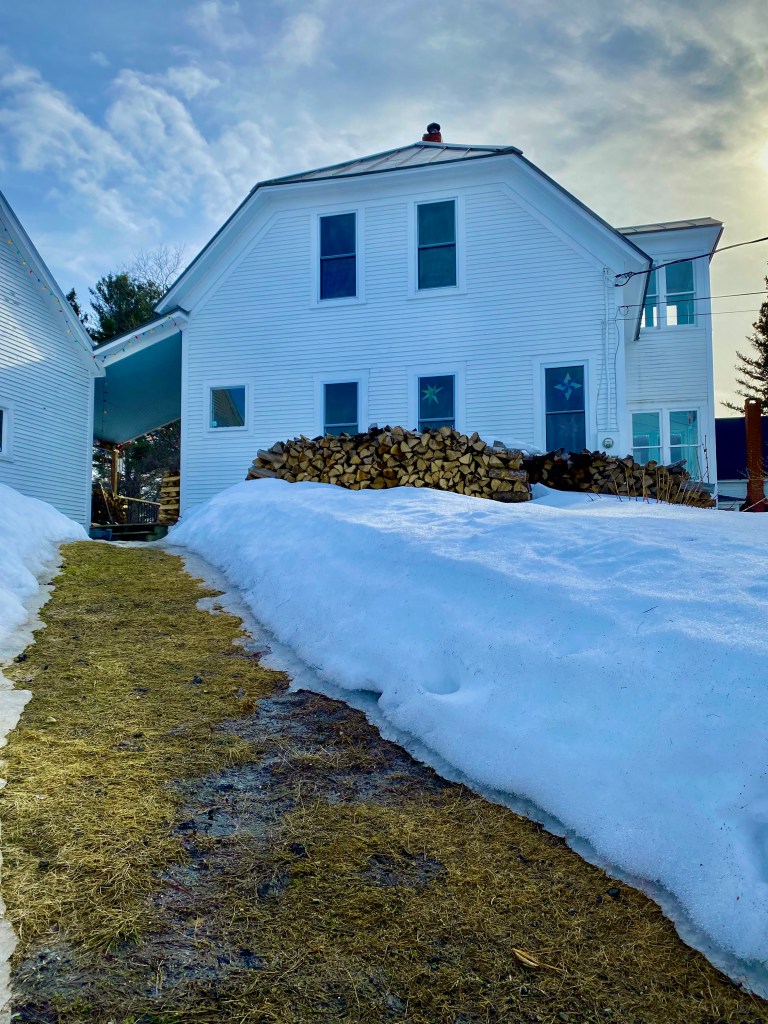
Spring is radiant light and also brokenness. The ash buckets trailing coals, the deck joists smashed by the roof’s ice, the barn still desperately in need of paint. Me, too, broken, with my few hours of clarity in the mornings, the stumbling way I’m heading towards this final treatment. Around me, too, the remains of this winter: people who have helped me more than I could have imagined, others who have distanced themselves, the disease itself, perhaps, too much, the leer of mortality a shivering thing. All that is neither here nor there. The cancer has stolen a share of my vitality, my economic steadiness, a winter of my life. And yet, all these pinwheeling days and nights as I’ve traversed this tunnel – what an infinitely rich journey, one I never would have booked a ticket to join.

My daughter sends word of singing redwing blackbirds. Spring, mightier than winter’s brawn. The season of planning, putting things back together, rearranging and cleaning, of tipping our eyes up to the sun, relishing the light.

…. Ariel Gore repeatedly quotes Audre Lorde’s The Cancer Journals in her Rehearsals for Dying. In these lines, I was reminded how we each respond to crisis in others’ lives, too, from the soil of our lives.

Each woman responds to the crisis that breast cancer brings to her life out of a whole pattern, which is the design of who she is and how her life has been lived.

Unsurpassable February.

For days, the forecast has trumpeted news of impending snow this weekend; still, sunlight floods into our kitchen this morning. Sure, it’s a few degrees above zero, nothing to sneeze at, but the icicles gleam, skinny stalactites, proof of this week’s warming. A crimson cardinal perches on the feeder.

We are in deep midwinter, the annual mark of collective cabin fever, of generalized bitching, of snow pile comparisons and, in precise detail, what is now hidden from view. It’s the season for skiing, for chocolate, for mooning over seed catalogs.

In my own cancer world, I mark the merge of days and nights in my own way, writing my thousand words a day (sometimes more, sometimes not at all), as my own shepherd’s crook to right my crooked self. In the afternoons, spent, I read and read, returning to that great pleasure of my youth. Around me, my family shifts and jostles, their own lives crammed full with their living, with jobs and classes and loves or longed-for loves. My daughters call me with stories about a grapefruit drink that I vow to drink this July and August, over smashed ice, my bare feet on the grass or maybe a sandy shore of Lake Champlain. It’s the time of year when we long for rain drops on our cheeks and clotting in our eyelashes. But February rain holds ice and sleet, not the green wash of spring, the scent of soaked earth, the tang of emerging garlic.

Every day, I talk with my old father in New Mexico. He asks, Are you sticking to the plan?

I am, I assure him, holding to the course of what the medical realm prescribes, meds and applesauce and so much water — but the here’s the refreshing, liberating, unbelievable thing: there’s no bones with anyone at all in the cancer world that this is a hard dirty blow. So seize this opportunity, turn your life inside out, remake it anew. Make no excuses. Take.

Driving, again driving in the dark to Dartmouth, the full moon hung over our shoulders the entire journey, a creamy light, brilliant on new snow, unsurpassable.

And here’s a poem from Ginger Andrews I used to read in my shut-in mothering-toddler days….

The Cure

Lying around all day
with some strange new deep blue
weekend funk, I’m not really asleep
when my sister calls
to say she’s just hung up
from talking with Aunt Bertha
who is 89 and ill but managing
to take care of Uncle Frank
who is completely bed ridden.
Aunt Bert says
it’s snowing there in Arkansas,
on Catfish Lane, and she hasn’t been
able to walk out to their mailbox.
She’s been suffering
from a bad case of the mulleygrubs.
The cure for the mulleygrubs,
she tells my sister,
is to get up and bake a cake.
If that doesn’t do it, put on a red dress.

What’s at the heart of a story?

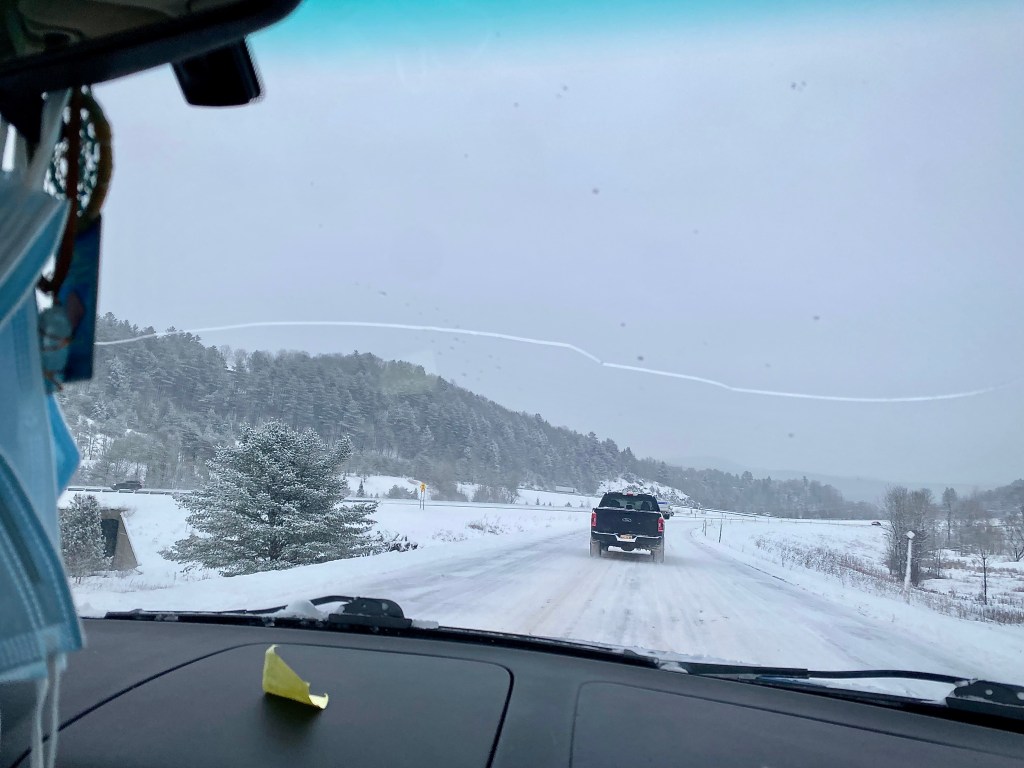
Crack in the windshield, the snowy interstate, the winter metaphor for this cancer journey.

25 hours. Here’s a smattering of highlights… A hard-knuckled drive on unplowed and marginally plowed roads, a side stop to avoid a collision on the exit ramp. Who knew these things gathered such snow? The town lights dimmed by snowfall. On a hotel’s second floor, I lay in bed talking to my siblings while my daughter ate chicken curry. In the bleach-smelling night, I limped up and turned off the heat, stood at the wide window looking out at the neon lights across the midnight-empty highway. The storm had ceased; the neon gleamed GARDEN, so brilliantly red and commercial that, in my sleep-addled mind, I couldn’t pair that word with loamy soil, coiled earthworms, the promising nub of May sugarsnap peas. Unable to sleep, I lay awake, parsing together a story: hook, conflict, and what does resolution mean, anyway? What’s at the heart of a story?

In the early morning, two full lanes of traffic streamed towards Dartmouth Medical Center. On the short cold drive, we drank hot coffee. From here, the story unfolds into the parking garage, blue paper masks, the complexity of so many stories, with so many words. The words alone are brand-new to me — Doxorubicin, Methotrexate— and I labor to learn these, to put pieces of what I can know of my story together. The wide halls in this building soar high, softening voices as the daylight falls down. Always, I hold in my body this conflicted and twisted sense of how much I do not want to be here and how immeasurably grateful I am to be here — but more, too, the profound and sacred sense of so many people, patients and families and the immense staff, each with their own mighty stories, living these stories, in pain and in joy.

In the infusion room, where I sleep and sleep, this time no longer needing small talk, I wake and watch the juncos and chickadees, the nuthatches, flitter in and out of the hydrangea bushes with their brown last-year’s blossoms, perch on the feeders the nurses fill and tend.

The interstate home is clear. The cats yowl for dinner. My house is warm, the dishes washed, the hearth fed. February. The story spins on.

What the living do.

I’ve written about the strange and often terrifying world of cancer here over the past few months. In the past week, my eyelashes have thinned. At first, my eyelashes looked as though I had walked through a rainstorm. I’m not at all adverse to rain and lousy about remembering a jacket, so I often end up in a deluge. Last July, I explored trails on a friend’s property. Over the past years, she’d designed and cut narrow trails. I walked through what seemed like enchanting forests of moss, stands of cedar so dense the light darkened, around a former beaver pond filled in as swamp, and finally discovered great white pines. She had unearthed pieces of white quartz and marked the edges of the trail. Walking back, rain fell, hard. By the time I reached my Subaru, I was drenched. I wiped my face on a sweater I’d left on the passenger seat. In the rearview mirror, my eyelashes held crystals of raindrops, diminutive pieces of that forest’s quartz.

January, temperature hovering around ten degrees, rainfall is in no immediate forecast.

As an andidote to the national clamor, here’s a few lines poet Marie Howe wrote for her brother from “What the Living Do.”

Johnny, the kitchen sink has been clogged for days, some utensil probably fell down there.
And the Drano won’t work but smells dangerous, and the crusty dishes have piled up

waiting for the plumber I still haven’t called. This is the everyday we spoke of.
It’s winter again: the sky’s a deep, headstrong blue, and the sunlight pours through

the open living-room windows because the heat’s on too high in here and I can’t turn it off.
For weeks now, driving, or dropping a bag of groceries in the street, the bag breaking,

I’ve been thinking: This is what the living do….