The Survivable.

It’s dark as the inside of my fist at five o’clock. I’m driving into spitting snow, my brand-new studded snow tires grinding. My companion and I are talking about all kinds of things — how language shapes our worldview and the personalities of tuxedo cats and dentists. I’m driving more by faith than anything else, not particularly fast, headlight beams filled with snow. As if cued, a deer waits in the forested roadside. I slow, then stop, people and deer staring at each other. Then the deer vanishes into the woods.

On this backroad, I’ve passed no other vehicle save a UPS truck, so I wait for a moment for the deer to return, for a companion to leap across the road.

My passenger says, apropros of some conversational thread, that I’ve shed bad karma in my months of cancer treatment, of struggling to survive. My devotion has always been my pencil or keyboard, not the meditation cushion. And yet…

I roll my car forward through the swirling snow. I’ve long adhered to that ancient Aristotelian notion that action defines character. When I realized I had cancer, a year ago, I was rapidly veering towards sepsis. I could not indulge any opinion. To survive, I had to strip away illusion. What were the facts? What was the wisest way forward? None of this was simple.

Cancer narrowed my world. Through weakness and the possibility of a fatal infection, I was confined to my few downstairs rooms, to Emergency Rooms, and hospital rooms. But unexpectedly, cancer widened my life, too, gave me the gift of friendships forged in rough experiences, reinforced for me that this world is propelled by cause-and-effect, that actions have consequences, and that I often grasp only the slenderest knowledge.

New England November drives us into the season of early darkness, blackness so profound our eyes struggle to navigate. When I left Dartmouth-Hitchcock after that last long stay, I felt old, aged in bone and flesh, and concurrently, miraculously restored to my twenties, those years when my lust for living and creating was ravenous and I did not yet comprehend the immutability of time. At the end of this evening drive, I stand for a few moments in this velvety and freezing darkness, snow hissing on the hot car hood, a slender strand of white lights twinkling in my kitchen window. I clench my mittens in my cold hands. Around me, beguiling night.

“When you survive something that was thought to be unsurvivable, the obvious is gained. You have your life—you have time. But it’s only when you get there that you realize your survival has come at a cost.”
― Suleika Jaouad

And last… my story “Tiny Towns” appears in the new collection: 2050: Vermonters Take a Swipe at the Future. Reading tonight in St. Johnsbury….

Something Else.

About a year ago, a friend and I hung out laughing in her car beside Lake Champlain. Early November, by 6 p.m. it was dark as a buttoned-up pocket. The lake lapped against the shore. We joked about the pan I held of the worst cornbread I’d ever baked and the potluck we skipped, the polite and surely erudite chat we’d missed. Ah, whatever…. Twenty plus years ago, we were young mothers, driving around in my old car or her old car, our toddlers in carseats. The kids sometimes bickered if nap time neared, sometimes spun tales about Mopsy bunny driving a dump trunk or wondered aloud if maybe the mothers would relent for creemees.

My friend’s kids and my kids — they’re all grownup now. Are their stories more fun now than the cups of sand and lake water they used to serve us on the beach? Those countless gritty root beer floats.

So a year ago… a kind of throwback, this time without the kids. She ran a stop sign. I insisted we walk out to the ferry launch, and the bitter wind was dreadful. We stopped and bought Thai noodles and kale, and my friend ate like a normal person, while I stared at her and wondered what on earth was wrong with me. I was convinced I had mold poisoning from a work exposure, and we kept laughing and laughing. Then she said, “What if it’s Lyme disease? What if it’s something else?”

It was something else, of course. A few days later, I was hospitalized, turning dreadfully towards septic. That winter, as I endured chemo, as things went from really bad to worse, I sometimes thought back to those hours of silliness, how rapidly my life altered. As a young mother in those years, I did not yet know this. I did not yet comprehend that the world does not go on and on and on.

Knowing this now, in my soul and body, does it make the laughter sweeter?

Yes, indeed.

But just when the worst bears down
you find a pretty bubble in your soup at noon,
and outside at work a bird says, “Hi!”
Slowly the sun creeps along the floor;
it is coming your way. It touches your shoe. ~ William Stafford

Calendar (and actual) spring…

In my rinse-and-repeat pattern of this long winter, driving back from Dartmouth in the late morning, sunlight sprawling over the brown fields, the tree limbers along the interstate beginning the season’s cutting, I notice the Connecticut River has thawed. Unmutable sign the back of this mighty winter has cracked.

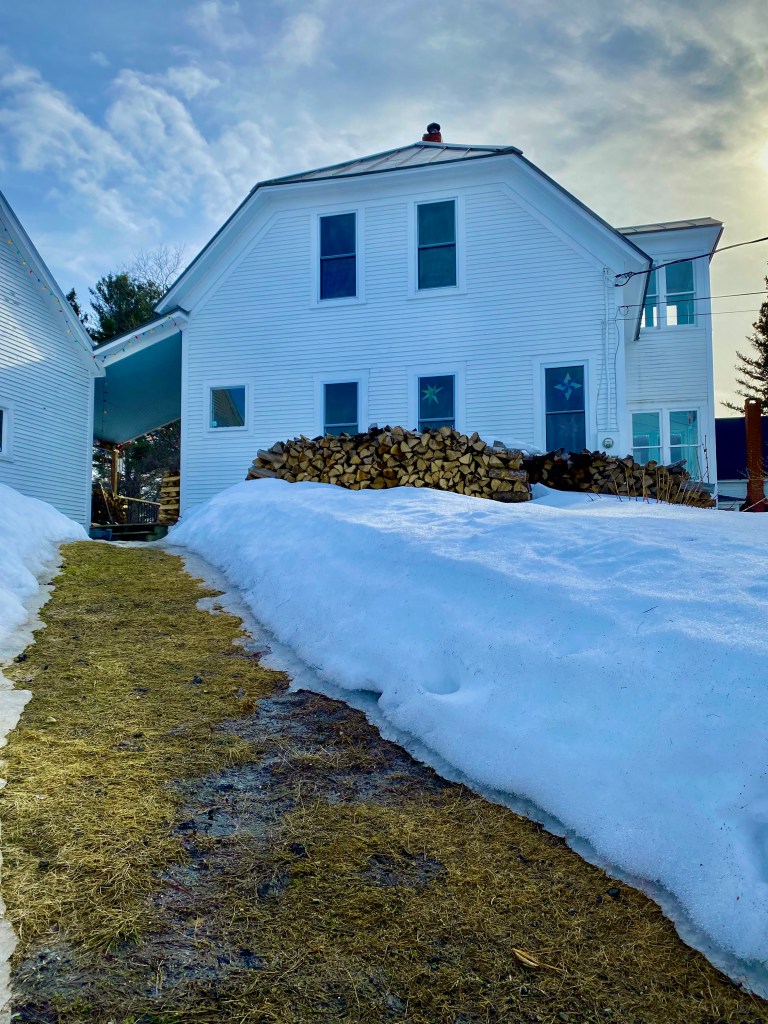
Home, my yard half-buried yet in twig-strewn snow, the ash buckets mark their winter resting place, a chaos of cinders that touch the edge of the quartz-pebbled rose garden my youngest and I made, years ago.

Later, a friend stops by with good cheer and belated and welcome Christmas presents. The sun is yet bright. We walk, slowly, slowly, on the short stretch of dead-end road before my house. I point to a robin perched in a pin cherry. She spies last summer’s hornet nest spun into the lilacs, a nest on the neighbor’s windowsill.

We were once neighbors ourselves. In mud season, we walked with our little kids up and down our back road, taking our time as the kids searched for frog eggs in the roadside ditches and tender green folds pushing up through matted brown leaves in the forest: the first spring beauties and trout lilies, bloodroot. Now, during my last hospitalization, her son repaired my daughter’s car, stayed for dinner and conversation.

Too snowy and wet to sit down, I lean against my car’s bumper. A robin chirps in the neighbors’ sugar maple, an expanse of curved trunk and branch and twig. Such a meager peep peep this rust-bellied hand-sized creature makes, prying winter away, thrusting our world towards nest building, egg laying, song.

“Against Panic” by Molly Fisk

You recall those times, I know you do, when the sun  

lifted its weight over a small rise to warm your face,   

when a parched day finally broke open, real rain   

sluicing down the sidewalk, rattling city maples   

and you so sure the end was here, life a house of cards   

tipped over, falling, hope’s last breath extinguished   

in a bitter wind. Oh, friend, search your memory again —   

beauty and relief are still there, only sleeping. 

A cup of tea, surrounded by ice, broken boards.

In the pale blue dawn, I wake with the taste of wild mushrooms in my mouth. In my dream, I’m eating tender stems from a soft paper bag. In the non-dreaming chemo world, I’m temporarily forbidden from dining on fresh anything from the produce world, but in this nubbly dream I munch on, relishing the residual taste of dirt, the forest itself.

I open my eyes. Day 4 – oh, I am counting these 21 days until the sixth of these six chemo sessions – Day 4, and through my window, geese wing across the sky. These past few days, spring blew in, fierce sun. On my back deck, broken by ice, a friend stopped by yesterday. I made tea, and we talked about this and that, kids and disease and politics, when we might plant spring peas. On my desk waits a cardboard box of wildflower seeds, a gift for this summer.

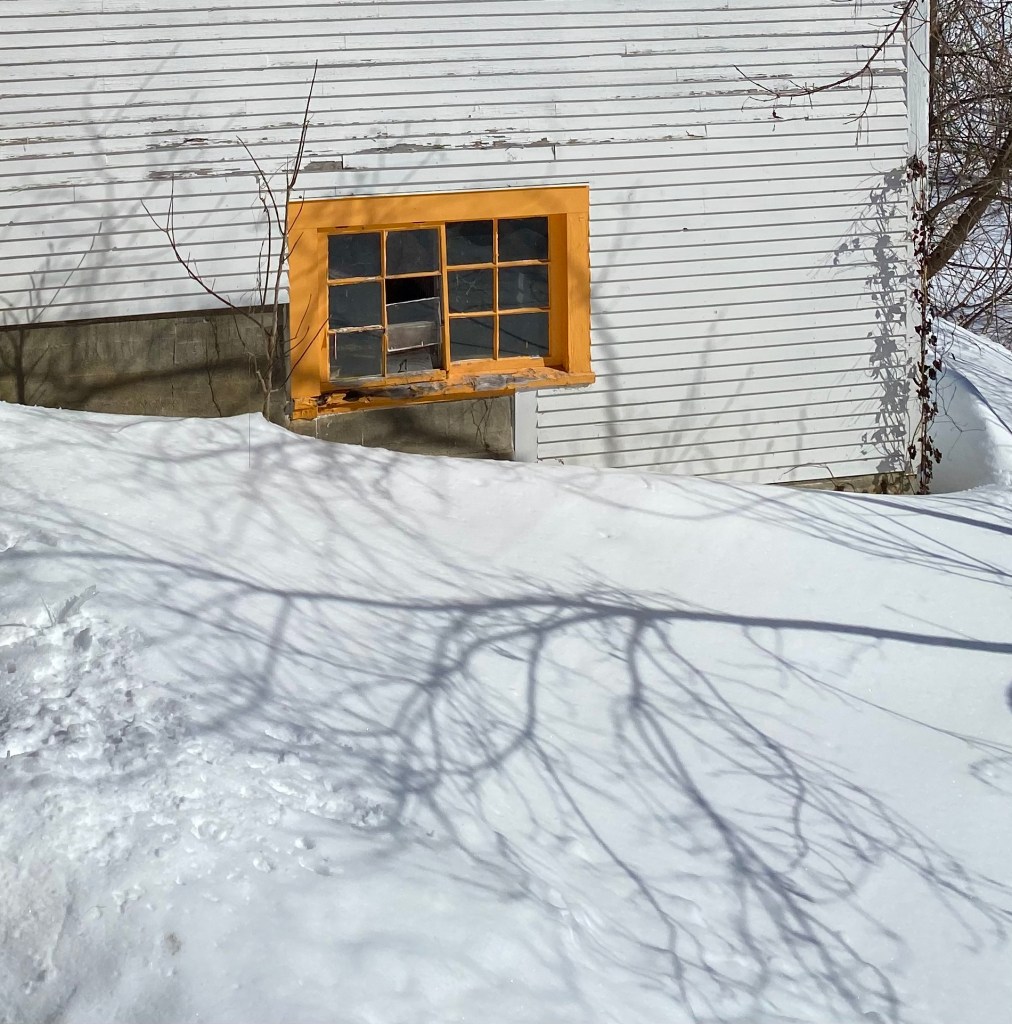
Spring is radiant light and also brokenness. The ash buckets trailing coals, the deck joists smashed by the roof’s ice, the barn still desperately in need of paint. Me, too, broken, with my few hours of clarity in the mornings, the stumbling way I’m heading towards this final treatment. Around me, too, the remains of this winter: people who have helped me more than I could have imagined, others who have distanced themselves, the disease itself, perhaps, too much, the leer of mortality a shivering thing. All that is neither here nor there. The cancer has stolen a share of my vitality, my economic steadiness, a winter of my life. And yet, all these pinwheeling days and nights as I’ve traversed this tunnel – what an infinitely rich journey, one I never would have booked a ticket to join.

My daughter sends word of singing redwing blackbirds. Spring, mightier than winter’s brawn. The season of planning, putting things back together, rearranging and cleaning, of tipping our eyes up to the sun, relishing the light.

…. Ariel Gore repeatedly quotes Audre Lorde’s The Cancer Journals in her Rehearsals for Dying. In these lines, I was reminded how we each respond to crisis in others’ lives, too, from the soil of our lives.

Each woman responds to the crisis that breast cancer brings to her life out of a whole pattern, which is the design of who she is and how her life has been lived.

Go for a walk around the block?

March 7, my father’s 88th birthday today in what is doubtlessly sunny New Mexico. So much for my plans, months ago, to visit him on this day.

Here’s the thing about living such a long life — I could pick countless numbers of things to write about, but what I woke up thinking about this morning was how my dad would often say, “Let’s go for a walk around the block.” At any time of day, we’d set off. Sometimes just up the street and actually around the block, or other afternoons on hours-long rambles through the woods behind our neighborhood. We walked in sunny days, through sleet, through knee-deep snow, in the sweet spring rain. It’s a habit all three of his children have continued our whole lives, and his four grandchildren, too.

Sunny, here, in northern Vermont, too, a day of such optimism that the blue sky choruses the inevitable promise of spring. And for my father, one of our favorite poems from the unmatchable Hayden Carruth.

Birthday Cake

For breakfast I have eaten the last of your birthday cake that you
had left uneaten for five days
and would have left five more before throwing it away.
It is early March now. The winter of illness
is ending. Across the valley
patches of remaining snow make patterns among the hill farms,
among fields and knolls and woodlots,
like forms in a painting, as sure and significant as forms
in a painting. The cake was stale.
But I like stale cake, I even prefer it, which you don’t
understand, as I don’t understand how you can open
a new box of cereal when the old one is still unfinished.
So many differences. You a woman, I a man,
you still young at forty-two and I growing old at seventy.
Yet how much we love one another.
It seems a miracle. Not mystical, nothing occult,
just the ordinary improbability that occurs
over and over, the stupendousness
of life. Out on the highway on the pavement wet
with snow-melt, cars go whistling past. 
And our poetry, yours short-lined and sounding
beautifully vulgar and bluesy
in your woman’s bitterness, and mine almost 
anything, unpredictable, though people say
too ready a harkening back
to the useless expressiveness and ardor of another
era. But how lovely it was, that time
in my restless memory.
This is the season of mud and thrash, broken limbs and crushed briers
from the winter storms, wetness and rust,
the season of differences, articulable differences that signify
deeper and inarticulable and almost paleolithic
perplexities in our lives, and still
we love one another. We love this house
and this hillside by the highway in upstate New York.
I am too old to write love songs now. I no longer
assert that I love you, but that you love me,
confident in my amazement. The spring
will come soon. We will have more birthdays
with cakes and wine. This valley
will be full of flowers and birds.

Small town, rural hospital, snapshot, tinge of the seventies.

Driving into the Dartmouth Hitchcock Medical Center, the soaring buildings with their blue-green windows inspire confidence. They’re just so darn topnotch, cream of the crest, but (in the cancer journey) I also use the nearby hospital, too.

At the local hospital, not far from our house, we arrive again in the dark, the crimson EMERGENCY sign glowing. My daughter leaves me at the door and disappears around the corner to park. Inside, it’s the same receptionist, who nods a little sadly to see me again. In the waiting room, there’s no one but me and the Mountain Dew machine, my reflection in the windows.

Months into this cancer, I’m familiar with the process (don’t ever put your feet on the ER floor without shoes!) of questions and fluids and meds, a room far away from the day’s flu and Covid patients. Here’s what has changed: the ER doctor and I know each other now. My brilliant oncologist calls me and thinks aloud, what’s going on now? and orders an unusual set of tests. The ER doctor listens, nods, yes, let’s try that. My daughter’s boyfriend appears. The three of us talk about xc skiing and DOGE.

I’ve crammed my backpack with my laptop and notebook, two books, and a few clothes. In the middle of the night, I’m admitted. The woman who takes me upstairs knows a longtime friend of mine. She tells me about growing up in eastern Montana. Wherever you go, she tells me, the sky is infinite. Vermont’s so small, I feel like I could put it in my pocket.

Having lived in the West, too, I sometimes chafe against the pocket-sidedness of Vermont but mostly I love it. I keep thinking of this woman’s description for these few days again, in this rural hospital that’s about the size of double pocket in the front of hoodie sweatshirt. The census is so low here the rooms are all singles. Each of the rooms where I’ve stayed seems to be finished with unique salvaged materials. Beadboard cabinets in my last room, painted glossy cobalt, line one entire wall. In this room, the window is trimmed with wooden rosette corners, the sill plastic faux marble.

The medical world is hurry up and wait, but this hospital leans back towards the 1970s. I drink Shasta ginger ale and chat with the LNA about the cold and maple sugaring. Here’s what changed in me: I see these people throwing everything they have at me. The hospitalist who advised me, just a day after the cancer was discovered, do not stay in bed; be part of the world. The social worker stops in and asks my daughter about her job. The chaplain and I talk Dostoyevsky and cats. The nurses who have survived their own savage cancers share their stories and let me ask my questions. I have so many questions. The questions narrow down to one: how will I survive?

Then I ask to leave. My daughter stops at the pharmacy for another prescription and texts that it will be a few minutes. I open the door and lean against her winter-salted car. I’ve been at this crossroads in this unremarkable section of town so many times. Across the road was the department store Ames where I bought this daughter her first pink ball so we could roll it between us, the baby version of Catch. In the Price Chopper parking lot, I used to meet people to exchange boxes of wedding favors in leaf or heart-shaped bottles, tied up with ribbons, for checks. Afterwards, I’d take my girls into Price Chopper and buy ice cream. Behind the pharmacy is a home center, where I’ll never go again, after my ex-husband absconded with his customers’ money and stiffed the home center… how many tens of thousands of dollars I never knew. I’d severed that cord by then. On the other side of the crossroads stands the hardware store where the girls and I used our pandemic stimulus money to buy a glass table and red umbrella for our back porch. We use those things every summer, nearly everyday.

Behind Price Chopper, craggy Elmore Mountain looms, where I and the girls and their friends have camped and hiked and swam for years. The gentlest of snowfalls sifts down, swirling. My long-legged daughter crosses the lot, shades on despite the overcast sky, grinning.