Making Effort

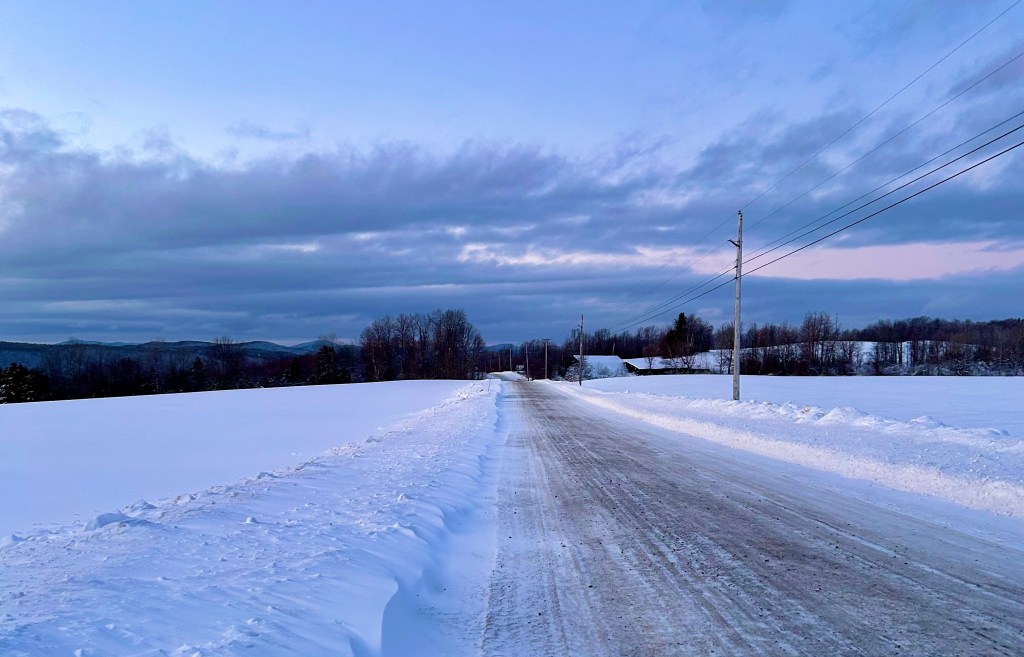
Under the waxing full moon, January’s hungry Wolf Moon, I hurry along in the few degrees above zero. I’ve forgotten my scarf, so when I turn and lean into the wind, I cover my cheeks and lips with my mittens and breathe in the scent of wool. It’s too cold for wetness, yet my mittens are redolent with sheep.

The wide sky and the fierce cold winnow me to shivering bones. Nonetheless, I walk further than I’d planned, thinking through a piece of writing, and then, so cold, words abandon me for images, then those, too, vanish, and it’s me in my boots and that good down jacket and the mittens just beneath my fluttering eyelashes, and intermittent pickups passing, their drivers lifting their hands silently.

My life flickers as a candle flame in my curved ribs. What great fortune to be walking along the earth’s curve as the planet bends into twilight, the ancient moon electrifying the new snow. By the time I return to the village, it’s not long after five and the darkness has settled in for the long go of the night. Nonetheless, it seems to me these wintry days are gradually lengthening. I mail a letter at the post office and then talk with an acquaintance for a few minutes in the co-op, a waxed bag of curry power in one mitten, an onion in the other. At the last moment, I remember to buy milk for the morning’s coffee.

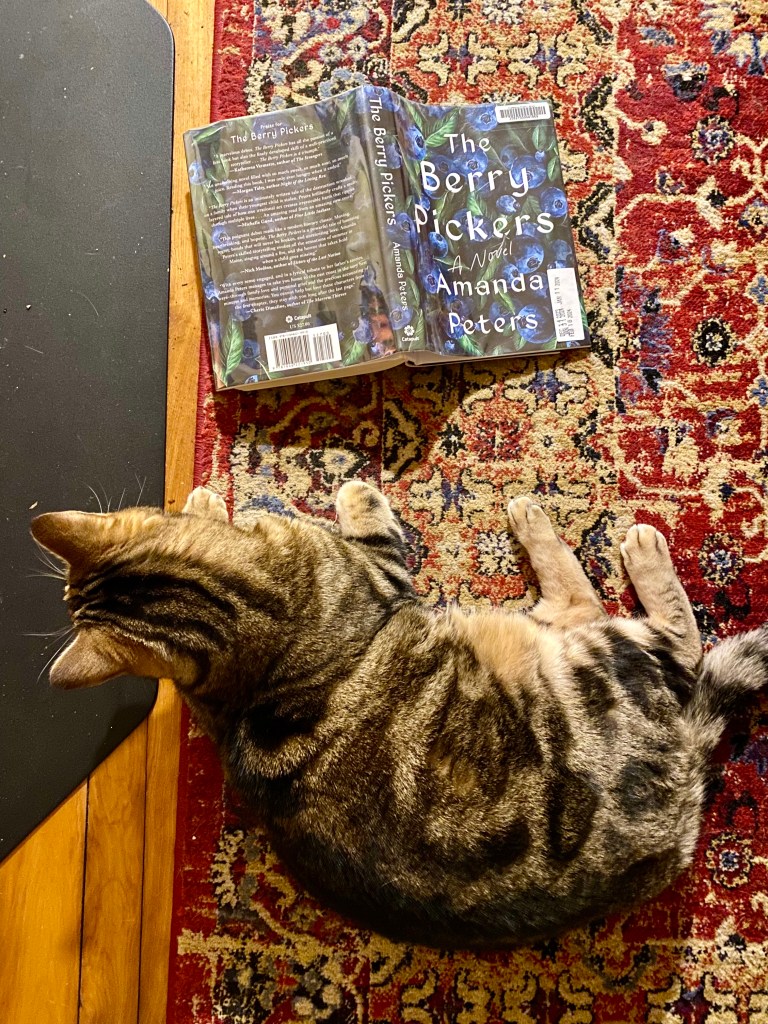
Winter. This starkly elegant season, straight-forward, no fussing around. A librarian friend passed me Andrew Miller’s The Land in Winter, a novel I’d longed to hold and read. A book of my soul. My cat Acer, eight-years-old, has discovered the pleasure of purring. We lie stacked on the couch—me, this tabby, library book—content. Who knew this was possible, my slow learner cat, my slow learner self?

“And though he was not much given to thinking about love, did not much care for the word… it struck him that in the end it might just mean a willingness to imagine another’s life. To do that. To make the effort.”
― Andrew Miller

Cat justice, homestyle.

A friend stops by with a gift of a stunning orchid. My naughty cat, Acer, immediately jumps on the kitchen table, and I swat him away. He lies on the couch, glaring unhappily as we talk. Gorgeous flower bouquets have come my way, been lavishly admired, then sent home with others to enjoy without cat destruction.

But the orchid is so stunningly beautiful I want to keep her. Later, I set this flower on the bathroom counter and shut the door. Acer is still sulking on the couch, paws stretched out before him, the epitome of cat depression, really hamming it up for my youngest daughter who mollifies him with kitty treats.

The cat and I: we are at odds. This morning, I let him into the bathroom. He sits on the counter, hungry to the core of his being to shred these velvety petals. In this new cancer world, my constant checking of time — my furious need to get stuff done — has instantly vanished. The mock orange outside the window sways in the breeze. Mid-November, this gloom is as much brightness as we’re going to get today.

Acer has no need to explain his position to me; his furriness is tense with desire. I pet his head and explain my infatuation with the orchid, which doubtlessly Acer dismisses as a weak case. And the orchid herself? Surely she wants to keep her own amazing life, both svelte and voluptuous.

The outcome is nearly certain. I’ll have to let her go. But for now, the house is warming with the wood stove, daughter sleeping upstairs, and — accusations of cat injustice be damned — just the right amount of ethical challenge and beauty, for ten minutes or so.

Cutting grass at night…

I’m finishing mowing the front lawn when my neighbor opens her door and hollers, “Hey, there!” across her driveway. Save for a series of apartments in my twenties, I’ve never lived so close to another house and moved here, in fact, from a house that was surrounded by wilderness.

She’s a darn good neighbor. Twilight fattens to darkness as we talk about small things — a mutual friend who visited her, red roses blooming yet by her door. My pink cottage beauties have long since dried up.

I’ve lived long enough now in this town to have experienced the meanness of catty gossip and the kindness of strangers; nothing different from any other town or city, I suppose, simply the variety of human behavior, the tenor of thinking that makes me satisfied to be standing here in this dew-dampening grass, listening. A fallen pear that’s split by the mower blade bleeds its sweetness into the evening.

It’s a harvest full moon night, diminished by the eclipse and then returned. I sleep with the windows wide open, the moonlight on my curled cat who’s sleeping in his own cat way, more dream than rest, busy at his own cat magic. Here, too, I can hear the traffic on route 15, coming and going, going and coming. At 3:30 a.m., the traffic stills. The tree frogs sizzle on.

As a girl, we traveled summers in a green jeep and slept in tiny nylon tents. Waking in the night on those cross-country trips, I’d hear the interstate. So curious I was to know where everyone was headed. I repeated all that again in my hungry twenties. For a summer, we lived near the river in St. Johnsbury, Vermont. Every night, the train whistle bleated mournfully, passing through. Here I am now, in my fifties, lying awake, listening. The scent of the grass I cut that evening drifted into our house. In the moonlight, my cat lifts his head, questioning. “We’re here,” I counsel, “all’s well.” He tucks himself back into his curl. The moon and the frogs keep on. A milk truck rumbles by, pushing us towards day.

Mending Myself.

Mid-morning, abruptly the weight of my mother’s recent death lies on me, a physical presence, as if she’s leaning on my shoulders. It’s 21 days since she passed, days and nights crammed full. Like most mother and daughters, my mother and I had a relationship filled with 10,000 things and more. Again, today, on the eve of a short journey, I pack my laptop and books. I vacuum and mop and talk and talk and talk with my daughter.

Rain falls all day, so chilly I light a fire to the intense pleasure of my two cats. A year ago, my youngest and I flew home from Europe, my heart filled with our trip’s happiness. So, too, again, my life unfurls forward with an offer of good writing news. Spring in all her exuberance sings — such sweet joy for us in a northern sphere.

I wander outside. My shoes fill with rain. I stop in at a friend’s house. In her well-lit living room, with her purring cats, we talk about travels and love. Later, as I leave, she leans out the door, and we keep talking about honeybees and blossoms. The rain falls steadily, streaming down the collar of my coat. I have that walk home and more work, but I linger in the billowing fog, the gleaming green, our conversation gently pulling me back into this world, stitching me.

‘I can feel my life start up again…’

We’ve crossed the halfway point of winter and can, again, believe in the possibility of crocuses, the promise of pearly-and-pale-pink apple blossoms. Monday morning, my friend Brad Ferland invites me onto his WDEV radio program Vermont Viewpoint again. I’m lucky enough to ramble on for a bit about writing, and I spoke a little about this blog. For those of you who are new here, I often write about what the seasons in Vermont mean to me. July is the Swimming Season. September the Season of Fat Sunflowers. February, in my mind at least, is the Season of Hope.

The days suddenly widen and grow. A sunshiny stretch like this, and my state’s collective spirit rises. February is still deep in the Woodstove Season, however, which means, as a writer, no need to worry about missing a few fine gardening hours. The clouds will descend again, and surely I’ll complain (again), but for now, with two days of radiance, savor. Savor.

I feel my life start up again, 
like a cutting when it grows
the first pale and tentative
root hair in a glass of water.

— Jane Kenyon

Onset of Pre-Cabin Fever.

I shake stunningly beautiful snow from my mittens onto my cats. Mid-January. Winter’s loveliness has just arrived. My house is again the three of us, two fluent in Cat and one marginally fluent in Human. The one who speaks Human gets the deciding vote, so we get up very early. The Cat speakers are wholly in favor of this, as the wood fire is fed and the cat kibble rationed into bowls. Eventually, the dawn finds us, and the rest of the world creeps in.

If this keeps us, the prognosis is mad-as-a-hatter by Honest Abe’s birthday. No fear of that. Any hermiting is constrained around here. Two small excerpts from my novel are accepted by journals. The cats and I nestle into our narrative. I let them lick butter from my fingers. Snow silently fluffs around us, concealing the stars, the sunflower stalks, the ash bucket I left by the step.