Autumn’s Radiance, Fine Medicine.

Before dawn, rain patters, a splatter through the open windows. The singing frogs are still at this hour. The rain moves through lightly. All summer: drought, drought, not likely to be relieved any time soon. In the town forest, beneath the soaring pines, the scent of the hot soil reminds me of the desert, a strange thing in northern Vermont. In the garden, the peppers, the sneezeweed, the Love Lies Bleeding relish the dry weather. By September, the garden will do whatever it’s going to do this year. Early autumn, colors burst. The hydrangea, so pink the large blossoms appear overly dyed, the coreopsis and compass flowers great bursts of little-kid-yellow, swaying with feasting bees.

Autumn, and I’m reliving last year’s descent into illness. A year ago, I was in a clinic’s office, asking what was wrong with me. I was sent away, and I went back to my toiling work, my sleepless nights. A month later, I returned again, thinner and weaker. Again, I was sent away. Shortly afterwards, I was in the ER and dosed with opioids. A scan revealed “unexpected severe neoplastic disease,” nothing that I’d conjured.

This fall, my novel heading towards an ARC for next summer’s publication, I reread my journal and the hospital notes and began writing a book about cancer. I’ve relied on my memory, that fickle creature, so rereading the notes from two hospitals is a vocabulary builder (so many medical words brand-new to me) and illuminating. This and then this happened. Our bodies and the world are known through numbers, like this drought, the inches of rain we need and the inches of rain to cure, a climatology record. Likewise, the hospital notes are records of lesions in centimeters and pulse in numbers and drugs in millimeters — my story’s elements. But, so, too, are the pears on our trees, plumper and sweeter than I’ve tasted in the eight years I’ve lived here. I pluck a weighty fruit from its branch, stand in the dusky-night yard, and watch the nearly full moon rise.

This week, driving to a friend’s house, I spy #10 Pond shimmering through the trees. The sheer unbidden beauty of the pond pulls me to a stop. I get out and stand on the dusty roadside, the crickets sizzling. A day like any other random day, a slip of a few afternoon hours. But here I am, still stitched into this evolving story.

“When I realized the storm
was inevitable, I made it
my medicine.” ~ Andrea Gibson

Lists, Loons.

My kitchen table, notebook, car console is littered with yellow post-its, my hand-scrawled lists of work things, schedules, BUTTER written on several versions, COFFEE BEANS, sandwiched between AT&T — my reminder to figure out the phone bill.

How good to have a list again — more, multiple lists — my daily roadmap under constant revision. An acquaintance tells me about a weekend of work and he’s looking forward to Monday. Of course, he says, on Monday I’ll look forward to Tuesday. On Tuesday… Isn’t my list a variation of this?

In contrast, I consider the loons who swim near us, diving under the pond’s still surface, reappearing, vanishing. Four sleek birds: two parents, two juveniles, the loon nuclear family charming us with their haunting songs, the younger ones still halting and squeaking.

Sunday evening, I stack my crumpled post-its into a pile and shove this in the recycling bin. To circumvent my churning thoughts, I email myself a Monday morning list. Autumn’s moving in, the majesty of these long summer days clipped shorter and shorter at each end, the daybreaks dewy and cool…. I pull on my sweatshirt and Danskos and lie on the picnic table’s bench, fingers in the unmown grass. The lilac leaves are withered brown with thirst. The woodchucks have been eaten by the foxes, or they’ve packed their own valises and headed out for new territory. Dusk creeps in, and still I’m there, the wood and my bones and flesh keeping some kind of wordless company. That afternoon’s loons and the swifts darting overhead, the crickets sizzling, and myself, too, each of us in our own language. At last, the rain patters down, drip-dropping, ubiquitous.

“How lightly we learn to hold hope,
as if it were an animal that could turn around
and bite your hand. And still we carry it
the way a mother would, carefully,
from one day to the next.” ~ Danusha Laméris

And another turn in the plot…

My body falls apart again, and my daughter drives me to Dartmouth. “My car only goes to this ER,” she tells me when I hint at negotiating a closer ER. She asks her blunt and even-toned questions, “What are you afraid of?”

Among other things, I’m afraid of waiting, in pain, which is what happens, and I survive that, of course. The hours in the ER waiting room introduce us to an intimate slice of others’ lives. The man who drove a screwdriver into his hand and didn’t seek antibiotics (not a good choice), another who crammed his hand between his two fighting dogs (the hand lost), a woman with a damaged foot who phones her mother on speakerphone. Across the large room, listening, I wince at the painful distance in that relationship.

Eventually, I’m given a bed in what’s labeled Hall 3. Shift change, a kind nurse hustles to give me meds. In the hallway, we are yet in the swirling mix of others’ lives. A hall mate (not a roommate) who I never see but who’s recently widowed; his companion struggles to figure out his meds. Later, my daughter steps outside and sees a prisoner who’s a patient run through the parking lot, high drama. She leaves after midnight. “Drive safely,” I say, “text me when you’re home.”

In the night, the surgeons stop in, and again the next morning, when the surgeons and the Good Doctor my oncologist meet in my room. Like a rushing train, surgery is coming rapidly and unavoidably towards me. Much as I’d rather not, really rather not, I begin to accept this. I think: get my tools together to survive this. Print out my manuscript, collect books and a knitting project. In all these countless hours in varying hospital rooms and hallways, I’ve never been bored. Frustrated and weeping, laughing and curious, but never dull. Another thing to be grateful for.

I’d rather not, but here’s another bend in my story, as with my hall mate and waiting room companions…

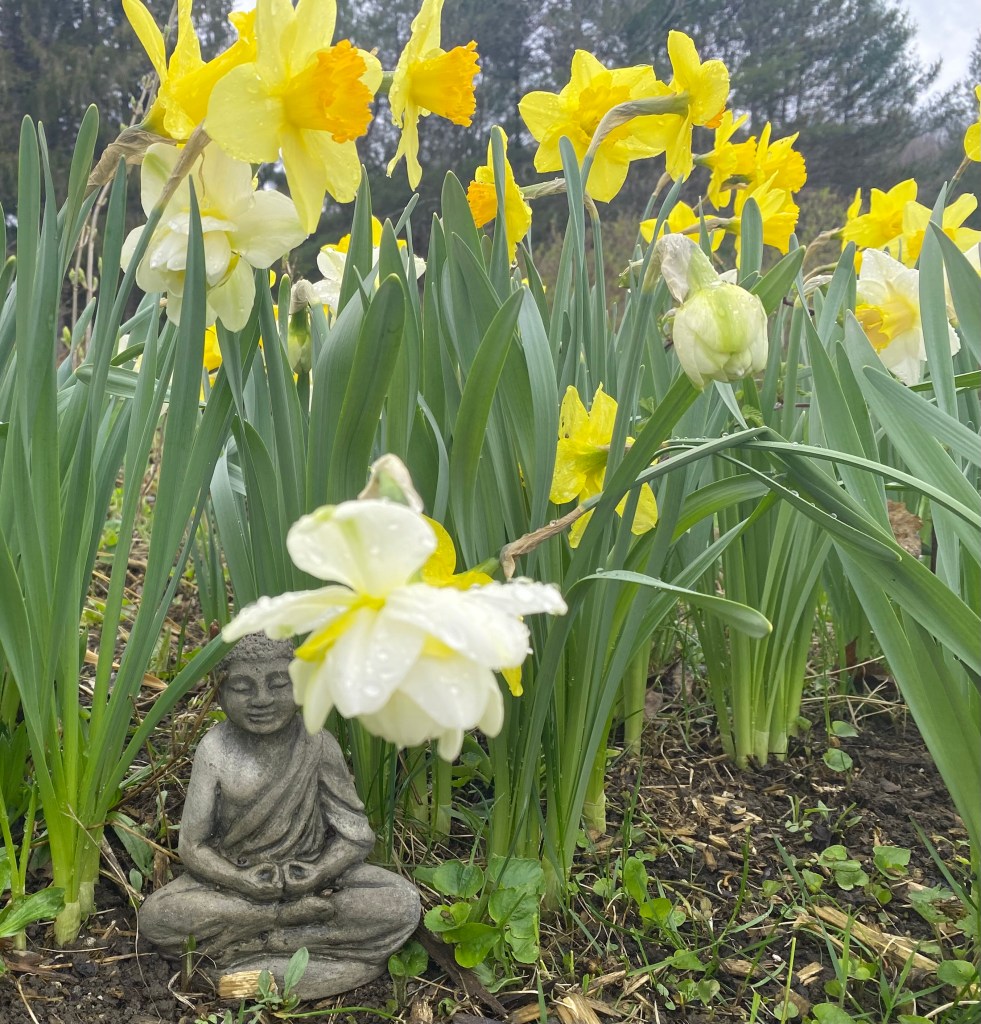
Spring, in all her variations.

In the dark, the robins chirp, their language weaving night to dawn to daylight. Imagine, a whole season of birdsongs ahead. Or, I remind myself, quit stretching into the future. Simply listen.

Word around northern Vermont is that the spring is stuck. Days with thin ribbons of chilly sunlight. Drizzle and damp. In my wool hat and sweater, leather boots, I pull out the broken branches beneath the mock orange. Last winter’s heavy snow slid from the roof and snapped the brittle branches that should have been trimmed, anyway, last year. Against the house’s southern foundation, a cluster of white violets blooms. Every morning, the green pushes forth. The Japanese lilac I planted last April brushes out. Red stalks of peonies emerge. The tulips hold their plump buds closed, teasing, tomorrow, tomorrow.

But in the realm of today, today, each day I feel the chemo less in my body. Yesterday afternoon, in my fifteen-minute house tidying, I suddenly realized that my body has been cycling through chemo for six months. Before that, I’d been (ignorantly) filled with rapidly growing cancer. Now, walking barefoot around the house, the cats lazily watching me from their perches on couch backs, I realized what was different was that my body felt like mine again, me, the way I’d forgotten as familiar.

In alignment with that strand of my good news (apparently in opposition to what’s happening with arts funding on the national level), here’s a line from Dostoyevsky’s Prince Myshkin I read this morning: “Do you know I don’t know how one can walk by a tree and not be happy at the sight of it?”

Backaches and all.

Snow returns to Vermont; I remember an April 1st years ago when the snow fell so mightily our sugarhouse was hidden. I worried our toddler might get lost in the drifts.

These (early spring) afternoons, I walk around my garden where last autumn’s sunflower stalks still stand. The robins, those cheery birds, cluster. Redwing blackbirds sing joyously.

I’m nearly at my last chemo session – yes, counting down day by day, my simple math calculations and not-so-simple life. Mornings, I pull myself together to work; afternoons, I lie on the couch with my cat and read. The town library orders me interlibrary books. Recently, Blue, an illustrated memoir of St. Bart’s that I read in a few hours, a sojourn into a Caribbean vacation with a sweet family. I will be traveling nowhere outside the country, anytime soon, although I dream…

Where I am now is different terrain. My house has sheltered me (and my family) so warmly and kindly during this winter of disease. Now, I see where our house needs tending – paint on the barn, boards hammered back on the porch where the ice crashed. Every spring and summer, too, I plant more in the gardens, cultivating good living for birds and pollinators, not necessarily the woodchucks who come, unbidden. There will be no wars on my patch of hillside.

The bigger work for me now is healing; how happily I’ll shed medical appointments, the world of sickness, and savor my long walks again. My oncologist told me last fall that someday I’d forget I ever had lymphoma, and I’d forget him, too. Maybe someday if dementia drills into me (many many years from now). I would need to live a long long life if I were to forget this year.

In these winter months of cancer suffering, I’ve longed for many things, but prominent among these desires is to imbue this cancer with meaning. So now, as I’m beginning to contemplate my next steps, the spring and recovery phase, I’m determined to not slip into old habits or careless living. I mean nothing sentimental about this, as if plastering a gratitude sticker on my life will fix up my world.

Which way this will go is yet to be determined. Certainly, planting more perennials.

Stacking wood today

I thought how much I loved this life,

Backaches and all.

~ John Straley