“Everything blooming bows down in the rain…”

We make the trek again to Dartmouth for a surgical consult, the sign-off after surgery. I’ve met numerous members of this team, but not this kind NP, who’s read my history and says, What an ordeal. I’m not expecting these words, and I pause. Last November, when was I first admitted to Dartmouth, I had unplanned surgery. That snowy November night, the surgeon spent so much time with me. Then her Fellow returned and answered my endless questions. In May, I had surgery again. Two bookends – that November night and this sultry summer day. I’ll be treated here for years, but my hope – and none of know squat about the future – is that I’ll never need a surgeon again.

I thank her and the surgical team and student entourage who appeared in all those ER and hospital floor rooms where I stayed – me, the reluctant patient, who tried to negotiate some other outcome than surgery. To my surprise, she’s grateful for my words, too. We try our best but it’s hard to know how we come across to patients. The surgeons who operated on me are trauma surgeons. My surgery was routine, but routine surgeries go south. Mine did not.

Afterwards, my daughter and I stop at Dartmouth College’s Hood Museum. There’s a Georgia O’Keefe painting we want to see and two Monets. The current exhibit has mesmerizing photographs. This is a good day and a good visit. We eat sandwiches in King Arthur Flour’s patio, where so many families have pudgy babies tucked into a parent’s arm. We linger, talking about my mother who would have loved eating here.

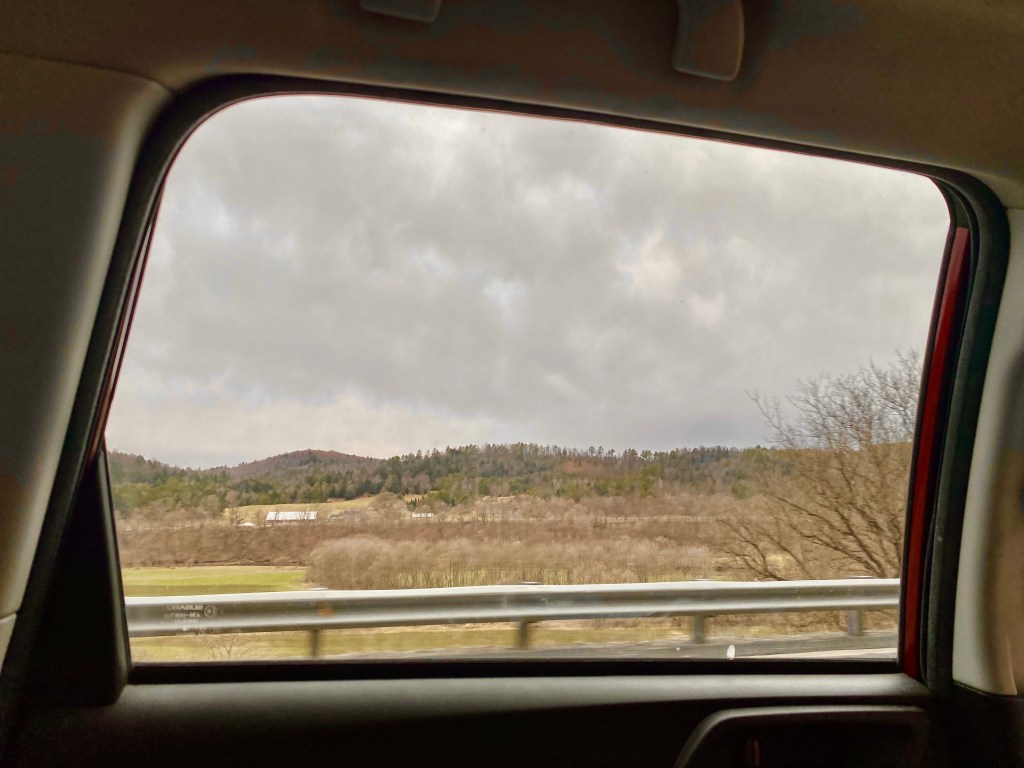
So many of those drives on the interstate home, I slept, nodding in and out of conversation. My weak days are long passed, and we keep talking, the interstate edging near the Connecticut River and up on the ridge again. In June’s green, the drive no longer seems so desolate. Traffic here is always sparse. We pass a trailer of hay bales, a pickup with three wheelbarrows.

Enduring cancer turned my world (and my family’s world) inside out. In the first five-day continuous course of chemo, I forced myself to wash every morning. In those days, my hair had not yet fallen out. I was too weak to brush my hair, so I tied it at the nape of my neck. That month, my daughter cut what snarled hair remained. Those miserable uncertain November mornings, how grateful I was for hot water and soap, to have access to a brutal but hugely effective treatment, in a sterile hospital in one of the richest states in a phenomenally country. I made my choices, but I had choices.

In the inside-out world where I am now, I’m ticking through my list: profusely thank my oncologists and surgeons for saving my sometimes-surly life, tend my garden, figure out my youngest’s college bill, finish my book, accept the ravenous roaming woodchucks….. my domestic realm.

In our little end-of-the-road neighborhood, visitors come and go on my back deck, gardens on three sides, the wild pressing in on the fourth. My own nexus.

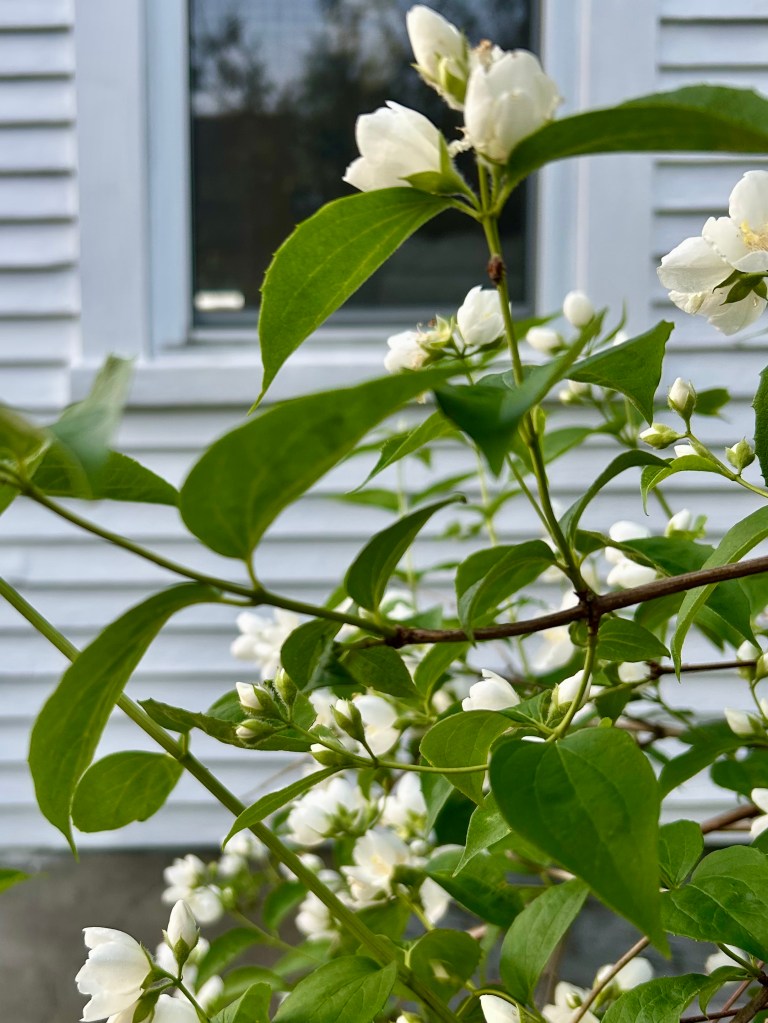
Everything blooming bows down in the rain:

white irises, red peonies; and the poppies

with their black and secret centers

lie shattered on the lawn.

~ Jane Kenyon

Seeking the Something New.

A friend arrives with a box of seedlings, including tithonia, AKA Mexican sunflowers, a tall, brilliantly orange, hopeful plant. A few mornings later, more friends appear with seedlings and a pitchfork. Lucky, lucky me.

I am a gardener who allows the Johnny-jump-ups and forget-me-nots to spread where they like, pulling back a few and nestling in basil, scallions, poppies. Why unroot a flower? Eventually, I weed diligently, ruthlessly. The garden mirrors my approach to novel writing. My friends leave with their boxes filled with forget-me-nots as a gentle rain falls on the tender seedlings.

Every day is a further day from surgery and chemo, the days and night accumulating like pages read in a book. I put away the narcotics, the Tylenol, the ibuprofen. Mornings, I drink a single cup of café au lait. I sauté mushrooms, bake a quiche. I ask for a ride to drop off my car at the garage, worrying about walking up my hill, but picking it up is mostly downhill. I walk.

For a little bit yet, I’m a person of interest in this small town. The postmistress asks me, no, really, how are you? For months, the PO staff has stuffed my box with cards and books and sheaves of medical bills from two hospitals. I’m there to pick up a book of essays (a gift which quickens my heartbeat). I tell her I’m in remission, that word still awkward as it emerges from my throat. I want to add that remission does not mean cured, does not mean that this strange and uninvited cancer beast has left my body – and certainly not my soul. I don’t know this woman at all well, but she looks steadily at me, as if she understands what I’m thinking.

Here’s the thing: how afraid I was of cancer eight months ago; honestly, I’m still fearful of it. Yet, cancer rooted in me, infested my family, my friends, a great wide circle of people around me, including my readers here. This is not unique. In its myriad forms, cancer spreads widely. I lived for years with the putrifying secrets of addiction. I refuse to repeat that with cancer.

Last November, I thought I wouldn’t live to see spring. I did. If jaywalking doesn’t do me in, cancer certainly might. Or I might die as a scrawny old woman from a stroke or heart attack. In this rainy late spring/early summer, I’m grateful for the possibly random dice throw, for plants and gardeners, for an infinitude of people. Among these are the people who’ve shared their stories with me, of decades-ago cancer diagnoses, almost always offered sotte voce, as if not to tempt the fates. Their stories ring clearly: I endured, I transformed, I thrived. This possibility can be mine (maybe yours, too).

From Suleika Jaoad’s The Book of Alchemy:

But there are also moments when our internal compasses tell us it’s time to change course–to leave something behind and build something new…. Rebuilding is not easy…. But to me, rebuilding unfolds alongside becoming. It is crucial, if we want to keep evolving and flourishing, to get rid of things that are no longer serving us and make space for something new to grow.

The crying moments…

I’ve written frequently in this space about living with cancer and cancer treatment since I was diagnosed with lymphoma last November. From the beginning, I was determined to hold myself together. Some of this was simply shock; I could not believe I had been walking around, working, going to birthday parties, hanging with family and my friends while cancer was devouring my body. By the time I ended up in the ER, telling the triage nurse I was circling the drain, the cancer had metastasized to stage four. I needed a moment. I was not about to get a moment.

In the long hours of yet another ER visit, my daughter told me that a longtime friend had asked her last November if I actually intended to undergo chemotherapy. I hadn’t heard about this inquiry, and the question stunned me. I’ve been my daughters’ sole parent for a decade now; even in the worst of these cancer nights and days, I remain foremost a mother, unable to relinquish my watchful eye. After diagnosis, it was immediately clear that the cancer was rapidly growing; without some kind of treatment I would die that winter. The lymphoma I have responds well to chemo. My other option, perhaps, was to seek an alternative treatment — where, for how much, and with what likelihood of success — was dubious at best. In my fifties, I was determined to live. My oncologist was clear that the chemo would shove me to the edge of demise. He told me, You are curable. So, in a rare action of trust, I stretched out my arms and said, Infuse me.

As the cancer was so advanced, I suffered numerous complications from the chemo, which resulted in all the hospital stays I’ve referred to in this blog — nearly a dozen — weeks and and weeks and weeks this winter.

Now, April, Easter rising tomorrow, I’m drinking a friend’s homegrown chamomile tea this morning at my kitchen table, watching the small rain feed spring’s green, alive, in remission.

From the get-go, too, I determined not to burrow into the rathole of despair that I’ve seen disease wreck upon individuals and spread to families. This recent ER visit, however, forced me to the crying day. I wept before the kind nurses, the warm hematologist with her sparkly hair, the PA who insisted I not leave even as I connived deals and plans for discharge. I did not cry before the elder hematologist, who had certainly been practicing medicine for most of my life. I said, yes, yes, I understand. And then I wiped my tears with my thumb when he left.

By the late hour when my daughter had left, and I was alone again in the darkened ER room, I’d taken stock of what I’d crammed in my backpack: two books, my laptop and charger, a handful of underwear, my notebook. I’d forgotten my knitting, which was unfortunate. The nightshift nurse brought me water and those eternal saltines. She was a traveler and had last worked in Iowa.

Much later the next night, two nurses wheeled me through the dim and empty hospital halls to another room. Of all the experiences I’ve had at Dartmouth-Hitchcock, I’ve oddly enjoyed these late night journeys through this huge building. So many stories here, so much living and dying, so much richness. By then, I’d finished with my weeping, joined the world again, all of us, doing what we’re doing.

A driving spring rain
gliding, wending through the trees
speaks in little drops

~ Bashō

Determined to do/the only thing you could do…

When I was six, I dropped a large wooden board on my toe, right where the nail emerges. My mother lifted me up and soaked my foot in the bathroom sink in Epsom salts. I cried fiercely, and my mother said she wished she could take the pain from me. Impossible, of course. Later, I lost the toenail.

The night before my last chemo infusion, I woke thinking of my mother who died nearly a year ago. She never knew I had cancer. Of all my family, only my mother endured chemotherapy, at age 80. Like so many mothers and daughters, we had a tangled and complicated relationship, sometimes fierce, sometimes outright silly and joyous. Not knowing about my cancer was one thing she was spared in her life, at least. No one seeks cancer, but in this long and snowy winter, I was spared the misfortune of being a parent of a sick child. Anything can change in this world, at any moment, but for now….

Recently finished with chemo treatments, how grateful I am to Dartmouth and its staff for their exquisite care. How humbled and thankful I am for the people who wrapped around me – some of whom I’d never met before. To write that cancer changed my life would sound trite. The deeper truth is that this disease will be with me for the remaining days of my life. But my life is in the present tense. I have not changed. I am changing. How blessed I am to be here.

… little by little…
the stars began to burn
through the sheets of clouds,
and there was a new voice
which you slowly
recognized as your own,
that kept you company
as you strode deeper and deeper
into the world,
determined to do
the only thing you could do —
determined to save
the only life you could save.

~ Mary Oliver

A fluttering stir like a fledgling first stretching its wings…

On my way home (again) from Dartmouth-Hitchcock Medical Center, I’m at a pharmacy, picking up prescriptions. The one I really want – the pain meds – is apparently not available, simply not stocked, which surprises the heck out of me. It’s a common opioid. In my brother’s car, I phone Dartmouth, miraculously reach a nurse who sorts out my problem swiftly. My brother drives down the road, where another pharmacy tells me I’ll need to wait.

In a dusty midafternoon sunlight, I take him on a downtown tour of Barre, around the courthouse where I spent so many hours. I point out the window where I stared at the chickadees in the crabapple trees. We keep going and walk around the Civic Center where my daughter and I went to basketball games. The lot is empty, dirty with winter sand. We talk for a bit about these neighborhoods and where we grew up, our mutual interest and speculation in local history, how towns rise and diminish.

In the Walgreens parking lot again, I pull up my sleeve. Where a nurse recently pulled out an IV, the band-aid is soaked. I show it to my brother. “Don’t touch,” he tells me, as I wince, creeped out. “We’ll clean it when I get you home.”

That blood-soaked band-aid, in a filthy parking lot, feeling beat down to hell and just wanting to head home, wash off the hospital reek and nuzzle a cat, but waiting for pain meds… is a sliver of cancer. In Walgreens, they’ve received my prescription. The pharmacist asks me if this is going to be an ongoing thing or what.

Hello, I think. I am clearly a cancer patient, with my scalp wrapped in a sparkly scarf and my eyes underscored by lines. The backs of my hands are red-dotted with red needle sticks from blood draws. My fingernails are broken by chemo. But there’s enough of me, yet, to lay into the pharmacist and both get my prescription and make him apologize. I know the deal about opioids. I’ve published a book that included Walgreens’ role in the devastating opioid crisis. Nonetheless, I’m determined to get my 21 pills, and I’ll send family back for the remaining allotted 21 pills, and I’m darn grateful for that. This, I tell him, is getting me to the finish line. And I’m going to get there.

I ante up my $4 copay, and then my brother drives north, over the Winooski River, where I happily point out the first spill I’ve seen of coltsfoot this year.

Later, at home again and opening my email, I’m gratified to read that my essay “Red Devil, Survivor Herself,” has been accepted for publication this April, my way of rowing against disease. A line from the essay reads: “Here’s a lesser known side effect of my chemo mixture, cisplatin: lying in bed, a whooshing revolved in my left ear, a fluttering stir like a fledgling first stretching its wings.”

Last, if anyone is so inclined, my youngest has signed up to walk in Dartmouth’s Cancer Center‘s annual fundraiser. Many thanks again, all, for reading my words. Happy April, wherever you may be.

From Donna Tartt’s The Goldfinch, my hospital read:

And I add my own love to the history of people who have loved beautiful things, and looked out for them, and pulled them from the fire, and sought them when they were lost, and tried to preserve them and save them while passing them along literally from hand to hand, singing out brilliantly from the wreck of time to the next generation of lovers, and the next.

A cup of tea, surrounded by ice, broken boards.

In the pale blue dawn, I wake with the taste of wild mushrooms in my mouth. In my dream, I’m eating tender stems from a soft paper bag. In the non-dreaming chemo world, I’m temporarily forbidden from dining on fresh anything from the produce world, but in this nubbly dream I munch on, relishing the residual taste of dirt, the forest itself.

I open my eyes. Day 4 – oh, I am counting these 21 days until the sixth of these six chemo sessions – Day 4, and through my window, geese wing across the sky. These past few days, spring blew in, fierce sun. On my back deck, broken by ice, a friend stopped by yesterday. I made tea, and we talked about this and that, kids and disease and politics, when we might plant spring peas. On my desk waits a cardboard box of wildflower seeds, a gift for this summer.

Spring is radiant light and also brokenness. The ash buckets trailing coals, the deck joists smashed by the roof’s ice, the barn still desperately in need of paint. Me, too, broken, with my few hours of clarity in the mornings, the stumbling way I’m heading towards this final treatment. Around me, too, the remains of this winter: people who have helped me more than I could have imagined, others who have distanced themselves, the disease itself, perhaps, too much, the leer of mortality a shivering thing. All that is neither here nor there. The cancer has stolen a share of my vitality, my economic steadiness, a winter of my life. And yet, all these pinwheeling days and nights as I’ve traversed this tunnel – what an infinitely rich journey, one I never would have booked a ticket to join.

My daughter sends word of singing redwing blackbirds. Spring, mightier than winter’s brawn. The season of planning, putting things back together, rearranging and cleaning, of tipping our eyes up to the sun, relishing the light.

…. Ariel Gore repeatedly quotes Audre Lorde’s The Cancer Journals in her Rehearsals for Dying. In these lines, I was reminded how we each respond to crisis in others’ lives, too, from the soil of our lives.

Each woman responds to the crisis that breast cancer brings to her life out of a whole pattern, which is the design of who she is and how her life has been lived.