Inoculation, Fallacy, and the Sacred.

A few years back, I did a joint reading with a woman who claimed she had discovered an inoculation for kids to prevent drug and alcohol addiction. She’s way more famous than me – and has made far more money – but the premise seemed prideful to me. There’s no shot against addiction, no simple fix.

For no particular reason, I was thinking of this on a recent walk. As part of my healing, I’m determined to walk every day, through rain, shine, or wildfire smoke from Canada. Sometimes with friends, sometimes alone. Late afternoon, I was on the wooded trails behind the local high school. Hermit thrush sang their endearing notes. I spent my childhood in the New Hampshire woods. As an adult, I backpacked. My former husband and I sugared for two decades and knew our maple acres in every variation of weather.

Not so many weeks ago, exhausted from chemo and surgery, I walked crooked over. Now, my boots confident on the path, I remembered those winter visits to the ER, more out of my mind than not with pain. A frequent visitor, I requested IV Zofran, Dilaudid, fluids, in that order. The scent of saline washing through the IV tubing became synonymous for me with the near promise of breathing easily again, the temporary ability to inhabit my body.

Dilaudid promises to make whole what’s broken. How well I know this enchantment. For anyone who judges this, I reply, you endure chemotherapy, you endure the way the lymphoma choked my innards, more brutal than childbirth labor. The narcotics pulled me back from pain into the world. There was that subzero night when we drove to the ER, and my daughter and her partner kept leaning against the ER’s wall heater, while the nurses buried me under heated blankets. And the balmy midnight I sat outside the ER entrance, high as hell again, listening to the heat shield rattle on my Subaru as my sister drove around the hospital. Those nights, the dilaudid nights, are all done. May they be finished, forever, for me.

These mornings, I take vitamins, mundane, boring. There’s that trite phrase that we’re all on a journey, but so much of our lives we simply click along. The lymphoma broke that clicking-along for me, the regularity of waking up and going about the day. Now, on these daily walks, I hold to this sacredness, this euphoria.

“One morning in April, I woke up a little sick. I lay there looking at shadows on the white plaster ceiling. I remembered a long time ago, when I lay in bed beside my mother, watching lights from the street move across the ceiling and down the walls. I felt the sharp nostalgia of train whistles, piano music down a city street, burning leaves. A mild degree of junk sickness always brought me the magic of childhood. It never fails, I thought, just like a shot; I wonder if all junkies score for this wonderful stuff.”

~ William S. Burroughs, Junky

“Where are you going?”

Photo above taken in a courtyard garden at Dartmouth-Hitchcock. Inside the building, there’s a short flight of stairs to a sunroom. Glass doors lead to the garden. Much of this winter, I couldn’t walk those half-dozen steps. When I finally could, I proofread my daughter’s college essays in the sunroom. We stared out at the blowing snow and wondered what grew in the spring garden.

Today, mid-June, an appointment of good news. The Good Doctor reminds me that I’ve finished treatments, that I’m in remission. Go on and live your life. Gain weight and muscle.

I’ve been so far out of the everyday world that, after this appointment, waiting in a gas line, seems like a small event. For some reason, I remembered the gas station a few miles from my father’s house in Santa Fe, New Mexico. On a random summer morning, I pumped gas and then stood for a moment, breathing in the spiciness from the station’s kitchen vent and staring up at the flawlessly blue sky. The desert’s hot breath touched my cheeks, my hands, my bare knees – at once so familiar to me (my birthplace the New Mexican desert) and enchantingly unknown. The day lay before us like a pie that could be cut any which way, and the result would be enjoyable.

That’s how I felt, leaving the cancer center, walking up the stairs in the parking garage – light – as if I had shed that caul of cancer and pain. I mean nothing easy or innocent about this lightness. One afternoon when I could barely walk around the high school, I sat in a friend’s car and imagined myself as gray – my face ashen, my bones crumpling to cinders. I wondered how I would survive. In December, wandering the halls of yet another hospital, I turned around and couldn’t recognize the only other person in the hallway, my friend Jo who was even calling my name. “Brett, where are you going?”

Living with cancer taught me that we are not creatures of the mind; we live in our bodies. Cancer may return in my flesh this summer, two years from now, or never. I may perish falling down stairs, or expire as an old woman in my bed beneath a quilt my mother sewed. Any hubris I once had about eating organic brown rice and my garden’s bounty vanished this winter; mortality’s blade is ubiquitous, final.

Nonetheless, this day…

Driving home on the interstate, my daughter and I mused about hurried drives through snow to the ER, the repeated treks, northward, home, where we scrutinized roadside trees for the faintest blush of spring green. This time, my daughter pointed out patches of lupines, purple and pink and white, sure sign of summer.

You must do something to make the world more beautiful.

~ Barbara Cooney, Miss Rumphius

Do Two Things at Once.

Walking on a trail beside the Lamoille River, my daughter points out a snapping turtle, a giant creature, its head tucked in, watchful. Her partner reminds us that he grew up in a village where snappers took over the elementary school playground to plant their spring eggs. An inherent element of that school’s curriculum was try to get along with other beings.

The irises and rhododendron bloom profusely. Rain falls, chilly, for much of the day. In the late afternoon, the sun emerges. I cut back the hostas alongside my house to stave off the wet and rot. By late afternoon, I’m finished with my work and chores. I hang out on the porch, read, drink my cocktails of ice water and lemon. Listen to Nina Totenberg.

A month out from surgery, six weeks from chemo, I met a friend for coffee. We talk cancer and community, about the joys of traveling overseas and shifting perspective. Myself, I will be traveling near to home this summer, most of it by foot. Each day, I walk more and more, reclaiming my strength. As next year’s woodpile is transported into my barn (thank you, thank you, kind wood mover), I imagine planting a garden on that emptied place. As a younger woman, I believed vegetable gardening would change my world. I wasn’t wrong; Red Russian kale and bull’s blood beets fed my growing children for years. But blossoms and bushes and trees nourish the wild (and me, too).

I live on a hillside where hungry young woodchucks run rampart. Not so long ago, I considered the chucks my enemies. Now, having endured the scorched-earth transformation of chemo and cancer, I worry far less about these sleek-furred creatures. By summer’s end, I know the foxes thin this population. In the meantime, I slowly go about that repetitive work of weeding and mulching, and the visioning research of transforming lawn into wildflowers.

My coffee companion reminds me to take my time and take risks. Who wants to take risks after surviving cancer treatments? Answer: why not, why not? Dig more gardens. Contemplate the woodchucks. Plant coreopsis to replace the hollyhocks holes from the woodchucks’ foraging… Do two things at once: go with the flow and keep paddling.

White peonies blooming along the porch
send out light
while the rest of the yard grows dim.

Outrageous flowers as big as human
heads! They’re staggered
by their own luxuriance: I had
to prop them up with stakes and twine.

The moist air intensifies their scent,
and the moon moves around the barn
to find out what it’s coming from.

In the darkening June evening
I draw a blossom near, and bending close
search it as a woman searches
a loved one’s face.

~ Jane Kenyon, “Peonies at Dusk”

“You got a God.”

Years ago, I ripped out a photo from the New Yorker of Marina Oswald taken the morning after her husband assassinated President Kennedy. She was hanging diapers on the clothesline, her face scrunched in misery. It was 1963, the realm of cloth diapers, and she had two babies. I tacked the photo on my wall.

No assassins in my household. Yet, as I described to a friend, I’m healing from chemo and surgery while the dailiness of life tugs me onward. In some ways, this is a relief; I’m utterly grateful to be in the world where I hand over my credit card for groceries, rise in the night when my daughter returns from work to ask about her hours. I order firewood, problem-solve our broken car scenarios. It’s triage and logistics, a math problem.

This May, a cold spring, snow yesterday all day in the New Hampshire White Mountains, I read through the mail. Make one phone call. A colleague stops by. My daughter makes grilled cheese, slices avocados, rims the edges of my plate with peanut butter cups. My brother texts, my sister calls, reminding me to eat, eat. In all this, I open the Grapes of Wrath, join hitchhiking Joad, and eventually sleep in the wood stove’s warmth. I dream of our lilacs who hold their buds closed against this cold, the Joad corn in the 1930’s, buried in feet of dust. Through my dream washes the rain against our windows, the purple and white violets studding our overgrown grass. Time and place and season sift like a jumbled dump cake.

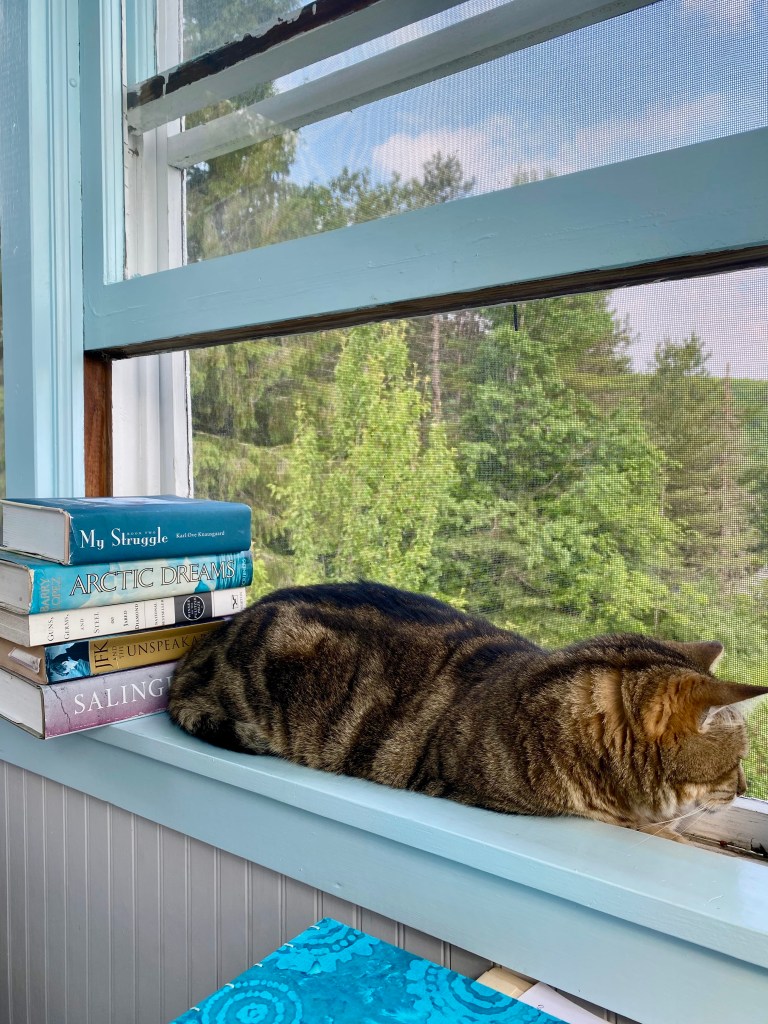
When I wake, my cat Acer lies purring against my foot, contentedly grooming a dainty paw, supremely confident of an imminent dinner and another toasty night before the beloved hearth.

Memorial Day weekend, when we always invite friends and neighbors for an outdoor dinner. Not so, this year. The pieces in my life, my family’s lives, shift, rearrange, mend. Slow healing, slow domesticity.

From Steinbeck: “You got a God. Don’t make no difference if you don’ know what he looks like.”

At the edge of damage…

A few days of radiant sunlight and steady breeze, a burnish on my cheeks: solid medicine. It’s spring.

In rapid succession now, the coltsfoot, the lungwort, Siberian squill, my mini daffodils bloom. Each day I remain out of the hospital feels like a victory, a day worth savoring. Afternoons, evenings, I lie in bed reading Dostoyevsky.

There’s this line from a Louise Glück poem I mull over as I walk around my budding forsythia, the Daphne I planted last summer that survived the winter. The line is: “Nothing can be forced to live.” In these lengthening days, I wonder if perhaps my attitude has been skewed for years, gritty-mouthed and wry, one foot behind me ready to flee, the other toes nestling into the garden. Mid-April, and green shoots and velvety petals thrust from the earth. The honeybees swarm. The groundhogs feast and dig. The children ride bikes.

We’re early enough in the season that I can yet pick out this patch of Chionodoxa, the lilac buds. My sandy Vermont hillside thrusts towards life. A poem my friend Jo sent my way, and I’ll send yours is below. Swan’s words about the crack in our world — how much these resonant with me. Now, in my days and nights after chemo, as I begin putting my life and soul back together, I remind myself (as my siblings remind me) to lean into my cracks, to embrace the holes and the whole of my life.

BOWL

BY HEATHER SWAN

for my mother

From the mud in her hands,
the bowl was born.
Opening like a flower
in an arch of petals,
then becoming a vessel
both empty and full.

Later, in the kiln
it was ravaged by fire,
its surface etched and vitrified,
searing the glaze into glass
as its body turned
to stone.

It is at the edge of damage
that beauty is honed.
And in Japan,
the potter tells me,
when a tea bowl
cracks in the fire,
that crack is filled
with gold.

An umbrella walks past…

File this week under “the best-laid plans of mice and men go oft astray,” or, just because I desire something has no factual bearing on reality. (Is there a message for national politics here?)

My sixth and infusion has been delayed, as I’m admitted, again, at Dartmouth-Hitchcock. Two days before that scheduled infusion, I woke around 11 at night and phoned my older daughter who was just getting into bed. I said, “You’ll have to take me back to Dartmouth again.”

In a thick fog, she drove my mother’s blue Subaru down the interstate along the wide river, with sparse traffic and scant words from me. In the ER, late, late, we’re taken into a room, and the usual questions and IV and meds began. The nurse remembered me from my previous visits. In a rocking glider, my daughter slept a bit while I wondered at the light’s hue: amber, or tinged with orange, like heating lamp mixed with a gentle reading light.

Eventually, awake for over 24 hours, my daughter heads home to sleep. My oncologist appears and reassures me. “You’re getting there. A few days later, but getting there.” Our conversation drifts into where I’m heading in this new phase of disease – recovery, oh say that word again, recovery. What will this mean for me, and how will my life change? We talk a little about trust, and he mentions that, once trust is broken, it’s nearly impossible to mend that damage, a fine thing ruined.

So here I am, in yet another bend of this journey, learning patience, learning something more along the tenor of faith, that whatever is not within my sphere of influence is not mine to alter, such as these days here.

April. My younger daughter brings me blooming hyacinths and bulbs in a glass vase. The doctors talk with me about Donna Tartt’s The Goldfinch, and if the federal funding for Vermont’s interlibrary loan system is jeopardized. I tug at the strings of normalcy coming my way: a nurse’s trip to Des Moines a few springs ago and the city’s tulip beds; a friend’s email about dropping a car at airport for her husband; another friend reads Mary Oliver and sends me recordings; will my cat sitter eat whatever I’ve left in the fridge? Small things that stitch our lives together.

Spring rain:

telling stories,

a straw coat and umbrella walk past

~ Yosa Buson