August Light.

A neighbor paints her house turquoise with salmon and forest-green accents. The colors are up for discussion on our short dead-end street; myself, I love this blue and speculate how cool it would be to transform our houses in a Vermont village version of San Francisco’s Painted Ladies.

Mid-August (already?!), rain has ceased. Our lawns are all cropped short and no one’s mowing. Late afternoon, watering the perennials I planted this summer, I eat sun gold tomatoes in the garden, the sandy loam warm beneath my feet. This summer, endeavoring to heal from lymphoma and surgery, I retreated into my garden, writing, walking. Pay attention, I cautioned myself. Take time to visit my neighbors and talk about shades of blue.

Survive cancer (and cancer treatment), and you discover the world has the same facts (the electric and property tax bills, the need for steady income, spilled oatmeal in an upper kitchen cabinet, a hole in the chimney that needs repointing; these chores jostle on my post-it lists) and the questions that muse through my mind in yoga practice and wick away (why?: an apple tree shedding leaves, a clandestine coffee klatch, my recurring expectation that I may see my dead mother around street corners….)

Vermont’s radiant summer rolls into balmy autumn. The rain may commence at any moment, or might hold off until snow and sleet. The winter will be whatever it will be. In my own realm, I soak up this end-of-summer stillness, water the new transplants, wake each morning, yet alive. A low bar, or, conversely, the highest I’ve set for myself yet.

Prayer

Whatever happens. Whatever
what is is is what
I want. Only that. But that. ~ Galway Kinnell

Survive, Thrive.

In search of a story about wool and weaving, about Colonial America and these sultry August days, I discover a trailhead for a nearby town forest. I return with my daughter. We drive on back dirt roads, the terrain unfamiliar to me. But the way the maples are nearly in the road, their leafy branches stretching over the road and touching, is the Vermont I first loved, so many years ago when I was 18.

We pass houses flanked by sunflowers and hydrangeas, gardens with six-foot high fences to keep deer from marauding the kale. Not so many decades ago, these were farm fields. In the forest, we follow a former road beside a stone wall. In New England, a forest moves in quickly, erasing the labor that once cleared this land.

August, the woods are quieting. In a break in the forest, we walk through a field of goldenrod, a strip of pink Joe Pye Weed at its edge. All summer, I’ve written sparsely in this space, intently picking up the stitches of my life: walking to mend lost muscle, relearning habits of sleeping and cooking and eating — such simple things I once did so easily. When an acquaintance’s dog leaped on me on a walking trail, I rushed deeper into the woods and wept. I’ve cried so little during this year of cancer, but there I was, ridiculously weeping beneath pines, so fearful of my own fragility, of breaking.

August, and I’d take a whole summer again, an impossibility. Instead, again, we’re in the edge between seasons, the days shortening, chilly at sunset and sunrise. My cats eye the unused wood stove and then eye me, wondering what my plans might be.

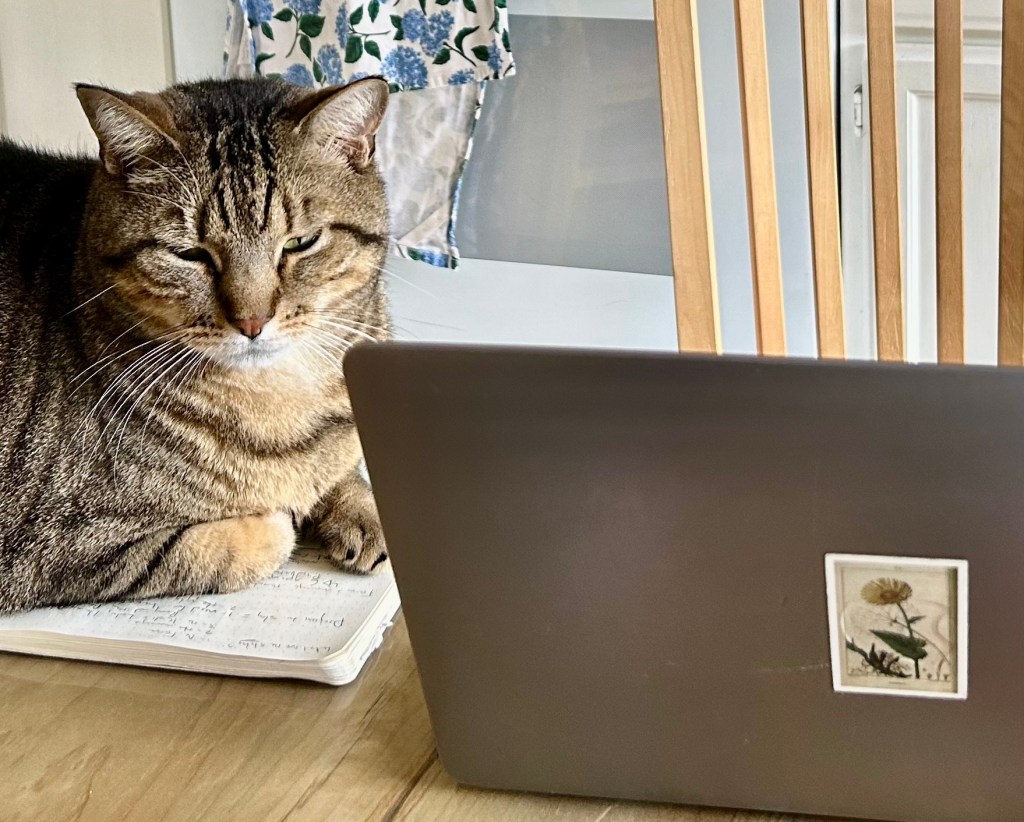
Survive, I think. I’m cooking fish and offer these plump tabbies a second course. Thrive, I add.

We must risk delight. We can do without pleasure,
but not delight. Not enjoyment. We must have
the stubbornness to accept our gladness in the ruthless
furnace of this world. ~ Jack Gilbert

Following the Bear.

Mid-August, the mornings are cool, the leaves of the pin cherry tree sparkling with dew. I find a bruise on my bicep; the cancer’s returned? But no. I remember I snagged my arm on the garden fence. Mid-August suddenly and the tomatoes are ripening. Last year, watching the full solar eclipse in our yard, the eclipse’s heart revealed this world’s ineffable beauty: such pure gold. Likewise, surviving cancer (thus far) revealed for me that knife of mortality within me, within all of us, hidden, ever-present.

Mid-August, mid-afternoon I’m drinking lemonade on a bakery porch and staring across the street at a house nearly obscured by sunflowers and globe thistle. I’m curious as heck about this Italianate with ornate corner boards. Who built this and who lives here now, and is the yard’s intent to cultivate wildness, or is no one at home?

My companion and I are talking about hard stuff, a third novel I’ve sent off to my publisher, the book I’m drafting now, about disease and suffering and how to wring meaning from misery. I’m compelled to write this book; writing this book looms impossibly. The afternoon’s quite hot, but by late afternoon the air will settle and cool. Nights, I walk after sunset, the crickets and tree frogs clamorous. I keep thinking about that house (empty or not?) and the thin line between wild and domestic. Here, this border has blurred. Will I cut the pin cherries to widen the canopy of the walnut tree I planted? The rose bushes seek a crack in my house’s foundation.

Wiser now, or maybe simply tired, I care less about the wild honeysuckle and raspberry canes that fortress around my house. I’m no Rapunzel, squirreled away in a tower, waiting for her Prince Charming. The hungry bear tunnels through the undergrowth, showing me a way.

Summer night—
even the stars
are whispering

~ Issa

Lucky.

August is exceptionally hot this year, the rivers so low they can be crossed by foot. In the woods, streams have dried to rock beds. In Montpelier, the state’s tiny capital, I walk by a store with bright bowls in the window and think, My mother would love this store. She passed over a year ago, and yet I still catch myself thinking that she might appear around a corner, her purse tucked under her arm, amused at me. Of course I’m not gone…

My father, the physicist, schooled his three kids early on about entropy. In a week where things repeatedly broke — the hot water heater leaking, the Jetta refusing to start in the rain — he made jokes that we were in a High Entropy Zone. So, this lovely August, with the chorusing crickets and the waning red moon — I’m determined to suck each day to its marrow. Sandwiched around work and the steadiness of washing dishes and so on, I’ve pushed aside space for swimming and ice cream, for lying under the apple tree and studying a spider spin her web. The entropy of living keeps on, as it does.

In the years when I was raising my own young daughters, our days zigzagged from bowls of blueberries to bath time. The days were endless, and the years rushed by. Now, my girls newly grown, I relish the silence and crave their company. Lucky I am, so lucky, to be alive this summer, this month, these days. All day long, I walk around with my tender heart cradled in my hands, wounded and raw from cancer, from weeks of hospitalization, from the knife of mortality pressed against my windpipe. August: the season of great loveliness, the intimation of winter. The reminder to love where and what we are.

Hitch Hiker at a Truck Stop

The hitch hiker asks to look at

the palms of my cold hands

and thanks me for unfolding them

on the frost-edged

picnic table between us.

While I look at his downcast eyes

trying to see if he sees,

nearby truckers stare

at his narrow face,

long blond hair.

He asks me if I garden,

rips a scrap of newspaper

and folds it up

into a tiny origami

package for anise seed.

Here, he says,

seed I gathered in Oregon,

plant it in Colorado.

I always have a garden, he adds,

I plant and leave to others.

He tells me he has no sex;

when you ride in the righthand seat,

you have to nod your head

without listening.

Face pressed to the window,

he can see the lacquered edges

of the earth.

So I imagine him 

practicing calligraphy

on truck windows,

recommending honey and vinegar

in a glass of water

every morning.

Mad, mad, mad.

A yellow warbler,

the moon at the bottom of the stream.

Out on the highway

he is raising his thumb again. ~ Mary Crow

“Like a definition of love…”

Eight summers ago when my daughters and I first moved into this house, we swam in a nearby pond, usually with friends who lived nearby. In those eight summers, the kids grew up and are now swimming in other lakes, other ponds. I kept on. The swimming and conversation was a peaceful way to end jammed and often chaotic working days.

Late last fall, as part of extensive testing after I was diagnosed with lymphoma, I realized I had Giardia, too, proverberial small potatoes compared to cancer and easily treated. This year, I never started swimming. In May, I’d endured a painful surgery with a lengthy incision that needed to heal. That nearby pond was the most likely source of the Giardia.

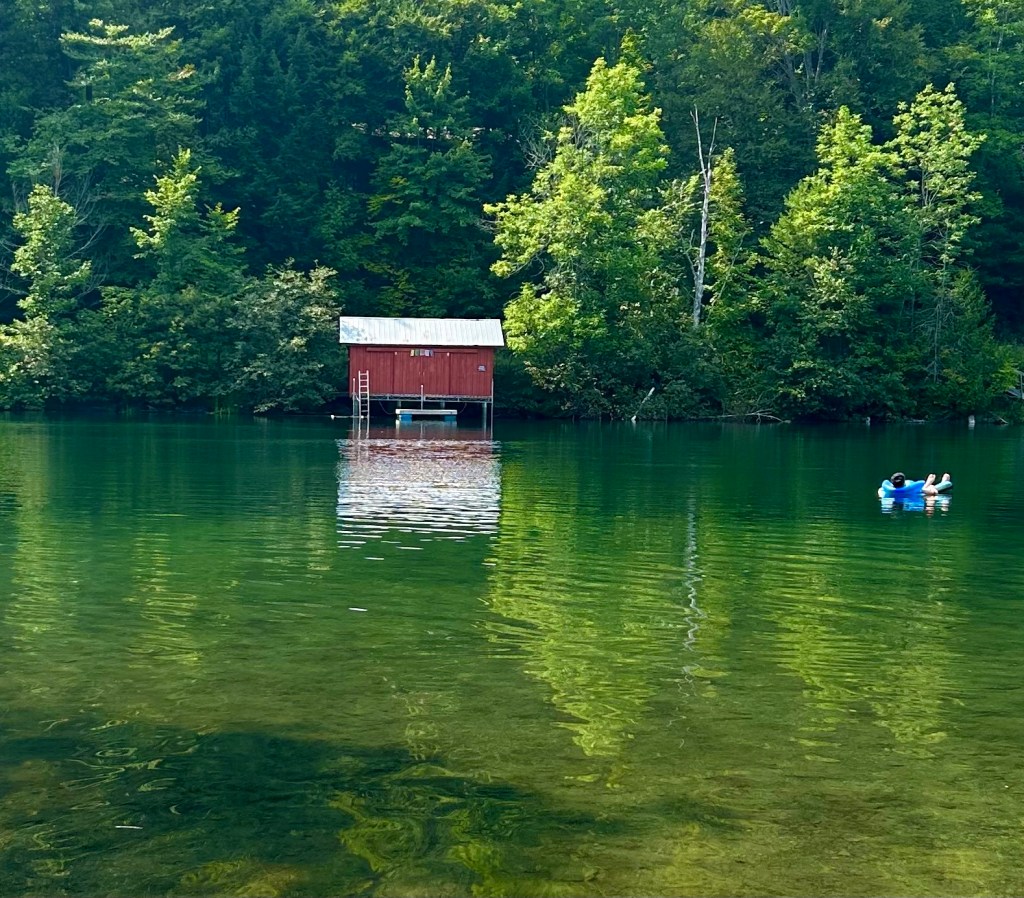
This August, a friend convinced me to swim at #10 Pond, familiar territory between our two houses, another place where my daughters and I swam and kayaked and picnicked. I arrived a few minutes early, opened my book, and the loons cued. This pond has always been one of my favorites: clear water, friendly fellow swimmers, scant motorized boats, little development. The water was cool. Kicking my legs, I felt my incision tug, but it was a sensation, nothing more. Afterwards, we lingered, drying and warming in the sun.

Yesterday, I was in sultry Barre and drove by the pharmacy where I had the go-around with the pharmacist and sharply insisted he fill my dilaudid prescription. I was on my way home from yet another lengthy stay at Dartmouth. We had to wait for the prescription, so my brother and I walked around Barre. It was early spring, hot, and the trees hadn’t yet leafed out. He’d parked on a hill and worried I couldn’t walk back up. I’d been on blood thinners, and the bandage around my IV site was soaked with blood. Don’t open it up! he warned me. It was so dusty and hot, and I was exuberant to be in the world where daffodils were blooming.

So yesterday, on my way home, I stopped at #10 Pond again, swam and read and listened to a nearby conversation between two men who were fishing — and the loons, of course, the loons.

We’ve now crested beyond the high summer. Each August day offers its own potential, for swimming or heartbreak or simply eating ripe peaches. Reader, wherever you are, love at least slices of your lives and places.

I’m about to send off a third novel manuscript to an interested party. In the dark this morning, I woke and began the book I’ll write about cancer and motherhood. Sure, cancer changed my life in small and great ways, but a year later it’s still the same me, rowing my life against the common current, compelled to write something that seems impossible.

And, for historical and record-keeping notes, I’ll add that the full moon, the Sturgeon Moon, rose smoky and red, ineffably beautiful over the cricket chorus.

“Green Apples” by Ruth Stone

In August we carried the old horsehair mattress
To the back porch
And slept with our children in a row.
The wind came up the mountain into the orchard
Telling me something:
Saying something urgent.
I was happy.
The green apples fell on the sloping roof
And rattled down.
The wind was shaking me all night long;
Shaking me in my sleep
Like a definition of love,
Saying, this is the moment,
Here, now.

Wildfire Smoke.

Are these days hot or chilly? All afternoon, working on my back porch, I put on and take off my sweatshirt, step into the sun to make phone calls, lean against the cool clapboards with my laptop. For days now, the air has been smoky with wildfires far away in the north. In the mornings, I wake coughing, wondering how people are breathing, so much nearer these fires.

August, and the raucous summer abruptly quiets. Walking in the woods with a friend, she notes a bird singing — wood or hermit thrush? — but all else is quiet save for our conversation. I’ve been here before, the pause between high summer and early autumn, when the swimming’s still good and the sunset lingers long after supper, but the mornings are filled with cool mist, and the shadows are not warm.

In past years, the faintest shadow of Long Winter has filled me with dread. Again, I will lose my tan, carry my laptop to the kitchen table, maybe go mad talking to my cats. Or not. Twice a day, I water the nasturtiums hanging in baskets on my back porch, listen to the neighbor boys biking. These days are yet long.

From Sunday poetry readings at the local arts center…

Wavering

What makes you think you’re so different? 
That was my weaker self hanging around outside the door. 
The voices over the telephone were accusing, too. 
“Must you always be you?” (They had the advantage, 
More bold without faces. They swirled a few ice cubes 
With a suggestive pause.) For a moment 
I took my heart out and held it in my hands. 
Then I put it back. This is how it is in a competitive world. 
But, I will not eat my own heart. I will not.

~ Ruth Stone