Trainwreck.

On the year anniversary of beginning chemotherapy, childishly I crab at my siblings. It’s a small thing—a bad internet connection, a request to make a phone call that might have taken 10 minutes—and I’m angry as all get-out, fury galloping in my blood. The common lingo is that chemo equals nausea, like a bad flu. That is not true, or was not true for me. Enduring chemo was like lying between two burning rails while a train sped over me. I held myself still as could be to survive that months-and-months-long train (how could something be so large?) rattling over me. Sure, there’s a few moments where the train slows, and you think maybe I’ll survive this, but steaming metal rushes right over your face, your mortality far closer than spitting distance. While the rest of the world is immersed in meetings or drinking wine in Spain or skiing, there you cringe, the pain so intense in your bone marrow that morphine means nothing.

In the first round, I had a common and horrific reaction to one of the drugs, rituximab, which stole my breath and shook my bones so hard the bed rattled. The room filled with people in scrubs. I did not know one person’s name. They kept talking to me, and I could not understand a single word. I was under that train, remember, the wheels hammering on tracks.

I never considered myself a warrior battling cancer. But my body was a war zone between two matched enemies: would the chemo quell the lymphoma, or would all of us go down together? A year later, in remission, I’m suffused with gratitude for my life, for so many people who got the train off me. And yet, a year later, there are days I’m still turning the pieces of my life over and over, wondering WTF? Like anyone, jab a shovel into the soil of my life, and the layers appear infinite. Twenty-two years ago, I left my crying four-year-old (“I want to come!”) behind and drove to the airport with my brother in my sister’s time of need. I had left in such a rush that I’d forgotten my driver’s license. It was not long after 9/11, and I had to cry to get on the plane without ID, but I finangled it. Coming home, we hit a snowstorm. My friend and her four-year-old drove over the White Mountains in a white-out to bring me home. At the crest of Franconia Notch, she pulled over. I got out to clean snow from the windshield and lights. No one else was on the road. Snow billowed through a freezing wind. I looked through the window at her son in his carseat between us. I had bought him a little toy, a hexagon of blue fluid with a yellow fish, and he was turning it around and around in his hand, so the fish would swim. It seemed like we were the last three souls on the planet. Such a long and treacherous way home to my little daughter and her twiggy braids. But my friend drove carefully in her red pickup. That story shook out into all’s-well, something that needs no bow-tie of a moral. Simply, all were saved. Our lives went on.

So many pieces of a life. On this Thanksgiving morning, how grateful I am to remain yet here, disease-and-treatment battered, broken by fate and my own rough actions. The terrain of the living.

… And last, I’m honored to have been nominated for a Pushcart Prize (a secret dream of mine) by Under the Sun for my essay “Weeds.”

The Survivable.

It’s dark as the inside of my fist at five o’clock. I’m driving into spitting snow, my brand-new studded snow tires grinding. My companion and I are talking about all kinds of things — how language shapes our worldview and the personalities of tuxedo cats and dentists. I’m driving more by faith than anything else, not particularly fast, headlight beams filled with snow. As if cued, a deer waits in the forested roadside. I slow, then stop, people and deer staring at each other. Then the deer vanishes into the woods.

On this backroad, I’ve passed no other vehicle save a UPS truck, so I wait for a moment for the deer to return, for a companion to leap across the road.

My passenger says, apropros of some conversational thread, that I’ve shed bad karma in my months of cancer treatment, of struggling to survive. My devotion has always been my pencil or keyboard, not the meditation cushion. And yet…

I roll my car forward through the swirling snow. I’ve long adhered to that ancient Aristotelian notion that action defines character. When I realized I had cancer, a year ago, I was rapidly veering towards sepsis. I could not indulge any opinion. To survive, I had to strip away illusion. What were the facts? What was the wisest way forward? None of this was simple.

Cancer narrowed my world. Through weakness and the possibility of a fatal infection, I was confined to my few downstairs rooms, to Emergency Rooms, and hospital rooms. But unexpectedly, cancer widened my life, too, gave me the gift of friendships forged in rough experiences, reinforced for me that this world is propelled by cause-and-effect, that actions have consequences, and that I often grasp only the slenderest knowledge.

New England November drives us into the season of early darkness, blackness so profound our eyes struggle to navigate. When I left Dartmouth-Hitchcock after that last long stay, I felt old, aged in bone and flesh, and concurrently, miraculously restored to my twenties, those years when my lust for living and creating was ravenous and I did not yet comprehend the immutability of time. At the end of this evening drive, I stand for a few moments in this velvety and freezing darkness, snow hissing on the hot car hood, a slender strand of white lights twinkling in my kitchen window. I clench my mittens in my cold hands. Around me, beguiling night.

“When you survive something that was thought to be unsurvivable, the obvious is gained. You have your life—you have time. But it’s only when you get there that you realize your survival has come at a cost.”
― Suleika Jaouad

And last… my story “Tiny Towns” appears in the new collection: 2050: Vermonters Take a Swipe at the Future. Reading tonight in St. Johnsbury….

The Illusion of the Ordinary.

A year ago, I entered the local ER with acute pain. I’d been there before with my kids for stitches and an allergic reaction, things that could be patched up and remedied. A year ago, an MD told me that a scan revealed metastatic cancer. It was the eve of a contentious election, the nation cracking apart. In my life, however, I suddenly had no time for beliefs or opinions. To survive, I had to lean on facts.

For years, I’d been running not so much as a lone wolf but a mangy coyote, hustling my single mama gig, utterly determined to nourish and protect. But there was no way I was going to weasel through this cancer alone. Almost immediately, I was forced to size up strangers — a surgeon, an oncologist, nurses — and do what I had never done before. I had to trust these strangers with my life. Divorce had school me to be wary; now, disease was forcing me to revise my life, rapidly, on the (incredibly painful) go.

A year later, I’m alive. Some was my stubbornness, the trait that enraged my mother — and yet she herself had taught me stubbornness. Back me into a corner, and, damn, will I fight. But that’s a scrap. The more profound reason I’m alive is that I had access to first world health care. I benefited from medicines and decades of trial-and-error, thanks to researchers and so many suffering patients before me. I had access to that small rural hospital who took me in, over and over, this winter, and to Dartmouth-Hitchcock, such a remarkable cancer center surrounded by New Hampshire woods. We drove down the interstate in multiple snowstorms, and always I was gladdened to see the crimson EMERGENGY sign that never turned off. Entering, I knew I would be treated with compassion, with unflagging skill.

I could not have been treated at Dartmouth without my daughters’ immediate willingness to relinquish nearly a year of their young lives to ferry me through the sheer wretchedness of chemo and the brutal complications, and to keep enduring when I finally broke. They had the patience to stay with me while I put myself together.

I was determined to endure all the chemo to gain the best chance of a cure — and I did, running and then limping and eventually crawling — but I received so much kindness from family, from friends old and new, from many of you here, and from strangers. People brought soup and pot roast, drove me to appointments and blood draws, took me outside on walks, carried in firewood and brewed tea, and insisted that I did not look so terrible at all when I couldn’t even sit up. My post office box filled with lovely cards that I taped on the wall over my bed. A friend texted me photographs nearly every day of the beautiful Vermont winter that I was missing; another dear friend texted me a poem she read every night. Boxes of books and cookies and stollen — such treasures. The end of the chemo was followed by a painful surgery. By then, I had no income, and a check from a friend carried me into the summer and recovery. All these well wishes — all this meant so much to me. Gratitude beyond gratitude.

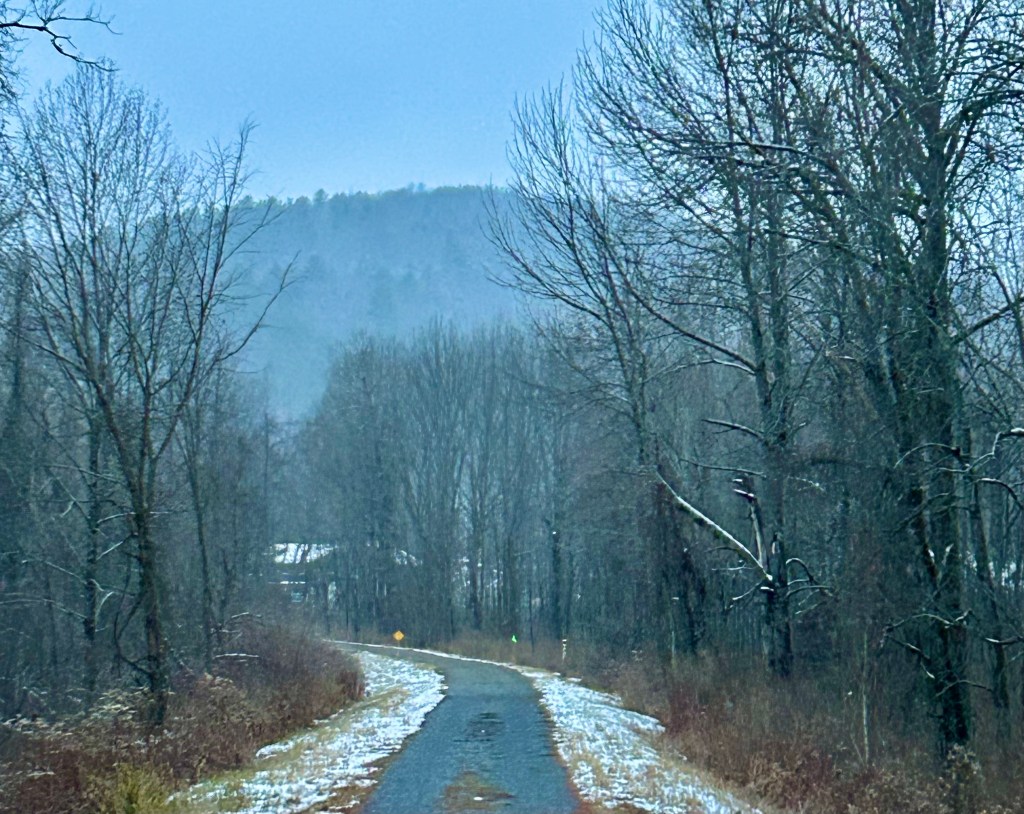
On the day before this year anniversary, I walked down a dirt road as the darkness fell down. In the gloaming, I could see across the valley a tiny white square I knew was my house where my cats were hungry for dinner. The neighbors’ house glowed orange and yellow with their Halloween lights. An utterly ordinary November day.

What remains with me is a body weakened and damaged, but alive, and the steely secret that the ordinary is luminescent with the extraordinary. Here I was — this small woman stripped down to a t-shirt in a billowy warm November afternoon walking along an empty road. Overhead, a line of cacophonous geese arrowed through the sky. The road dipped down in a wet area, and the mud stunk of rank water and rotting leaves. Ahead of me, mist hovered. What luck! I thought. I strode into the mist. In the spring, Daphne plants grow in these roadside woods where someone too broke or too lazy keeps dumping household trash. By the time I was back at my car, I was in the solid dark, the stars and moon swallowed by clouds. Oh, this messy, unclear, uncertain, marvelous world. What luck.

Something Else.

About a year ago, a friend and I hung out laughing in her car beside Lake Champlain. Early November, by 6 p.m. it was dark as a buttoned-up pocket. The lake lapped against the shore. We joked about the pan I held of the worst cornbread I’d ever baked and the potluck we skipped, the polite and surely erudite chat we’d missed. Ah, whatever…. Twenty plus years ago, we were young mothers, driving around in my old car or her old car, our toddlers in carseats. The kids sometimes bickered if nap time neared, sometimes spun tales about Mopsy bunny driving a dump trunk or wondered aloud if maybe the mothers would relent for creemees.

My friend’s kids and my kids — they’re all grownup now. Are their stories more fun now than the cups of sand and lake water they used to serve us on the beach? Those countless gritty root beer floats.

So a year ago… a kind of throwback, this time without the kids. She ran a stop sign. I insisted we walk out to the ferry launch, and the bitter wind was dreadful. We stopped and bought Thai noodles and kale, and my friend ate like a normal person, while I stared at her and wondered what on earth was wrong with me. I was convinced I had mold poisoning from a work exposure, and we kept laughing and laughing. Then she said, “What if it’s Lyme disease? What if it’s something else?”

It was something else, of course. A few days later, I was hospitalized, turning dreadfully towards septic. That winter, as I endured chemo, as things went from really bad to worse, I sometimes thought back to those hours of silliness, how rapidly my life altered. As a young mother in those years, I did not yet know this. I did not yet comprehend that the world does not go on and on and on.

Knowing this now, in my soul and body, does it make the laughter sweeter?

Yes, indeed.

But just when the worst bears down
you find a pretty bubble in your soup at noon,
and outside at work a bird says, “Hi!”
Slowly the sun creeps along the floor;
it is coming your way. It touches your shoe. ~ William Stafford

Crazy-Making.

Yesterday, my oldest and I made that drive again down I-91 that flanks that Connecticut River. My knitting in my lap, I counted exits, St. Johnsbury first exit, then the second, the third that heads east to New Hampshire’s White Mountains, the fourth Barnet, which I took when I stayed at Karmê Chöling. We talked about fall colors and a meatball recipe and family, of course, all the way down to exit 13, the Norwich and Hanover exit, where we stopped for coffee and scones, as if a good luck charm. Coffee and sweets, not a dash to ER. We watched the time, careful not to be late for what I hoped would be a mere routine check-in.

All summer this day has hovered in my mind — what will this day reveal? — but this past week this coming journey was as near to me as something I held in my hand as I went about my days, doing what needs to be done. The day before, talking with friends, the fear of this day erupts and I hear myself on the verge of screeching, nearly crying. All summer, I’ve relished my good life, learning to walk again and eat again, to read on my back porch in that hand-me-down butterfly chair. To marvel that I am not in pain. That I might sleep and reasonably expect I might wake in the morning exactly as I want, in the pre-dawn darkness drink milky coffee and write. That I will witness the unexpected autumn buds on a yellow rose bush open, these final velvety blossoms of the season.

At Dartmouth, we wait again in 3K, in the cancer center. I am no longer one of the pallid-gray-faced chemo patients, hobbling, enduring. How desperately I never want to return here. My oncologist gently reminds me that he’d assured me I’d pull through this winter, even as I was admitted again and again and again, a dozen times. Add to that, more ER visits.

Later, a friend asks about the scan’s sign-off, but the only rules that matter are what the hidden mysteries of my blood and flesh reveal. The markers are that the lymphoma has not returned. I know that the reaper’s scythe heads towards me as that inarguable blade poises over each of us. But not this day for me. Not yet.

Driving home, people crowd the interstate bridges with RESIST signs. As our car sails beneath the metal and steel, we wave. I’d told the oncologist that my wellness plan was four-fold: eat real food, walk, do my work, and try not to go crazy.

He said, This is crazy-making. Just do your best.

There is only one heart in my body, have mercy
on me…

Thank You for letting me live for a little as one of the
sane; thank You for letting me know what this is
like. Thank You for letting me look at your frightening
blue sky without fear, and your terrible world without
terror, and your loveless psychotic and hopelessly
lost
with this love

~ Franz Wright

Small Kindnesses.

Writing a novel, you pay attention to action. What are the characters doing? And why? At the midpoint, the action often switches; the protagonist ceases to react and, instead, acts — and not without mishap, without complications.

I’ve long thought of labor as a metaphor. The mother’s cervix dilates (helped, sure, by walking, by receptivity), followed by the uncertainty of transition just before the mother engages in the pushing phase, the brief or lengthy or sometimes stigmied phase of bringing this child into the world.

I’m in the transition phase again in my life, beneficiary of cancer treatments and so much medical care. Mornings this winter when I woke, I began each day with a survival mindset; I would endure my body’s illness. Now, June, the birds wake me, the feathered creatures intend on nest-building, procreation, survival, maybe the joy of communal singing. In the garden, the tithonia abruptly deepen their green, expand their leaves. The hydrangeas sprawl into a fortress.

At my desk, I lean into my day’s work, hours and hours unspooling.

Late afternoon, my friend arrives with her little girl, and the three of us walk in the cool town forest. The child removes her shoes and runs over the pine-needle-spread paths. She buries her bare feet in the shallow stream’s mucky mud. Yes, June…

Mostly, we don’t want to harm each other.

We want to be handed our cup of coffee hot,

and to say thank you to the person handing it… 

We have so little of each other, now. So far 

from tribe and fire. Only these brief moments of exchange.

What if they are the true dwelling of the holy, these

fleeting temples we make together when we say, “Here,

have my seat,” “Go ahead — you first,” “I like your hat.”

~ from “Small Kindnesses” by Danusha Laméris