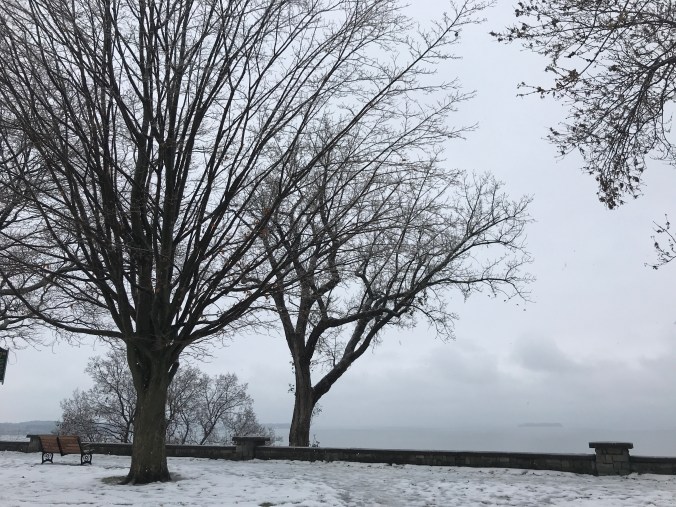
On this rainy November early morning, here’s a lovely poem from Bashō.
Wrapping the rice cakes
with one hand
she fingers back her hair

On this rainy November early morning, here’s a lovely poem from Bashō.
Wrapping the rice cakes
with one hand
she fingers back her hair

The day’s few hours of sunlight seemed distinctly February-ish — gold wild apples are still frozen to the tree.
November narrows down to the holidays, to that time of Vermont dark. The daughters decide to bake corn muffins — perhaps because of the color.
On impulse, I buy a small jar of raw honey at the co-op. 4:30 now, and the light is that pale pink and blue that reminds me of the sea. We’re warm, we’re well, our house is well-lit with little lights. I’ve stocked up on library books. The daughters are busy with their own stories and studies. I remind myself, It has not always been this way.
Time to close the curtains and start dough for empanadas.
If it’s darkness we’re having, let it be extravagant.
— Jane Kenyon

The full moon gleams in the sky this morning as I head out to start my daughter’s car this pre-dawn morning.
Winter, my familiar friend.
Yesterday, chatting with my neighbor while we’re back to our traditional winter activity — snow shoveling — he said laughingly, Well, what are we going to do? Be mad about it?
Winter, dear friend, I now know you very, very well, in your elegant beauty. This year, I’m going to love you wholly — for at least two weeks.
Here’s a few Rebecca Solnit lines for this impeachment hearing week.
Every woman knows what I’m talking about. It’s the presumption that makes it hard, at times, for any woman in any field; that keeps women from speaking up and from being heard when they dare; that crushes young women into silence by indicating, the way harassment on the street does, that this is not their world.

This is the gray time in New England, when even the daylight is dull. Gone are the spring days of blue squill, the early morning birdsong.
After dinner, we walk in the dark.
My daughter and I read for hours. Later, she disappears for a run, while I proceed with my persistent thread of work. In all this, Marlboro College, where I was an undergraduate, appears (truly, this time) on the precipice of closing. All weekend, I follow the alumni FB thread — grief, anger, plotting — while I keep thinking of Marlboro and how much this tiny college gave me. I’m not alone in that, I see, listening to alumni after alumni.
November. Our house is warm. I open the curtains and let in the daylight. At 4 p.m., the noisy cat comes and yowls over my book, demanding his dinner. My daughter puts on her ski boots and walks around the house, listening to snow in the forecast. November: life churns on.
The rain had been falling with a pounding meanness, without ceasing for two days, and then the water rose all at once in the middle of the night, a brutal rush so fast Asher thought at first a dam might have broken somewhere upstream. The ground had simply become so saturated it could not hold any more water.
(The opening lines of Southernmost, by Silas House)

Leaves drift through the air wherever I go these days, in autumn’s near-constant breeze, whooshing out of sight.
At a high school soccer game beneath lights, bundled in boots and hats, we watch the boys cheer for the girls. In the second half, the boys brush off an impending fight with a rival team. For just a moment, we wonder, Which way will this go? Overhead, Vs of geese call loudly, heading out of here, south. The scent of frying hamburgers tantalizes.
The high school’s the most run-down I’ve seen in Vermont, the field patchy, dwarfed by an enormous research facility for adult work, gleaming in the setting sun. Somehow, we have the sense the adults’ cafeteria serves up finer fare than subsidized school lunch. My daughter’s high school is one of the state’s scrappier — no secret there — but much more moves beneath the sailing soccer balls.
All the long drive home, the river swallowed up in the dark, we talk and talk and talk, passing the time and the miles, our two headlights illuminating the first traces of snow.
Home through the woods, through the chill rain. The last leaves down and sodden on the ground. The end of autumn...
—David Budbill

Enter a caption
My running route leads me into the woods behind the town’s community gardens, through a path flanked by frost-nipped goldenrod. A hundred years ago, the town’s granite industry spread over that field. Just before I cross a wooden bridge into the forest, I always pause at a historic sign marking where an industrial building once stood.
Really? I think. Only dog walkers and I, an occasional kid fishing, wander along there now.
My route follows the former railroad bed, its tracks ripped up for scrap metal in WWII. Yesterday, just over the bridge, I see the rain and erosion have revealed a chunk of granite, about the size of a library book, the number 12 marked on it.
Whose hands printed that? And with what indelible ink? I tried to pry the rock up and carry it away. The rock was determined to remain — for a while longer, at least.
An empty day without events.
And that is why
it grew immense
as space. And suddenly
happiness of being
entered me.