Is that church door open?

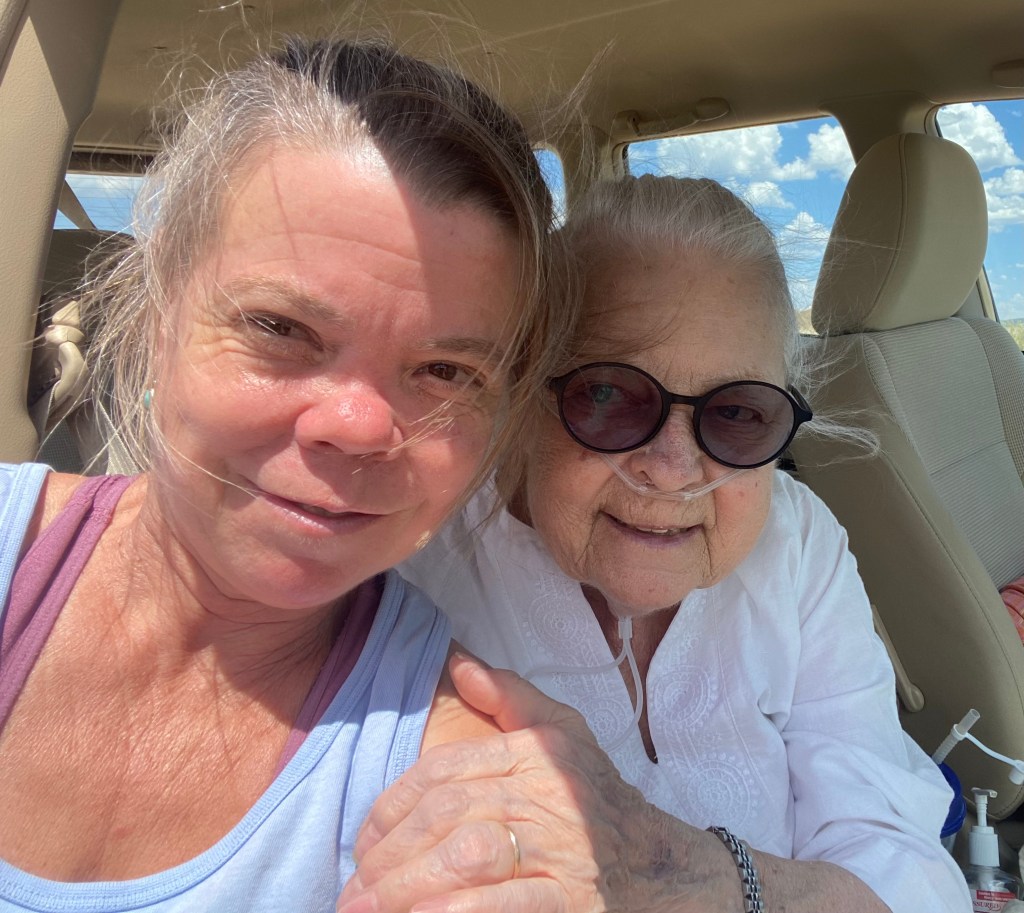
About a year before my mother died, I visited my parents in northern New Mexico. My mother was on 24/7 oxygen then, which she understandably chaffed against, and I took her on long drives so she could leave the house. One afternoon, I drove the rural roads to the Lamy train station. Take the Amtrak to Santa Fe, which I’ve done, and you don’t disembark in the quaint plaza town. 20 miles outside the adobe city, there’s the small Lamy station and an old saloon named the Legal Tender, and not much else. I parked at an old church that appeared to be abandoned and told my mother I’d be right back. I called over my shoulder that I wanted to see if the door was open, as church doors often are. When I looked back, my mother had her car door open, one foot on the earth, determined to follow me. She said cheerily, “I’ll come, too.” She was attached to a heavy oxygen tank on tiny wheels. The terrain was rocky, and there was no way I could navigate my mother to that door.

Somehow, I talked her into staying in the car. That was my mother, usually up for an adventure, willing to rattle a locked door, peer through a window, maniacally curious. It’s me, too.

In these brown-grass April days, as I begin to walk again, further and further each day, I think of my mother, how she would search for daffodil buds and admire the blooming snowdrops. Robert Frost is famous for his line, “In three words I can sum up everything I’ve learned about life: it goes on.” Bitter, perhaps, or maybe not so. Having faced my own (blessedly at this moment passed over) demise this winter, I’m beyond happy to immerse myself in the stream of life going on…. This life.

I woke this morning with a dream that I’d never had cancer. In the dream, I’d overslept and was late to work…. I was sweating, nightmarish. The dream haunted me all morning, trailing me, while my dear friend visited and brought me birthday presents that reminded me of my mother, and then fetched my library books so I could lie on the couch these afternoons and recover from this last cancer dose. When she’d left, I slept again. When I woke, the dream had broken and lay on the floor like broken glass: rubbish.

Such a labyrinthine world – mothers and daughters and granddaughters – disease, too. In these still days, waiting for spring’s rushing green, I embrace what I know, and that I never will.

… we are all

the dead, I am not apart from you,

for long, except for breath, except for 

everything.

~ Sharon Olds

Picking at the salty remains of roast beef…

Shortly before the November election, I’d heard word of a friend’s illness, and I determined to fly West and see this couple. At that time, I thought I was poisoned by mold and struggling myself, but I really wanted to visit. I decided to hold off buying the ticket for a few days until just after the election, because, well, what if? What if the grid crashed or something? I’ve lost money on airline tickets before.

What happened, instead, is I ended up in the ER the night before the election and discovered the mold was a red herring. I had cancer — although I hold, yet, that the mold was an element of a complicated equation that may, or may not, have added to turning on that cancer gene. By then, flying was impossible for me. Now, news comes to me of her final passage from this life. My friend has lived a long, loving — a good, very good — life, and yet…

All afternoon, another friend and I text back and forth. Remember the nights we ate in their dining room where the walls were painted light blue above a cream headboard? On the wall thermometer, we watched the January temps dip to 20, 21, 25 below zero, laughing at what would be a cold drive home. We never wanted to leave early. Instead, we kept drinking wine, eating chocolate cake, picking at the salty remains of roast beef.

Sorrowful, indeed. We are all now far enough along in life to know that no one dodges the Reaper, that the cut of illness or injury might fall swiftly at any moment. That, in the end, we leave as we entered. While my daughter drove me home the other twilight, I watched the stars ignite in the burnished blue along the horizon, one by one, these ancient untouchable illuminations. She followed the highway home; my eyes fastened on those seed pearls, the slender thread that thickened just the merest width as the night flushed in.

Here’s a line from Niall Williams that, by stroke of coincidence, I read today.

“… you could stop at, not all, but most of the moments of your life, stop for one heartbeat and, no matter what the state of your head or heart, say This is happiness, because of the simple truth that you were alive to say it.”

October: where are we going?

This weekend cleaves the summer, the marker where the light changes.

As the leaves drop, the light sharpens and thins. I’ve been here before, so many times, knowing full well how the sun will continue to dwindle. October is a season of brilliant contrasts: emerald hayfields, swaddles of mist, orange remnants of zinnias.

The season mirrors the human realm, too, such a lusciously lovely summer this has been. Now I yank out spent tomato vines, stow away my garden rake and hoe. I gather a handful of kindling, an armful of wood. So much winter, so far to go.

In the co-op’s baking aisle, I run into an old friend, and we chat while her daughter shops. I’m certain we mark different sides of the ballot, but our friendship is hard-tested, solid. Our conversation swirls. Through the window, yellow leaves scatter and leap in a breeze. I lean towards her, listening to a thread of her story.

Change of season is never the same. My youngest daughter tumbles towards womanhood, our lives shift, stretch. Within, always the constants, the long threads of conversation, the joy of the natural world, my ever-present marvel at the world’s flux: where are we going? why? Is it true that other people live these steady, predictable lives? Who knows?

Overhead, those geese, honking their way out of here. And us, here, for now at least.


Each fall in New Hampshire, on the farmwhere my mother grew up, a girl in the country, my grandfather and grandmother finished the autumn work, taking the last vegetables in from the cold fields, canning, storing roots and apples in the cellar under the kitchen. Then my grandfather raked leaves against the house as the final chore of autumn.

— Donald Hall, String Too Short to be Saved

Crash, smash, end of summer….

Sure, it’s hot again, but it’s a day without swimming. I’m in the nether in-between place where the youngest is headed back to college, and my life inevitably tips towards the not-so-fun adult things I’ve kicked down the proverbial road. Borrow a spark plug wrench and fix the lawn mower, walk down the hill and ask the young carpenter what to do about that stucco that crumbled from the house foundation, just behind the rose bushes that we sliced away last weekend, tearing away the moss to keep the moisture, moisture from my house.

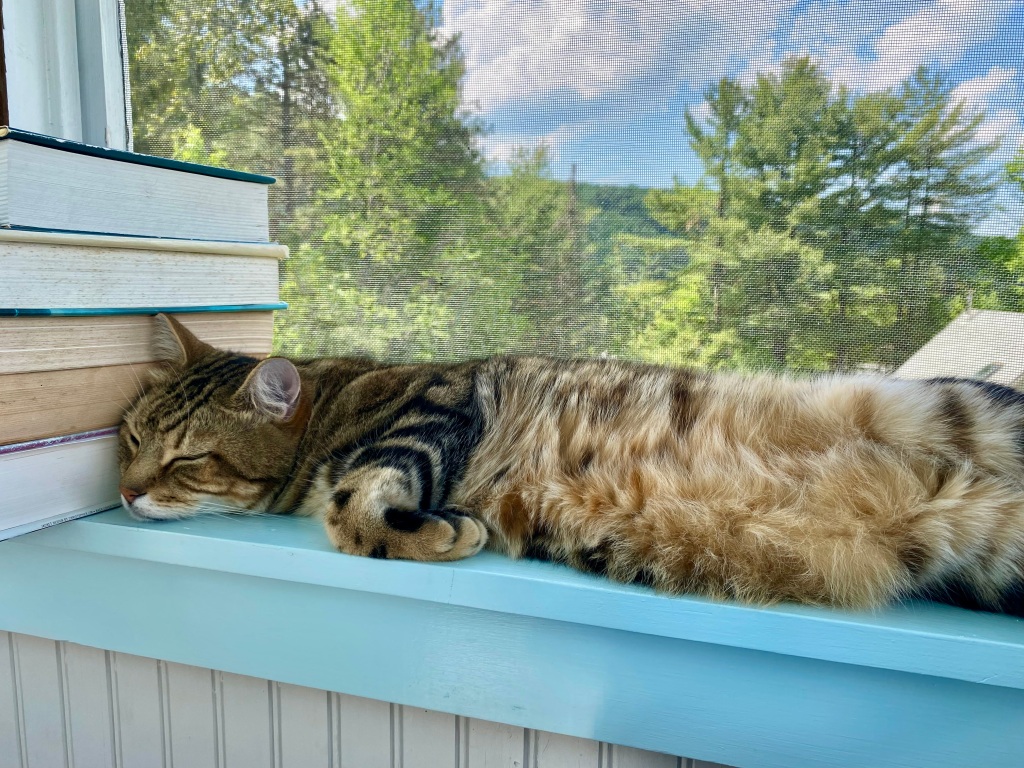
We are inside and outside all day long, hanging up laundry and sweeping the porch, loading a car… The cats are confused. The kitchen floor is sandy. I think of this day and the next and the few following until I might meet my friend for dinner, exchange our mothering stories, ask what’s happening? what now? what next? This year, I have officially crossed over into the population of the dead mothers club. In a strange kind of way, I find this like membership in the new parents club: once you’re a parent, you’re in, a lifer, whichever way you’re going to take that ride. As for me — and maybe it’s really my suspicion I’ve been poisoned by mold at work — but I turned with an anathema against cattiness and pretense, as if my own death perches on my back just like my daughter now heading back to college classes who hung on my back not that many years ago, her miniature fingers curious against my ears, reaching for wild blackberries. Evenings, the August she was one, I walked her sleep every night as the twilight sank and then laid her, sodden with dreams, on our bed.

So it goes, this rich wild life.

On a whim, I buy a copy of Pearl by Siân Hughes in Montpelier. Oh, novel of my heart:

Had I stopped to think for a minute that the fracture in my family, the rift opened in my own heart, would be passed down to the next generation, through my own damage if nothing else? No, I hadn’t. It never crossed my mind….

Garden, fence, lilacs, vultures.

Last spring, a late frost ate the lilacs, death-knelled a young apple tree. Not so, this year. All morning, I work on the back porch, the pollen sifting over my keyboard and laptop screen, the scent of lilacs surrounding our house. May is the brand-new season of pea shoots and asparagus, of peony buds and bleeding hearts.

In the late afternoon, my daughter finds me in garden and salvages the fence from bedstraw and witchgrass. Our garden abuts a town cemetery, fenced by metal and lilacs. On this holiday weekend, the cemetery is busy. As we work, talking, we spy folks wandering through, some tending graves, others gathering handfuls of lilacs or wandering about some other business.

I’m at the early summer gardening place of great good cheer: so much is possible this year. My daughter — a grownup now, but a young grownup — works easily and happily. We’ll share dinner soon, feed our two tabbies, and my daughter will disappear with friends and her swimming suit. I’ll walk into the cemetery and, lured by the scent of lilacs, keep on for a bit. The turkey vultures, maybe a few dozen, will circle low over my head. Then eventually I’ll head down to the village, and the birds and I will part ways.

In these early summer days, I think about my mother all the time. I live in a house that she visited only once. I live a life she did not understand at all. And yet, as I scissor bouquets of lilacs to bring to a friend, as I stand barefoot in my garden deciding to sow sunflowers here, plant basil there, I know these are things my mother loved keenly: the lushness of blossoms, the vim to create a garden.

The Bardo.

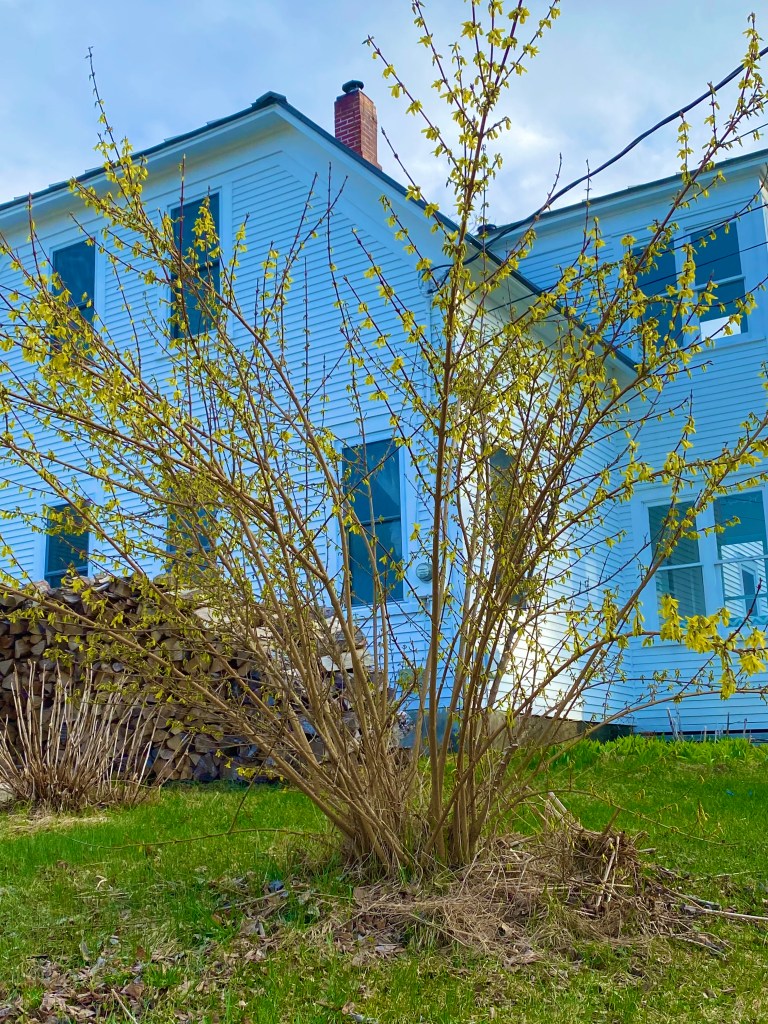
A few years ago, I bought a stick of a forsythia plant. The plant had withered in a nursery which hadn’t cared much for this plant, one of the three or four remaining perennials at the season’s end. For years, I had wanted to plant a forsythia with its cheery early-spring blooms, but I stood there and considered. The plant was about ten dollars. I eventually opened my wallet and took the admittedly meager risk.

The plant thrived. A few years later, I sold that house, dug up the forsythia, and carried the pot in the back of a friend’s pickup to my new house. The plant grew but never thrived, more stick and leaf than bloom.

This year, however, seven years into our life here, the blooms are abundant. I am not a Buddhist, not trained or schooled in any formal education at all, but here’s a thing. For a period of time after each of my daughters was born, I lived in a rarefied space, not of the common everyday world, but exposed and tender, as if the sky had opened up. I had labored to carry a six-pound baby into this mortal world. I had a foot in this world, and a foot still lingering in a gauzy undefined realm. But each day of nursing and crying, of meals of roast chicken and buttered toast, bricked up that entrance, planted me securely in this world again.

So, on the other end of mortality, I see my mother lingering yet with us, in profound and complicated manifestations, in the four of us — her husband and three children — and her four grandchildren as she drifts into her new realm.

In the house where I grew up, my mother and her neighbor bickered over ownership of an enormous forsythia that straddled their property line. As I walk around, planting and watering a lilac tree, stacking firewood, raking, I’m tugged to these delicate gold petals, so brief, such a long struggle, so miraculously splendid.

Darkness overtakes us on our way 

in my lodging the roof leaks 

weeping cherries in flower 

— Buson