“The real, long history of this place…”

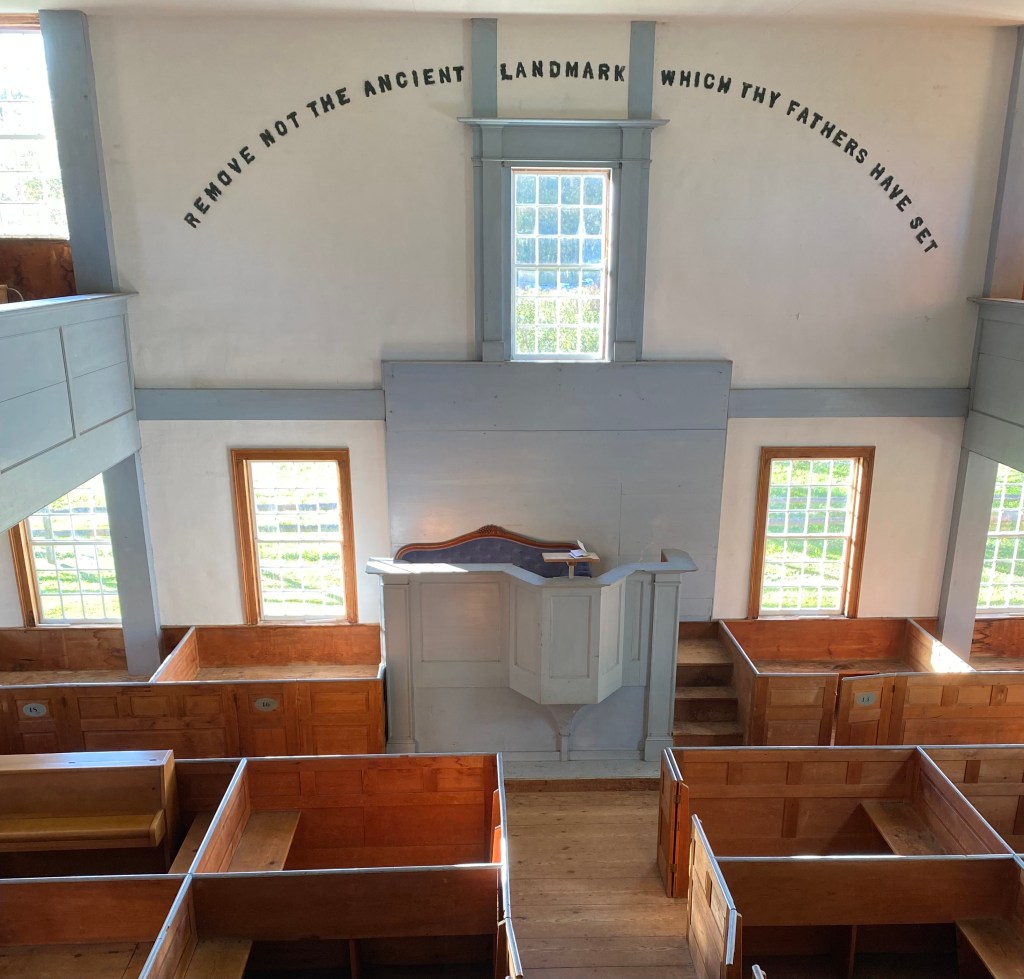
Old West Church, Calais, Vermont, 1823…. The fieldstone foundation was laid 200 years ago. I’ve been tossed a lucky bone, and I’m reading here this afternoon. Recently, I swung by with a friend to check out the acoustics and ended up sitting and watching the sunlight shift through the space. The structure remains in the 19th century with no electricity.

In an interesting way, it seems fitting to do these things in the autumn when the light in our northern realm is shifting so rapidly. On each side, the days shorten. What began in April as a sprinkling on the forest floor of hepatica and trillium and spring beauties has flourished all summer in such a lush and lovely summer. Strangers remark, “What a summer of growth!” as if to make up for these past few years of soddenness, of rain and wildfire smoke from faraway (but apparently not that faraway) places.

At the transfer station, I pull up with my hatchback crammed with that metal lidded can of cat food cans, my bins of used paper and things I no longer want in my house. I’ve been coming here for decades now. On this peach of a September afternoon, the owner and I stand outside his office, our faces up to the sunlight and a circling hawk. I mention that I’d take a month more of these days, but I don’t want to be greedy. He looks at me and says, Let’s just be greedy and want that, anyway.

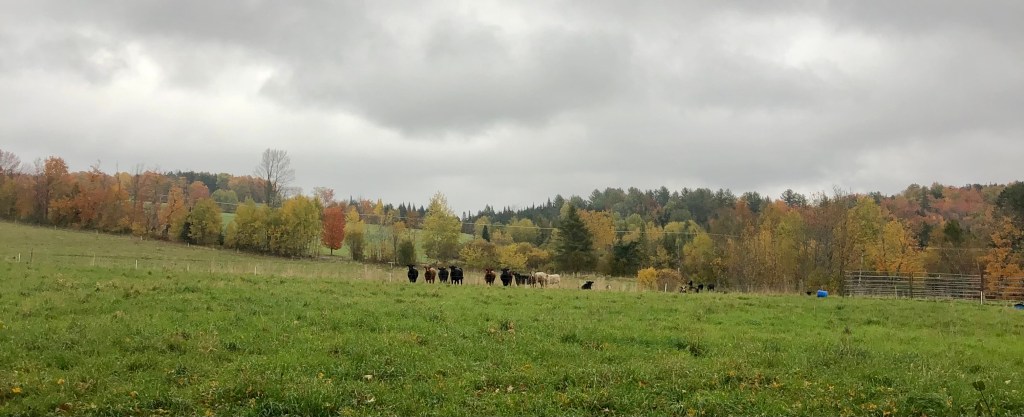
Autumn is the long weeks of the growing season’s finale, the landscape gold and crimson. But within the landscape are the tiny places where we walk and live: my garden’s pink glads, the neighbor’s blooming roses, the gold flush of the butternut tree I planted as a bare root stick, seven years ago, and the girls laughed at me. The tree stretches far above our heads now, and my girls marvel. Have faith, I remind them; beauty thrives from where we least expect it….

From Carolyn Kuebler’s gorgeous essay about Vermont:

The real, long history of this place goes even further
back, to the beginning of this landform as we know it, about twelve
thousand years ago when the glaciers drew back from the land and
various species, including humans, eventually moved in.

Evening gathering….

In the spring, I moved my remaining hollyhocks into the fenced vegetable garden to save these flowers from feasting groundhogs. Spring, summer churned along. Now autumn, my garden still blooms its rainbow. Gathering tomatoes and basil for dinner, scraps of birch bark and kindling to start a fire, I pause for a moment in the drizzle, soaking in the delicate petals, the mist brushing in for the night, the trees already doing each their own foliage thing — some gold and orange, some already shaken down to bare twigs, others green, green, as if in defiance of winter.

Across the valley, the coyotes call, once, twice, as if testing their voices.

I snip bunchy orange marigolds for my table, their centers spicy. Overhead, the geese are always winging away these days, gathering their Vs, heading for their winter quarters, elsewhere. The clustered sunflowers, in their different heights and states of disarray from gold petal to curled brown leaf, rustle with the fat little chickadees dipping in and out, scavenging. Oh, sunflowers, so easily grown: scattered seeds, my palms pressing soil, water and sunlight. For me and the birds I imagine I sow these beauties, but of course that’s not true at all. The sunflowers are the waving prayer flags of my garden, this small territory.

The neighbor boys pile their sweatshirts and run in their t-shirts, the smallest hustling in and out of the lilac bushes, hide-and-seek. Rain pitters on leaves. A T.S. Eliot line runs through my memory, that graceful dismal poet, “…music heard so deeply/That it is not heard at all…”

A few snippets of autumn.

On Not Speaking the Language of Cat.

My cat Acer, above, exemplifies not only feline beauty but a steady reminder that I do not speak Cat, that I live in a world rich with beings going above their own wise lives, despite the lack of an opposable thumb.

For anyone who’s never lived where the days constrict in November and December, here’s a snapshot: I’m home at four and our house is satisfyingly warm as my daughter, home on college break, fed the fire. In the dusk that drifts down, my neighbor and I walk to the town library, which seems a natural destination. When we return, we stand in the light from the windows of her house, remarking about the dark.

We talk about little things that seem irrelevant — our children and Thanksgiving and my asparagus bed gone to weed — these things that stitch our lives whole. The air holds just the right amount of cold, nothing too fierce but sharp enough to whet desire for my warm house, the wood smoke trailing from my chimney. In its wordless language, the half-moon rises through the pines around my neighbor’s house, luminous in the black sky where the stars appear one by one, and then suddenly the Big Dipper glows. The horizon is a thin crimson line, and then that, too, winks down into the night.

“Muddy water is best cleared by leaving it alone.”
― Alan Watts

Round Earth.

Autumn reminds me the earth is a globe. The days shorten; dusk draws in earlier. The shadows hold a chill.

This year, purple asters spread prolifically — along roadsides, in the woods, in seemingly random sprigs around my house. The flowers flank the two pears in my front yard that someone planted years ago. One tree mightily growing, the other a persistent dwarf.

Autumn is the season of so it goes. What passed for summer this year is finished, the harvest wrapping up. In its own way, perhaps, the most poetic of all season.

Someone goes by wearing a hood
in his own darkness
not seeing the harvest moon

— Buson

A few garden words…

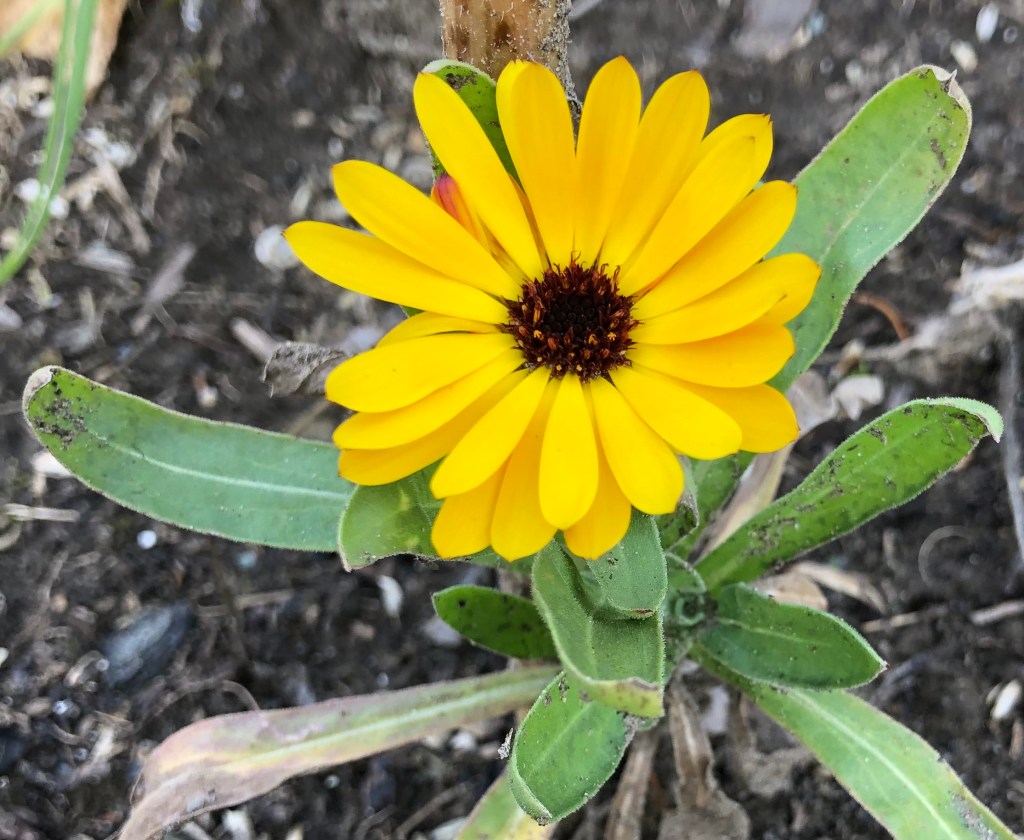
Calendula, such a pretty word, such a marvelous little flower, still blossoming beneath the frost-killed sunflowers in my garden.

Late Sunday afternoon finds me piling fallen maple leaves around these beauties in my garden, tucking in the soil for a winter’s hibernation. There’s celery, yet, too, among the Brussels sprouts. As I work, I snip off celery leaves, dusting off sandy soil on the hem of my shorts. The leaves are slightly grainy in my teeth, but when push comes to shove (as life inevitably goes), I’d rather have tried my teeth on a little grit than none at all.

Here’s what happens in New England’s October: the shadows creep in before the day has finished. We all know these shadows are edged with cold, with the intimation of winter and wind, of snow and more snow, and the always surprising dazzlement of winter’s glistening beauty. I bake an apple crisp, listen to election debates on public radio, comb my cat. October.

At no other time (than autumn) does the earth let itself be inhaled in one smell, the ripe earth…

— Rilke

Mid-October.

In the night, a wild wind throws rain through my bedroom window. It’s before midnight. At twilight, the maples shimmered with a rosy-golden light, but our world has shifted. The wind’s tempestuous, shaking the storm against my house, driving away that autumn dreaminess.

The cats and I are awake. I lie on the couch, reading Ducks. Our little world has seen a proliferation of cats recently — a gray one the neighbors’ boys named Follower, a glossy black, a white-and-brown tabby, a tortoiseshell. The light on the back porch kicks on when the cats, one by one, appear, sodden, and then race off again. A raccoon sniffs my sandals I’ve left out beneath the overhang. My two cats stare through the window, mesmerized.

All night long, all day long, leaves fall. The butternut tree I planted a five years ago is skinny trunk and branch. Magnificently golden, the neighbors’ maples shed their leaves into a giant carpet. Their little boys rake and burrow. As their top branches reveal their starkness, the height of these trees soars above our houses.

October, and midday the light is tinged with sootiness as the sun bends away from my place on the earth. Whether it’s the pandemic or where I am in life, the old patterns I knew for years have splintered, fractured. To my list I write long before dawn, I add: cover the garden with leaves.

The water wheel spins
holding up the milky way,
and then spills it out.

– Kawasaki Tenkō