100 Daffodils.

In this balmy late autumn, I walk with new acquaintances in an oak forest where I’ve never wandered. Oaks are sparse in the woods where I generally walk, these lovely-leaved beauties, the ground beneath them strewn with acorns, some broken, their centers chewed out.

I’m with other women who are unwillingly on a journey similar to mine — cancer and chemo, the shock of our worlds slashed apart. Our conversation drifts to the kindness of friends and strangers, and the flip side of kindness — a kind of harshness: why can’t you get on with your life since the chemo is finished? (a raw impossibility) and didn’t you eat enough kale? For the record, when my daughters were young, I grew three kinds of kale in my garden, fifty plants to carry us through the winter, fenced from the foraging deer. All that kale, so carefully tended, and yet, here’s the luck of your draw: cancer.

It’s a rare kind of privilege to walk with these women, listening, offering snippets of my own story. On this cloudy afternoon, these woods are light-filled through the barren branches, the poplars and beeches still shimmering patches of gold. One woman ventures, “All nature has scars.”

Every year, I dread this season of dwindling light, the creeping-in edgy cold, the giant fist of winter readying. And yet every late autumn, the falling leaves enchant, the wood stove’s warmth soothes, the moon gleams its crescent cut-out in the starry sky.

Writing this book about cancer has pushed me to read and gather facts and history, the scientific low-down. And yet, simultaneously, I appreciate more and more the great mystery of this universe. A friend counsels me that I can hold two things in one hand: knowledge and uncertainty. But these, too, are beyond numbers; this world’s mysteries are multitudes. My sister once remarked that cancer is the great leveler: it’s humbling. On a recent chilly morning, I planted one hundred daffodil bulbs: a meager offering to this sweet place where I live. The story behind these spring beauties will surely sink down and vanish into the sandy soil.

Auto Mirror

In the rear-view mirror suddenly
I saw the bulk of the Beauvais Cathedral;
great things dwell in small ones
for a moment.

Adam Zagajewski, translated from the Polish by Czeslaw Milosz and Robert Hass
Touching the Earth.

Right at the solstice, frost.

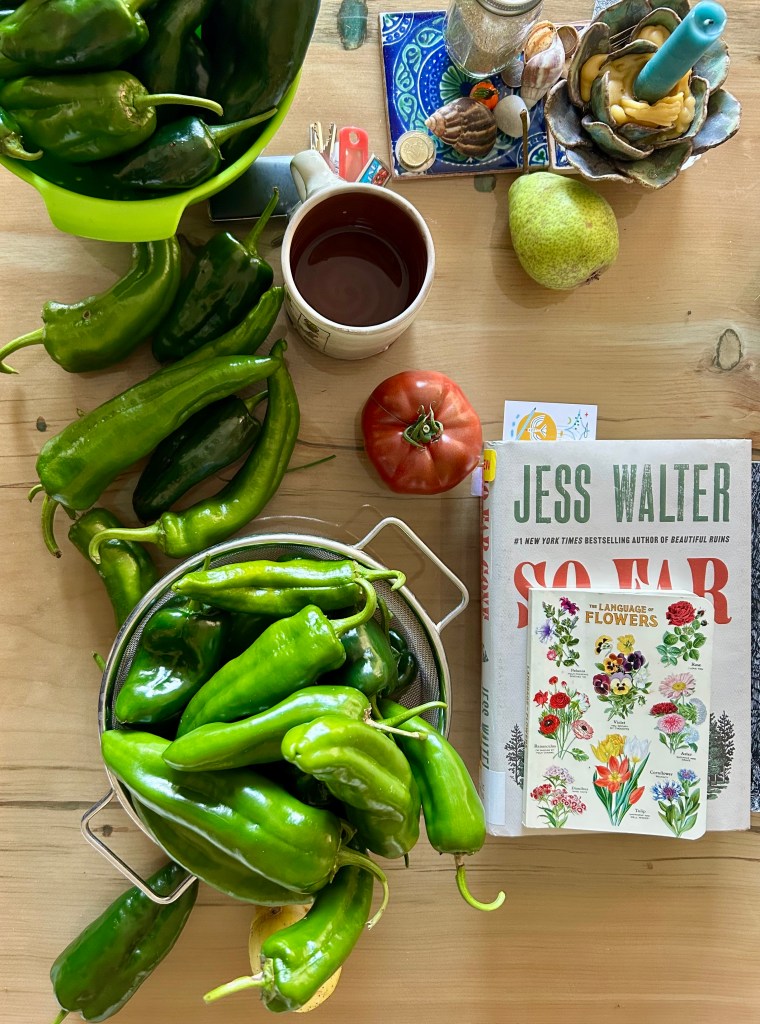
My garden planting this spring was a combination of friends who appeared and weeded and planted, of the sunflower seeds I sowed and the woodchucks ate and I replanted and the woodchucks devoured again, of volunteer calendula and love-lies-bleeding and towering gold sneezeweed, and the pepper plants from a friend that produced in enthusiastic abundance.

Hurray for the garden. These evenings when I light the first wood stove fires of the autumn, my cats chew shreds of birchbark, sprawl before the warm stove. Hurray, they purr in their cat way.

Season’s change again, so familiar and yet different, each day fresh and welcome. Season’s change for me, too, some days filled with friends and colleagues, other days I hole up and get my work done. Writing now about cancer, I imagine holding this keen awareness of my mortality, of the perishable world, in my hands: a tender-eared rabbit, a vicious rat, or maybe simply a handful of sunlight.

In the deep fall
don’t you imagine the leaves think how
comfortable it will be to touch
the earth instead of the
nothingness of air and the endless
freshets of wind? And don’t you think
the trees themselves, especially those with mossy,
warm caves, begin to think
of the birds that will come – six, a dozen – to sleep
inside their bodies? ~ Mary Oliver

Autumn’s Radiance, Fine Medicine.

Before dawn, rain patters, a splatter through the open windows. The singing frogs are still at this hour. The rain moves through lightly. All summer: drought, drought, not likely to be relieved any time soon. In the town forest, beneath the soaring pines, the scent of the hot soil reminds me of the desert, a strange thing in northern Vermont. In the garden, the peppers, the sneezeweed, the Love Lies Bleeding relish the dry weather. By September, the garden will do whatever it’s going to do this year. Early autumn, colors burst. The hydrangea, so pink the large blossoms appear overly dyed, the coreopsis and compass flowers great bursts of little-kid-yellow, swaying with feasting bees.

Autumn, and I’m reliving last year’s descent into illness. A year ago, I was in a clinic’s office, asking what was wrong with me. I was sent away, and I went back to my toiling work, my sleepless nights. A month later, I returned again, thinner and weaker. Again, I was sent away. Shortly afterwards, I was in the ER and dosed with opioids. A scan revealed “unexpected severe neoplastic disease,” nothing that I’d conjured.

This fall, my novel heading towards an ARC for next summer’s publication, I reread my journal and the hospital notes and began writing a book about cancer. I’ve relied on my memory, that fickle creature, so rereading the notes from two hospitals is a vocabulary builder (so many medical words brand-new to me) and illuminating. This and then this happened. Our bodies and the world are known through numbers, like this drought, the inches of rain we need and the inches of rain to cure, a climatology record. Likewise, the hospital notes are records of lesions in centimeters and pulse in numbers and drugs in millimeters — my story’s elements. But, so, too, are the pears on our trees, plumper and sweeter than I’ve tasted in the eight years I’ve lived here. I pluck a weighty fruit from its branch, stand in the dusky-night yard, and watch the nearly full moon rise.

This week, driving to a friend’s house, I spy #10 Pond shimmering through the trees. The sheer unbidden beauty of the pond pulls me to a stop. I get out and stand on the dusty roadside, the crickets sizzling. A day like any other random day, a slip of a few afternoon hours. But here I am, still stitched into this evolving story.

“When I realized the storm
was inevitable, I made it
my medicine.” ~ Andrea Gibson

Vectoring….

Autumn has stretched out in Vermont into days of balminess, the warm air shot-through with the gold that lingers on the trees. It’s so warm, I keep at my makeshift back porch deck, a table I moved out this summer that’s become a place of succor, resting my bare feet on a wooden crate of those onions I pulled from the garden.

I’m taking a class with the unmatchable Lauren Markham about structure in writing, one of the hardest challenges. Online, there’s attendees from California (what? you get sun and ocean?) and Phoenix and Boston. Signing in, I leave my laptop camera on. I throw a chunk of wood in my stove from sheer laziness so I won’t need to rekindle the fire as the colder night creeps in, but I open the back window so my cats can sit on the sill and enjoy this sweet October breeze. When I join, the group is admiring the view of my clapboard house and frost-killed morning glories vines. I tell them my chore which doubtlessly immediately marks me as…. quaint rural.

Late afternoon, I pull out the dead basil plants and then lie down under an apple tree. Her leaves, blacked with frost spots, spiral down, one by one, to the unmown grass. It wasn’t until I had babies and was forced to slow down (all those nursing hours beneath apple trees, milk-sweet baby in my arms) that I realized every leaf takes its own precise trajectory, from spring bud to the autumn dive earthward. Around me, rotting apples, persistent slow-flying wasps.

I might have slept; when I open my eyes, the sky is already draining of blue. Thinking of Markham’s words, I suddenly see the taunt arc of this fourth, yet unfinished book, the map that holds this story, the treasure at the reader’s end far from a Hallmark card. Vector is the word she used. Indeed, all story, all life, is motion. The chill rising up from the earth, I vector myself indoors….

A great many, who have spent their lives in cities, and have never chanced to come into the country at this season, have never seen this, the flower, or rather the ripe fruit, of the year. I remember riding with one such citizen, who, though a fortnight too late for the most brilliant tints, was taken by surprise, and would not believe that there had been any brighter. He had never heard of this phenomenon before. 

— Thoreau

October: where are we going?

This weekend cleaves the summer, the marker where the light changes.

As the leaves drop, the light sharpens and thins. I’ve been here before, so many times, knowing full well how the sun will continue to dwindle. October is a season of brilliant contrasts: emerald hayfields, swaddles of mist, orange remnants of zinnias.

The season mirrors the human realm, too, such a lusciously lovely summer this has been. Now I yank out spent tomato vines, stow away my garden rake and hoe. I gather a handful of kindling, an armful of wood. So much winter, so far to go.

In the co-op’s baking aisle, I run into an old friend, and we chat while her daughter shops. I’m certain we mark different sides of the ballot, but our friendship is hard-tested, solid. Our conversation swirls. Through the window, yellow leaves scatter and leap in a breeze. I lean towards her, listening to a thread of her story.

Change of season is never the same. My youngest daughter tumbles towards womanhood, our lives shift, stretch. Within, always the constants, the long threads of conversation, the joy of the natural world, my ever-present marvel at the world’s flux: where are we going? why? Is it true that other people live these steady, predictable lives? Who knows?

Overhead, those geese, honking their way out of here. And us, here, for now at least.


Each fall in New Hampshire, on the farmwhere my mother grew up, a girl in the country, my grandfather and grandmother finished the autumn work, taking the last vegetables in from the cold fields, canning, storing roots and apples in the cellar under the kitchen. Then my grandfather raked leaves against the house as the final chore of autumn.

— Donald Hall, String Too Short to be Saved

Oatmeal Chat, Vultures.

Vermont sends its swiftwater team to North Carolina, repaying a favor when Vermont was in need. Word comes of similar terrain and climate causes, but far worse devastation. We send them our empathy, our skilled folks, certainly money, to their world broken apart….

In Vermont, these weeks have been tepid, the foliage gently rotating to gold, the sun warm in the afternoons. This year, the purple asters decorate the landscape everywhere, pallets of brushiness.

Thursday afternoon, I take my laptop to our picnic table, the bluejays creeping near, curious, my bent-over sunflowers in the garden shaking with feathered gleaners. I’m stuck on this notion of impermanence my father and sister and I have been kicking around, when we connect in our disparate parts of the country via our laptops. Autumn in Vermont personifies impermanence. Stepping out for firewood in the early morning, geese clack over my porch roof, getting their V formation together, out of here for warmer waters.

In the co-op, I round an aisle and meet an old friend filling a paper bag with oatmeal. You can imagine me, he tells me, standing at my back door, just staring at the mountainside. What perfection today. From there, our conversation quickly bends into small town democracy, how each of these three adjacent towns are different. We step to the aisle’s side and dig into the grittier details of a legal letter circulating on email. My friend, thinking like me, asks about motivation. Who’s desiring what? Why? What’s the intent, for what human footing?

Fascinating questions. Vermont Selectboard meetings are generally unfettered democracy. Anyone can show up and speak their piece, ask questions.

Later, I step outside with my pound of coffee and pound of butter. The turkey vultures are circling, swooping low over this section of highway and co-op and river. In my wool sweater, barefoot in Danskos, I stand watching for the longest time, the sun falling behind the hillside.

A passerby, walking in, glances up, too, and shudders. “Them. Those birds.”

I start up the hillside, under the gyrating vultures.

 Even  in Kyoto—
hearing the cuckoo’s cry—
 I long for Kyoto.

— Bashō