On this stormy Thursday morning, William Wordsworth:
My heart leaps up when I behold
   A rainbow in the sky....
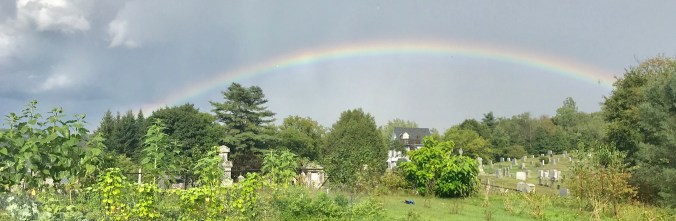
On this stormy Thursday morning, William Wordsworth:
My heart leaps up when I behold A rainbow in the sky....
What I might lamely describe as rain and the middle school girls laughingly referred to as moistiness, we stopped at the two painted silos. Beautifully painted with agricultural scenes, these two silos stood empty by the side of Route 15 for years.
I walked through a puddle-ish field. The girls, impetuous, ran.
I’ve been aching for weeks now for some brightness of color — and here it was — art transforming the landscape. Around the back of the further one was a barred owl I hadn’t seen. The girls wandered over cement pad around the silo, talking about what might have once been here.
Four more cars had parked around mine. We took one last look and headed off into the mist and rain — the moistiness — again.
In art, either as creators or participators, we are helped to remember some of the glorious things we have forgotten, and some of the terrible things we were asked to endure…
— From Madeline L’Engle’s Walking on Water


A few years ago, my daughter bent all the paper clips in our house into necklaces, a project involving pliers and colored beads, with incredibly cool results. One necklace still hangs from the windowsill in my room, crooked over the sill.
At the time, I was running a business out of our house that involved frequent and complicated mailings. One morning, I fumed around the house, muttering about the lack of paper clips, before I realized all those boxes of small metal pieces had been transformed into kid art.
There’s one pattern in my life: my intent adult life knocked up against the busyness of childhood.
In the end that day, I mailed out those so important papers sans paper clips, and here I am, years later, having forgotten what was on those papers while the necklace still hangs over my desk.
In the penetrating damp
I sleep under the bamboos….
One by one the stars go out.
Only the fireflies are left.
Birds cry over the water.
War breeds its consequences.
It is useless to worry,
Wakeful while the long night goes.
– Tu Fu, from “A Restless Night in Camp,” in David Hinton’s The Wilds of Poetry: Adventures in Mind and Landscape
I stumble spelling the same handful of words, stupidly over and over. Fuchsia. Schedule. Traveling. As good, serviceable words, I use them repeatedly, and yet I always catch myself just for an instant. How do those consonants line up in schedule, anyway?
I imagine a surgeon has terminology, methodologies, sterilized silver, to utilize in her trade. Writers weld words with the subtlest shades of meaning: fuchsia in a hanging plant, profusely blossomed; or fuchsia I wrote about this morning, the color of a woman’s silk blouse and hazily diffuse through an unwashed convenience store window, filtered through a storm of twisting snowflakes.
Roseate. Coral. Magenta. Cerise. Bloodshot. Ruby.
Red is the color of blood, and I will seek it:
I have sought it in the grass.
It is the color of steep sun seen through eyelids….
– Conrad Aiken

Hardwick, Vermont
My ten-year-old came downstairs the other morning dressed in shorts although it was only 39 degrees. No. I immediately said. But it might warm up, she insisted.
In this afternoon’s rain, the kids have headed down the road to the neighbors’ trampoline because it’s fun in the rain, apparently, even in a cold May rain.
These Vermont kids, like the unfurling leaves in my apple trees, are vigorously unstoppable with their own flowing sap. At ten and eleven, the world is as new to them as this magnificently unfolding spring. Lacking rigid expectations, why not leap in the rain? – Although I did notice the girls had the foresight to pull on extra pairs of socks.
The artist, and particularly the poet, is always an anarchist in the best sense of the word. He must heed only the call that arises within him from three strong voices: the voice of death, with all its foreboding, the voice of love, and the voice of art.
– Federico Garcia Lorca

Vermont dusk
When my older sister was a student at Williams College, I often rode the Greyhound and visited her. While she was in German or physics class, I walked to the Clark Art Museum. Entrance was free for students, so I could visit over and over. As I read a lot, too, I learned about Monet and his garden, and Renoir and his women.
Although I didn’t realize it at the time, I was learning art is a physical craft. None of the guards cared if I leaned into the paintings and admired brush strokes, bending in to see the raised curved of paint Sisley’s brush had left. I studied how a particular shade of yellow lent a certain light. I became a writer and not a painter, but those hours in the Clark were invaluable to me. I learned to step into light, to realize darkness as moving force, and to see what is there, rather than what I expected to be there.
Yesterday, I visited with my daughters. In a room suffused with natural light, filled with Impressionist beauties, my younger daughter walked to my most beloved painting in the whole museum – Monet’s ‘Geese in the Brook’ – a golden, sunlit beauty. This child, who had been more interested in the possibility of ice cream rather than Pissarros, said that was her favorite.
When I asked her why, she said, Because it’s beautiful. Look at it, mom.
Bingo, I thought to myself. That was worth the trip alone.
I was learning something from the painting of Cézanne that made writing simple true sentences far from enough to make the stories have the dimensions that I was trying to put in them. I was learning very much from him but I was not articulate enough to explain it to anyone. Besides it was a secret.
Ernest Hemingway, A Moveable Feast

Williamstown, MA
 Stony Soil Vermont