Oatmeal Chat, Vultures.

Vermont sends its swiftwater team to North Carolina, repaying a favor when Vermont was in need. Word comes of similar terrain and climate causes, but far worse devastation. We send them our empathy, our skilled folks, certainly money, to their world broken apart….

In Vermont, these weeks have been tepid, the foliage gently rotating to gold, the sun warm in the afternoons. This year, the purple asters decorate the landscape everywhere, pallets of brushiness.

Thursday afternoon, I take my laptop to our picnic table, the bluejays creeping near, curious, my bent-over sunflowers in the garden shaking with feathered gleaners. I’m stuck on this notion of impermanence my father and sister and I have been kicking around, when we connect in our disparate parts of the country via our laptops. Autumn in Vermont personifies impermanence. Stepping out for firewood in the early morning, geese clack over my porch roof, getting their V formation together, out of here for warmer waters.

In the co-op, I round an aisle and meet an old friend filling a paper bag with oatmeal. You can imagine me, he tells me, standing at my back door, just staring at the mountainside. What perfection today. From there, our conversation quickly bends into small town democracy, how each of these three adjacent towns are different. We step to the aisle’s side and dig into the grittier details of a legal letter circulating on email. My friend, thinking like me, asks about motivation. Who’s desiring what? Why? What’s the intent, for what human footing?

Fascinating questions. Vermont Selectboard meetings are generally unfettered democracy. Anyone can show up and speak their piece, ask questions.

Later, I step outside with my pound of coffee and pound of butter. The turkey vultures are circling, swooping low over this section of highway and co-op and river. In my wool sweater, barefoot in Danskos, I stand watching for the longest time, the sun falling behind the hillside.

A passerby, walking in, glances up, too, and shudders. “Them. Those birds.”

I start up the hillside, under the gyrating vultures.

 Even  in Kyoto—
hearing the cuckoo’s cry—
 I long for Kyoto.

— Bashō

We are every experience we’ve ever had…

A sunny morning, I’m at a place I’ve never been before, a sizable post-and-beam gallery at the end of a road. A fenced vegetable and flower garden shines orange and gold. A marble bust smiles mysteriously.

I love this about Vermont: these unexpected pockets of mighty talent. The woman’s house is built around the gallery — a beauty of wood and stone and glass. We talk for a while, and we discover that her artist parents were from the same midwest area as my father — Detroit — and then she opens the gallery and takes me in. Let me say here: I’ve been around the block a few times, seen my share of museums and art; I’m also feeling this sunny morning like the dirt road my Subaru tires pounded into, driving uphill.

The gallery ceiling soars in a peak. The wooden space holds the owner’s and her deceased parents’ work. She allows me walk through the metal sculptures wordlessly. Then I stand beside an oil portrait of a woman wearing a black and red dress that reminds me of a velvet blouse I bought for a friend, many years ago, when she graduated from college. The woman in the painting rests her chin on her fist.

The owner looks at me. “It’s always the females who are drawn to her.”

“She’s me.” Woman of a thousand and one sleepless nights, bread baker, hearth tender, the woman who swam under the luscious full harvest moon. Woman hard as these back roads, fragile as coreopsis.

We walk upstairs and finish the tour. Before I leave, though, I stand again before this portrait, a long soulful moment. “Gracious,” I say, “gracious.”

“…we are everything, every experience we’ve ever had, and in some of us, a lot of it translates and makes patterns, poems. But, my God, we don’t even began to touch upon it. There’s an enormous amount, but we can touch such a little.” – Ruth Stone

“Everything blooming bows down in the rain…”

In the sultry dawn, I’m wandering barefoot in the garden, snatching the lingering strawberries before birds have nabbed the remainder. By late afternoon, thunderstorms have settled in. I’ve left a wooden chair on the porch, a throw rug over the railings, both sodden now. Book in my hand, I lean against our house’s dusty and pollen-layer clapboards, reading in the coolness that’s washed in. Our porch looks out over a bed of bleeding hearts, false Solomon’s seal, hostas. Beyond that, the cemetery, the river valley below. Behind our house, the wild presses in. Ferns tall as my shoulders, goldenseal, the groundhogs, thrush, chittering sparrows, the cut of ravine and the great life there.

Equinox; the lushness burgeons. Bring it on. The rain blows through the bedroom screens whose windows we left open all day. The box elder shoves between the porch railings. The grapes rise hungrily against the barn. All night our rooms are filled with moonbeams, the blowing dew, the mixture of milk trucks rattling down the road and the calling frogs.

Everything blooming bows down in the rain:

white irises, red peonies; and the poppies

with their black and secret centers

lie shattered on the lawn.

~Jane Kenyon

Sips of May.

As the spring dusk settles down, I’m wandering around the edges of my garden. The lilacs have just begun opening, a tiny four-petaled blossom here, another there, the remainder of that lavender flower still knotted, not yet relaxed into the wide open spring season.

I’m in my ragged jeans, dirt under my nails, when my neighbor pulls into her driveway and gets out of her Prius. She’s wearing what she calls her rag-bag dress, and the two of us make a kind of pair. I’ve known her since our oldest kids were babes in arms, not yet eating smashed carrots.

It’s been a year for each of us — and I mean that: a year. We both have college-aged kids in and out of our houses. Under the fragrance of pear blossoms, we immediately head into that long-running conversation we have about her work and my work, about writing and art, about aging parents. The half moon rises over my apple tree.

May, in all her radiant beauty. Here I am, with a hundred chores in one day — a hot water heater repair, more writing, plant arugula and Brussel sprouts, my constant fiddling with the wood pile, the daughter chat. How this Vermont world loves to green. Yes, and again, more, yes, yes.

Ruined!

In this sweet May rain, working on the covered porch of one of my favorite libraries, I remember a rainstorm about a year ago. My daughter and I were in Rome, eating dinner in an outdoor café. In the storm, the staff had pulled a plastic cover over the terrace. The effect was warm, cozy, intimate. Beside me, a group of young men were drinking wine. One man remarked that Italy had ruined him. There was no way he could return to his Chicago cubicle and drink lousy Dunkin’ Donuts coffee. Hearing this, my daughter and I laughed aloud. Italy had ruined us, pleasurably, too.

Likewise, after a week of such largesse at the Vermont Studio Center — the gift of time and space, the pampering of meals, the kindness of the place — I wondered if I might be a little ruined, too.

Not so, perhaps. May in Vermont is one of my most favorite times. Here’s the gold of marsh marigolds behind an old grange. Gold.

Sweeping Out Inner Clutter.

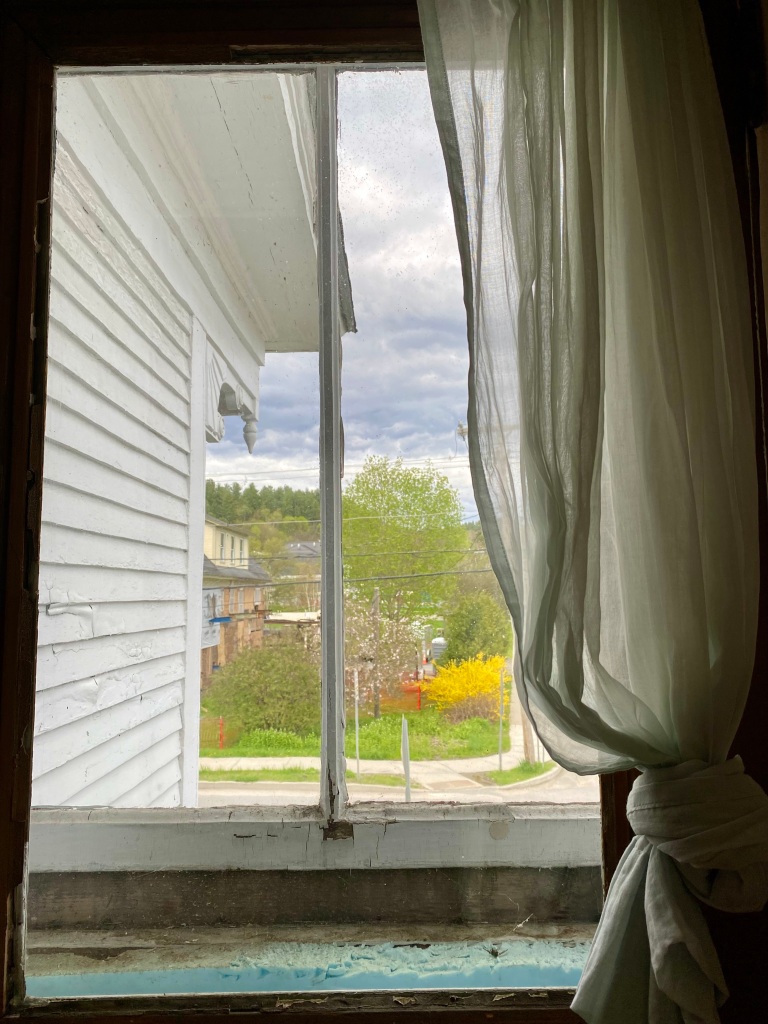
Spring window, upstairs study.

Early evening on Friday, after a long workday, I’m in a nearby town’s general store, talking to an old acquaintance on the porch. The store’s door is propped open. A warm breeze swirls. Rain isn’t far in the offering.

A few years ago, a stranger stopped on the porch steps where I was eating ice cream with my daughters and said my name. She’d read my first book, she said, and loved it. That conversation: a shift for me.

On my way home, I stop at the town beach and lean against the tall cedars, whitecaps chopping on the lake. The breeze is no longer so warm here, and I have the beach to myself. Last fall, weekend afternoons and stuffy evenings, I swam here, when everyone else was too busy or too disinterested to swim at my usual places. With my youngest at college, I lived alone again, and I determined not to drench my empty nest with tears. For those hours, I brought pages of my manuscript. Dusty sand drifted into my printed words and into my bag that held my ever-present things: library books and knitting. I’d swam here before with my daughters, but I began to know this lake in a new way: how the bottom drops quickly and few boats venture to this far end. I kicked far out, leaving the weeds and the strangers on the beach behind. Curious or not, the loons joined me.

And a line from the mesmerizing Annabel Abbs’ Windswept about women, walking, solitude, and creativity: “She purged her inner clutter with outdoor space.”