A stranger appears at our house…

A stranger appears at our house while I’m watering one night, the little drink I offer my tomato plants on hot days. Her grandmother lived in this house, an old woman widowed now in another part of Vermont. I let the stranger in. She’s mystified that a tiny pantry in the kitchen was removed. I can answer some of her questions — that the four tiny bedrooms were changed to two tiny rooms and one larger one, that the downstairs walls were painted yellow by me.

Someday, I say, someone will knock down a wall and change this, too.

Outside, in the evening light that’s storybook shades of peach and lemon and lime, I tell her the soil is sand. She remembers the ants who bit her as a tiny child, and she remembers the lilacs. We stand talking a little about our lives — how I came to live here, where she’s now. I ask, Who planted the roses, but she doesn’t know.

Just before she leaves, she looks at the foot-wide strip of cement that surrounds the house. “My sister and I used to dress up in my mother’s old clothes and high heels. Everything was too big for us, so we scuffed the heels around the house.”

She gets back in that rusty mini-van, waves, and heads off. A few days later, she sends me photos, 1960s-style, of kids in what’s now my living room. And the wallpaper? She remembered it indelibly and wanted me to see it, based on some notion that pineapples and giant leaves were a fine addition to the walls of a small Vermont living room.

There’s one last thing, though. She even wanted to see the basement. As we stood looking at the stone walls and the rough-hewn floor joists, we wondered about the housewrights. How well-built this house is, tucked on a hillside in a place that seems both part of the village and not. My days, too, are numbered here. I’ll die here, or I’ll move elsewhere. All these stories are pieces of this house — these little girls, sixty years ago, in too-big shoes, hands pressed against this house for balance, giggling.

July, it’s worth noting again, July July July, month of growth, today own parents’ anniversary. Each of these July days…. Savor in some kind of way.
The Might of Imagination.

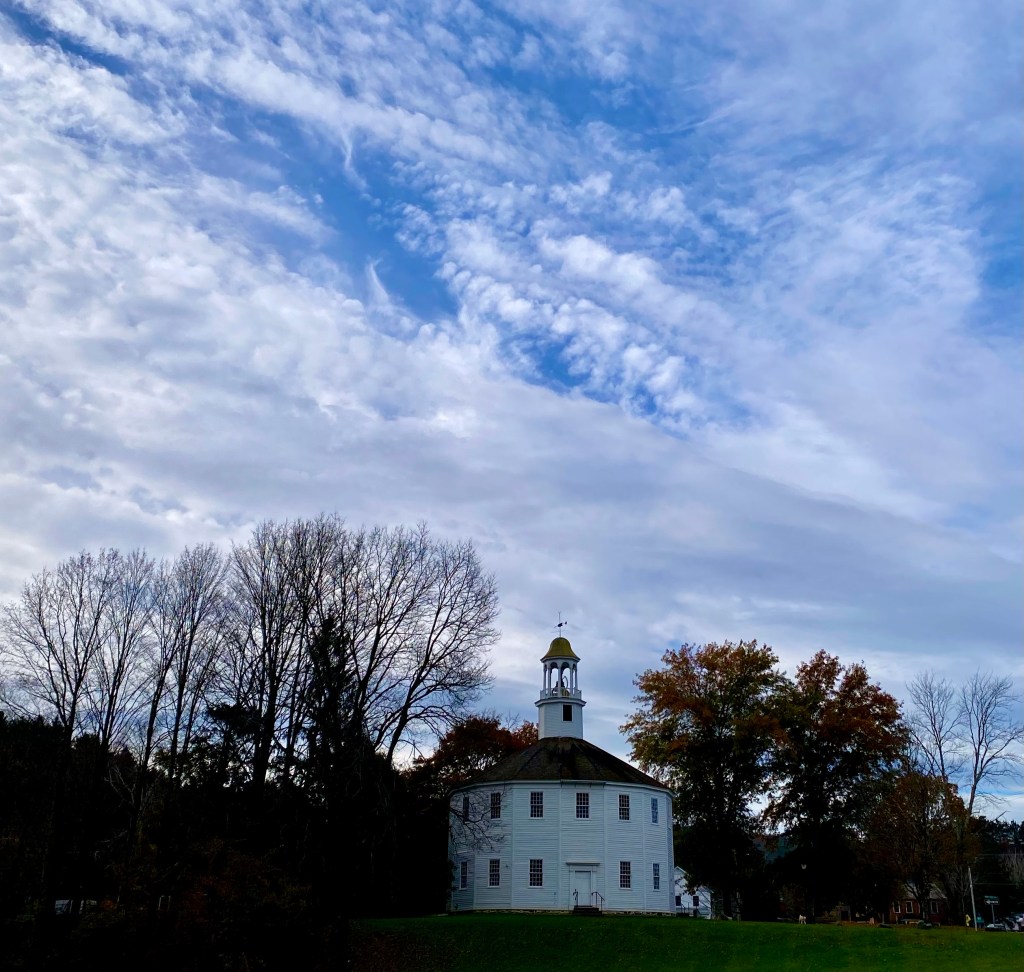
Round Church, Richmond, Vermont

The geese fly overhead in great Vs, chattering in geese-speak as they align themselves, tugging their flock together. In my garden, I rip out the frost-blackened tithonia, the dry fronds of bachelor buttons.

The migratory geese are rhythm, nothing clichéd about their brassy calls. As I steadily work at my annual chores — burying more daffodil bulbs, the candy-like crocuses I’ll happily search for, months from now — I let my body do this work, my boots on the earth, a few spits of rain falling from the clouds, listening, listening.

In the town office where I work, stories surge through, as in any small town. Having lived through scads of my own drama, I know too well how the private seeps into the public, any truth strewn carelessly among chatter. For the most part, I endeavor to do my work and head out; yet, like anyone, I’m always listening, listening, wondering about motive and desire, curious about betrayal and courage, and the ineffable complexities of human behavior. In a conversation with a friend about a couple we jointly know, my friend said, For anyone who’s been following the story, this shouldn’t be a surprise… In a similar vein, I realize I’ve long been quietly following the story of the world where I live.

On my way to visit my daughter, I detour slightly and walk around Richmond’s round barn, shuttered up until dandelion season returns. The afternoon is especially balmy, sunlight bright even in the scarcity of November. I marvel at how mightily humans can create, mixing utility and beauty. How well we can do this.

“Sometimes it seems to me that, in the end, the only thing people have got going for them is imagination. At times of great darkness, everything around us becomes symbolic, poetic, archetypal.”

— Helen Garner

This Old House

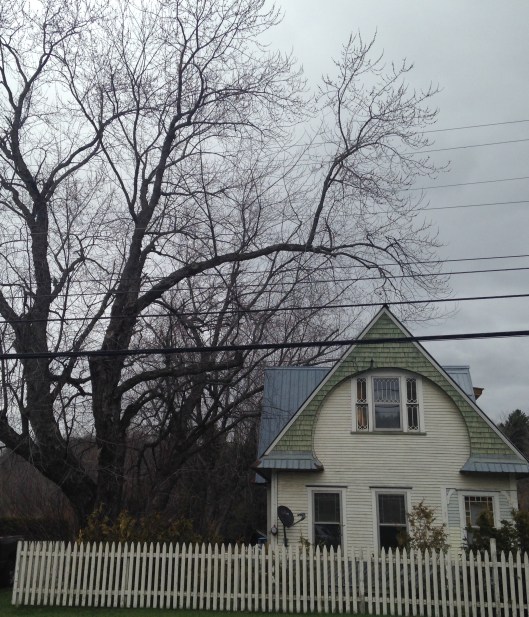
For years, I’ve been buying my daughters creemees in the summer and admiring a small, terribly neglected house across the road. With an exterior of stained glass windows and ornate eaves, I imagine the inside has extraordinary woodwork. Surrounded by too many power lines, lived in by a series of renters, the house appears unkempt and ill-loved, the modern world grown up around it.

As a writer, I’ve looked at innumerable houses, and this little house seems hard-pressed for a good future, too near the road as it is, too near a river that floods, too not wanted… and yet, I’d love to walk through these rooms. I’d love to know who once lived here. With that riverbed soil, I imagine someone tended a burgeoning garden.

The grammar of shape is innately understood. Unlike speech, it is visible in plants and animals everywhere. The intuitive design process gives access to that knowledge. You do not work at design, you play at it.

– Jonathan Hale, The Old Way of Seeing

FullSizeRender.jpg

Hardwick, Vermont