Watching the Light

I walked into work yesterday morning with a woman who didn’t grow up in this country. She’s learning to drive, an oddity here for a woman in her thirties. In rural Vermont, just about every kid – usually long before the requisite 16-years-old – drives.

Although like most Americans I’ve had a romantic fling with the happy motoring years (just how many times have I driven around the country?), I told this woman part of me longs to hang up the keys and know the earth only through the soles of my boots.

Our world is so overly, crazily full of images – mine as much as anyone’s. As one kind of antidote, our after-dinner twilight walks are as much about the walking and conversation as wandering through the lingering bits of daylight and spying the first stars twinkling overhead. Spring, drenchingly wet, raw, gloriously full of minute surprises, tugs us.

Last evening, my younger daughter and I stood outside as the cool night came down, listening for the peepers. These tiny creatures haven’t stirred in our neck of the woods yet, but the streams tumbled melted snow, in a steady song, to Lake Champlain.

My sister-in-law is a painter, and I’ll say, how long did it take you to paint that painting. She’ll say, It took me maybe three days, but it took me all my life to get the skills to paint that painting.

– Anthony DoerrFullSizeRender


Midwinter Hunger

A sizable deer appeared in my garden this morning among the bean stalks I never pulled, lifting its head, listening. In the woods around our small field, a flock of wild turkeys comes and goes, bent over dark creatures who remind me of Puritan old women dressed in black, crouched at their work. In the kitchen, my daughters mix pork, scallions, garlic, vinegar, for soup dumplings.

This stillness of winter is a false cliche; overhead, the crow flies for its meal. Squirrels run rampart over the compost. Even the wood stove devours. The children, asleep in their beds, dream of journeys. In the morning, sleepy at breakfast, they appear to have grown in those dark hours.

When we eat a steak, we build its proteins into our bodies and become part cow. Eat an artichoke, become part artichoke. Drink a glass of orange juice, become part orange tree. Everything eventually corrupts: from our first draft of milk, we are corrupted, the world is corruption, time is corruption, and we are forever hungering for more.

–– Anthony Doerr, Four Seasons in Rome

FullSizeRender

West Woodbury, Vermont


Seeing & Writing

A rare epiphany today. Sitting in on a grade school math class, I listened to children figure strategies to determine the precise number between 28 and 43.

Like that, I saw in the sunny classroom the mistaken path I’d taken in my novel’s rough draft. So intent was I on constructing the whole that I’d overlooked the necessity of knowing each particular piece – the unknown that will carry me from 28 to 43. Is it merely that I feared to lose sight of the whole? In each of my characters – as in every one of us – there’s an empty place, a yearning of trembling hunger.

After school, sprawled on the dim staircase while the kids practiced basketball, I wrote my own variation of strategies for those missing pieces – about the teenage boy who lost the lucky rabbit’s foot he had stolen from a corner store years before, while his uncle argued with the cashier about a lottery ticket. As stolen contraband (and girly pink), the boy had kept the rabbit’s foot hidden. Through coincidence, a woman finds the broken thing ground into an icy road….

In the handful of those classroom moments, I realized these pieces might form the schematic of this novel yet-in-the-writing, and while amorphous destiny hides from us, the coincidences winding us unwittingly together are a misplaced rabbit’s foot or a sweater left on someone’s chair.

… over time, we stop perceiving familiar things – words, friends, apartments – as they truly are. To eat a banana for the thousandth time is nothing like eating a banana for the first time. To have sex with somebody for the thousandth time is nothing like having sex with that person for the first time. The easier an experience, or the more entrenched, or the more familiar, the fainter our sensation of it becomes. This is true of chocolate and marriages and hometowns and narrative structures. Complexities wane, miracles become unremarkable, and if we’re not careful, pretty soon we’re gazing out at our lives as if through a burlap sack.

— Anthony Doerr, Four Seasons in Rome

IMG_0500


Wolves in the Moonlight

In the deep of last night, I woke with a south wind rushing over the ridge behind our house. In my sleep, I’d been dreaming of howling wolves in the moonlight, and when I opened the balcony door to stave off the wolves from my household, a strange warmth blew in over the snow. In the moonlight, I saw only the bare sticks of blueberry bushes, the hydrangea with its papery blossoms, long since dead yet stubbornly hanging on. Persistent.

With the wind murmuring like the sea, I lay reading Anthony Doerr’s memoir about living in Rome with his wife and two infant sons. In that ancient city, he watched flocks of starlings rise and dive in enormous flocks, while he held a baby, the little one drinking milk. Afterward, the book closed, I lay thinking of the pigeons I’d studied not long ago, weaving in and out of a slate-shingled church steeple in Montpelier. I’d stood alone on the library steps, admiring the ribbons of flight, and then I simply closed my eyes and listened to the cooing.

Knowingly or not, we all stand there… reading the omens of the birds. The real question, the one that keeps me coming back to this railing, night after night, is Why do they bother to be so beautiful?

Starling, earthling. How little we understand, Nero had a starling that spoke Greek and Latin, Mozart kept a starling in a cage beside his piano.

–– Anthony Doerr, Four Seasons in Rome

FullSizeRender

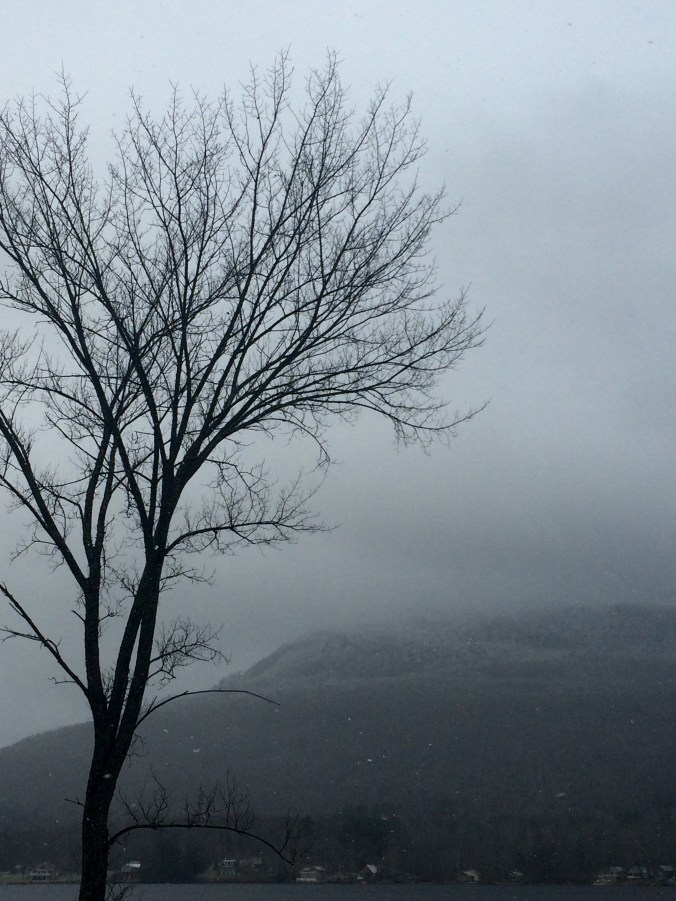
Photo by Molly S./Lake Elmore, Vermont