Myriad Things

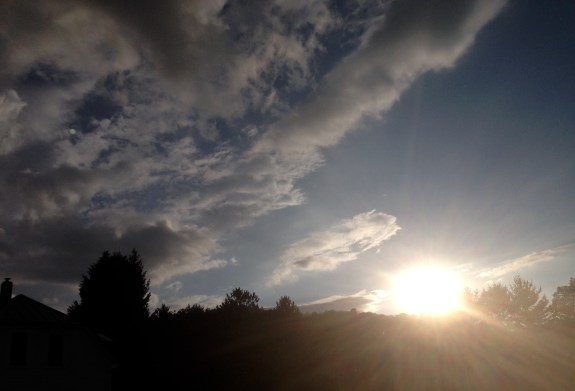
These summer days, I often work at home, awake and drinking coffee while the girls slumber, and the sun rises and slowly steams off the dew from our croquet patch, the garden, and the town’s rusted metal fence and cemetery beyond.

Yesterday afternoon, my daughter and I walked into the sultry town for another of my meetings at the town library. Some rouge patron had plugged up the basement plumbing, so I shopvacc’ed the cement floor while librarian lifted boxes from the spreading flood. Then we sat outside in the sunlight, nodding to patrons, while she answered my questions about the little library I manage. One patron returned three books, including the novel I’ve written. I restrained myself from quizzing, What did you think?

At home again, in the late afternoon, my daughter picked handfuls of cucumbers from our small garden. While we talked, I made a savory dinner the girls love – peppers, onions, herbs, sausage, tomatoes, rolled into bread dough, coarse-salted and rubbed with olive oil. While the bread baked, we worked in the garden, the half moon rising through crimson clouds over the peak of our house. She was chattery and happy. I love the evenings best, she said.

Poem (As the Cat)

As the cat
climbed over
the top of

the jamcloset
first the right
forefoot

carefully
then the hind
stepped down

into the pit of
the empty
flowerpot

– Williams Carlos Williams

FullSizeRender


Crossing Open Water

My canoeing experience, while somewhat lengthy, has always been confined to summery, pleasurable afternoons, on Vermont’s still lakes and ponds, often with swimming and almost always with kids. Only once, on my honeymoon, did I worry our canoe might flip.

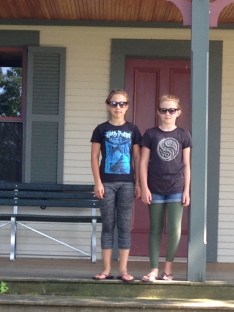
Oddly, I found myself on nearly those same waters in Lake Champlain this weekend, worrying again if I might roll the canoe. While the two cheerful and sunglasses-wearing 12-year-old girls waited for the ferry, I headed out to an island with a canoe loaded low with camping gear, not looking closely at the lake – a very large lake – rough with wind, torn up with the furled wakes of motorboats.

After I spun around, I gave myself a rapid crash course in reading the water washing near the low sides of my canoe, keeping my prow headed into the waves – those long curls might have delighted me swimming near the shore but frightened me with all this water around. The silver ferry passed by with my smiling girls, waving merrily in the sunlight.

On the return leg of the journey, after a few days of bicycling and card playing on an island magical with fiery sumac and twining vines, the water lay invitingly still, just me and the ducks and few gulls cavorting overhead.

It was then, on that crossing, that I remembered the children’s father and I had paddled in a rainstorm to this same stretch of beach, from an island further out, in a canoe we had borrowed from his parents that had no lifejackets. In a different version of my life story, I would have taken the ferry with the girls and he would have rowed the canoe – much stronger than myself and far savvier at reading wind. He would not have gotten stuck on the far side of the island as I did, and struggled against the current to round the rocky edge.

As I rowed, the lake lifted against my old red fiberglass boat, all that deep blue water, stretching far further than I could imagine, filled with darting fish and frond-waving plants, the shale-splintery islands, boats with white sparkling sails, sunlight profuse, with sunken ships and ancient fossils. I had been reading David Hinton’s The Wilds of Poetry, filled with narrative and a collection of stunning poems, from Rexroth to Robinson Jeffers, a stonemason apprentice who built his house at Carmel-by-the-Sea, all about motion and change. Kismet reading for sleeping on an island. I imagined how the gulls might see me, a small woman with a braid and a wooden oar with a broken handle, rowing home with a basket of dirty clothes, crumbles of crackers, softening cheese, a coffee pot and an unfinished sweater on knitting needles. I could not have wished to be anywhere else than there.

On the mainland again, I unloaded the canoe and walked along the high bluffs, waiting for the ferry. The wind was picking up then, and the day, the first of August, was bright with promise. The grass could not have been greener. I read the heartbreaking memorial marked for the boys who had died in the Second World War and then leaned against a bent cedar tree, one small woman in a landscape beyond time, myself just one living piece of its infinity.

When I met the ferry, its captain asked if the two girls alone were mine. Yes, indeed, I said and walked onto the rattling gangplank to greet them.

I have tried to write Paradise

Do not move
Let the wind speak
that is paradise.

Ezra Pound, from Cantos in Hinton’s The Wilds of Poetry: Adventures in Mind and Landscapes
IMG_1490

Repeating Patterns

A few years ago, my daughter bent all the paper clips in our house into necklaces, a project involving pliers and colored beads, with incredibly cool results. One necklace still hangs from the windowsill in my room, crooked over the sill.

At the time, I was running a business out of our house that involved frequent and complicated mailings. One morning, I fumed around the house, muttering about the lack of paper clips, before I realized all those boxes of small metal pieces had been transformed into kid art.

There’s one pattern in my life: my intent adult life knocked up against the busyness of childhood.

In the end that day, I mailed out those so important papers sans paper clips, and here I am, years later, having forgotten what was on those papers while the necklace still hangs over my desk.

In the penetrating damp
I sleep under the bamboos….
One by one the stars go out.
Only the fireflies are left.
Birds cry over the water.
War breeds its consequences.
It is useless to worry,
Wakeful while the long night goes.

– Tu Fu, from “A Restless Night in Camp,” in David Hinton’s The Wilds of Poetry: Adventures in Mind and Landscape
FullSizeRender

Watering Down Deep

When I was a kid in the backseat of our green Jeep while my parents drove back to New Hampshire from our trips to Toledo and then often west of the Mississippi, Vermont was the final stretch on a very long journey home, and my mother claimed it was always raining in Vermont. It sure can rain in Vermont.

This morning, mist waters broccoli starts I planted yesterday, spinach and lettuce sowed for fall consumption. Even as a kid, I was fascinated by Vermont, with its infinitely promising green depths – what’s in all those woods? We stopped at a sugarhouse, and I was lifted up to peer into an enormous pan steaming with boiling maple sap, where we tasted hot syrup from tiny paper cups.

Later, as a young adult, I lived for years not far from that very stretch of highway, Route 9, all tangles and bends, some of which the department of transportation straightened out since then, some which will always reflect the jagged steepness of those mountains. I later possessed a giant sap pan myself, and served countless cups of hot syrup to children.

What does a kid remember from a childhood, anyway? While my parents were fighting exhaustion and worn-out windshield wipers, bending the atlas, their younger daughter was in the backseat, sowing the seeds of her adulthood.

In retrospect: could have been worse. What’s going on in my backseat, while I’m reading the map?

Raising children was not about perfecting them or preparing them for job placement. What a hollow goal! Twenty-two years of struggles for what – your child sits inside at an Ikea table staring into a screen while outside the sky changes, the sun rises and falls, hawks float like zeppelins.

Dave Eggers, Heroes of the Frontier


On the Footpath

Rain last night – cold rain in July. What about a sultry summer sunset?

At my parents’ urging, my 12-year-old and I watched Lion last night, and driving to work this morning I thought about how this is a story about home – about longing for home and what that means – a story that unfolds with secret after secret, all the way until the very last line.

Lion is a journey story, too. My daughters and I have taken so many journeys in these last few years, literal and metaphorical, that I might almost be tempted to lay down the journey fascination if traveling weren’t at the very heart of human life.

As my daughters grow up, now long past the toddler or little kid age, that cuddling, hand-holding phase, the journeys we each take get longer, deeper, more intricately complex. At the crux of our journeys, like everyone else on the planet our travels are inherently about ourselves and our loved (and sometimes unloved) ones. Same household, same parents: but each of my daughters travels a uniquely bending path, which at least has the benefit of keeping domestic life lively.

Here’s a few lines from my early morning reading, from Dave Eggers’ Heroes of the Frontier.

That only having left could she and her children achieve something like sublimity, that without movement there is no struggle, and without struggle there is no purpose, and without purpose there is nothing at all. She wanted to tell every mother, every father: There is meaning in motion.

FullSizeRender

Where we live now, Hardwick, Vermont

More Midsummer, Memories

In the crimson-hot July sultriness downtown yesterday, standing on a sidewalk, I flashbacked to what my parents used to call with enthusiasm “being on the road.” For years, we trekked from New Hampshire to humid Ohio to visit the anticipated happiness of cousins, and often far across the Mississippi, spending weeks in nylon tents and cooking canned corn over campfires.

I picked up that thread through much of my adulthood, crossing over from the backseat to the steering wheel. As a kid, of course, meshed in with my siblings, the primary concerns revolved around swimming possibilities and how good a campsite we were going to score.

The landscape from the driver’s seat looks mighty different. Navigation ranks right at the top of my list, something I never would have considered as a kid. Life on the road, I believed, would always get us from here to there. But maybe there’s a real element of truth there, too.

Our road has landed us here, on a dead end street, in a house whose property is bounded by lilacs on two sides. Last night, into dusk, I pulled out the deep weeds along these bushes, listening to the girls laughing about a game they had made up on the trampoline with four deflating soccer balls. We’ve put away the atlas for now, and traded in the scent of fresh asphalt for black soil, damp with early falling dew.

stream in summertime—
this joy of wading across
with sandals in hand

– Buson


FullSizeRender.jpg