This.

There’s a place in Maughm’s Of Human Bondage where the main character, Philip Carey, sits down and eats dinner with a family in a London tenement. Although I haven’t read this section in years, it stuck with me, because Carey eats happily with the family, no longer squeamish about accepting food cooked in less than pristine conditions. Not so many years ago, I might have written what Carey learned was “humility.” Perhaps. But maybe he had been hungry often enough in his life to appreciate company and shared food, and had no fear about poverty’s uncleanliness.

I first read this novel when I was 22. I was living in a downtown Brattleboro apartment where a running box fan fell out of our second-floor window to the sidewalk below, and, by fate’s luck, missed pedestrians on that busy Friday sidewalk. Paired up with Walden, these two dissimilar books have become the books of my adult life.

Sitting in the Washington County Courthouse, where I have become a known woman, I thought of clubfooted Philip Carey, knocking around poor and rainy London, homeless at times, desperate to become a doctor. It was fitting to think of him, in that enormous and ugly building, filled with an apparently ceaseless flow of human misery. What would be the point of all this, really, if you didn’t pass through, and, on the other side, cherish pulling up a chair and eating with others, no matter what the circumstance?

He was always seeking for a meaning in life… He seemed to see that a man need not leave his life to chance, but that his will was powerful; he seemed to see that self-control might be as passionate and as active as the surrender to passion; he seemed to see that the inward life might be as manifold, as varied, as rich with experience, as the life of one who conquered realms and explored unknown lands.

– W. Somerset Maugham
FullSizeRender.jpg

Rain This Way

Cricket songs and screeching starlings. In little flashes, the world around us brightens in bits of red, preparing for autumn.

My daughter, busy with middle school and soccer all day, leaves her hula hoop as a calling card for any stray visitors. Reading the lines below, I think they may apply equally to parents of young children. In theory, we might believe our babies will one distant day shoulder a backpack and venture into their own journeys, but in practicality lies the rub….

We typically take the world of our day-to-day lives far too much for granted, assuming without much thought and despite all evidence to the contrary that what we see before us is just the way things are – and presumably always were. This is, I think, especially true of many young people….

From William Cronon’s Changes in the Land: Indians, Colonists, and the Ecology of New England

FullSizeRender

Depths of Domesticity

In a cold rain, my teenager heads out to the barn in search of a saw and a just-right piece of wood, then disappears upstairs with her wood-burning tool. The younger girl spreads between the kitchen table and oven, baking mini-eclairs.

Not so long ago, the girls were toddlers, with me trailing behind, frazzled and tired.  While I believed they were so needy as little girls, I was likely wrong, caught up in our society’s crazy ideas of overparenting. Even then, my girls were writing their own stories, learning the ways of the world – beginning with nursing (and more nursing and yet more nursing), with skinned knees and bruised shins, with making friends, once sharing stories about a beloved stuffed Piglet and now trading their own girl secrets.

While I’m in the dining room, in my own writing world, my daughters are writing and rewriting their own lives. Toddlerhood is darling, but this is cool, too.

How do you begin to tell your own story?

Jacqueline Woodson, Another Brooklyn

FullSizeRender


A Single, Superlative Sentence

Like this cold September (what? covering gardens already?), reading Knausgaard is both exasperating and mesmerizing. Does he really live in a house with small children and can write about minutiae?

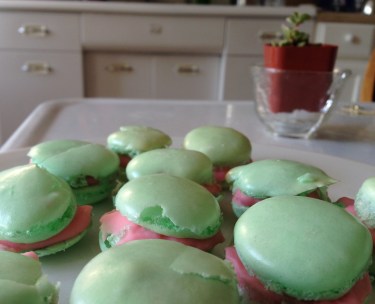
Reading at the kitchen table, my bare toes rub over the sugary effluvia of lime-green macaroon making on the floor. I keep reading.

The children wander in for more macaroons, my daughter’s afternoon vision yielding these quarter-sized airy sandwiches with a pink sweet filling.  While I was in the other room, trying not to listen while tediously working on a paid project, the girls, left to themselves, experimented with baking whipped egg whites (Wow, that’s weird), periodically carrying in a baking sheet of baked samples, the hot sugar still bubbling from the oven, asking my unskilled opinion. In the end, they assembled two dozen uneven tiny cakes, dripping filling. Extremely satisfied, they stand back. Look.

Writing this, I realize (again) our life is all minutiae. Maybe that’s the gem of having children – tiny things mixed in with cosmologically-sized love – Blake’s world in a grain of sand.

Check out this sentence about ancient triceratops and reading to children at bedtime.

That petrol (in a puddle) was extracted from crude oil, which was brought up from reservoirs deep under the ground and consisted of transformed organic matter from a time when human beings didn’t exist, only dinosaurs, those gigantic but simple creatures, and when trees and plants too were larger and simpler, and that it was the prehistoric force of that zoological and biological matter which now unfolded around us, all this made sense – the kinship between the bulldozer and the dinosaur was obvious to any child – but not the connection between the power of petrol and the mysterious beauty of the small trembling rainbow swirls in the many puddles of the 1970s.

Karl Ove Knausgaard, Autumn

FullSizeRender


Some Hard-Core Adolescence Advice

Here’s a great thing about living with a teenager: after making (and consuming) wontons, you linger at the table and discover your daughter is searching for a penguin.

A penguin?

Apparently, a mate for life, although the last I’d read some penguins are seasonally monogamous. Apparently, that’s a technical point.

I offered advice, which, as my daughter pointed out, might actually be useful, as I’ve messed up my penguin quest.

I rattled off the general look-for list – respectful, responsible, disciplined, generally decent and humorous – and finally said, Think about what he fills his life with, and what you fill yours with. Does he pursue money? Sports? Video games? Career? Will what he pursues bear out, decades later?

We ate the second batch of wontons. I mentioned what drove her father and I apart, in the end, was what we each love most. We kept talking, around and around, about little bits. She offered me the last wonton.

Here’s a few lines from an incredible essay my father emailed me. If you read nothing else this September, read this.

In the day-to-day trenches of adult life, there is actually no such thing as atheism. There is no such thing as not worshipping. Everybody worships. The only choice we get is what to worship. And an outstanding reason for choosing some sort of God or spiritual-type thing to worship — be it J.C. or Allah, be it Yahweh or the Wiccan mother-goddess or the Four Noble Truths or some infrangible set of ethical principles — is that pretty much anything else you worship will eat you alive.

– David Foster Wallace

FullSizeRender


Library Book Find

These early August morning, mist nestles around the house. Laundry left overnight on the line wets again. I’m reminded of the first three days I lived in Vermont – 18-years-old, in unbroken mist, concealing this new landscape. I had no idea where I had arrived.

Reading Knausgaard is akin to entering fog – uncharted, mesmerizing. Years ago, on a long expedition with my girls, I insisted we would take only what we could carry. At one repacking stage, my older daughter lifted a heavy hardcover book from my backpack and demanded, What’s this?

Knausgaard. Here’s a few lines from his latest:

What makes life worth living?

No child asks itself that question. To children life is self-evident. Life goes without saying: whether it is good or bad makes no difference. This is because children don’t see the world, don’t observe the world, don’t contemplate the world, but are so deeply immersed in the world that they don’t distinguish between it and their own selves. Not until that happens, until a distance appears between what they are and what the world is, does the question arise: what makes life worth living?

Karl Ove Knausgaard, Autumn

image2

Photo by Molly S.