Fire

Seriously? my 14-year-old demands. You want me to scrape paint? 

I’m merely suggesting it as a possibility, a fine August afternoon option before school begins next week. She opts to clean her chicken coop instead, which I can’t help but think is a healthier option.

At lunch, she shows me photos of the Amazon rainforest burning, immense swathes. She’s a Vermont teen; these are digital images that can’t possibly contain the heat and wind, the roar and terror of these fires.

Talking, I think of all the ways I’ve provided for this child and failed her, too — an American child who’s benefited from American largesse, and yet she’s a child who hasn’t seen her father in years.

On this breezy August afternoon, the crickets are working away, reminding us that summer’s yet here, but not for long. In her eyes, I see myself reflected. She cuts her grilled cheese sandwich in two and eats silently, filled with the power of adolescence.

The crickets felt it was their duty to warn everybody that summertime cannot last for ever. Even on the most beautiful days in the whole year — the days when summer is changing into autumn — the crickets spread the rumour of sadness and change.

— E. B. White
IMG_6313.jpg

Nearly 9th Grade

While the girls swim and jump off the bridge, I read a chapter in a history of Vermont — same old, same old.

We’re in the long, slow, cricket-singing days, just before school starts. The garden is jammed full, the leeks a failure, the nasturtiums a mighty army colonizing beyond their territory.

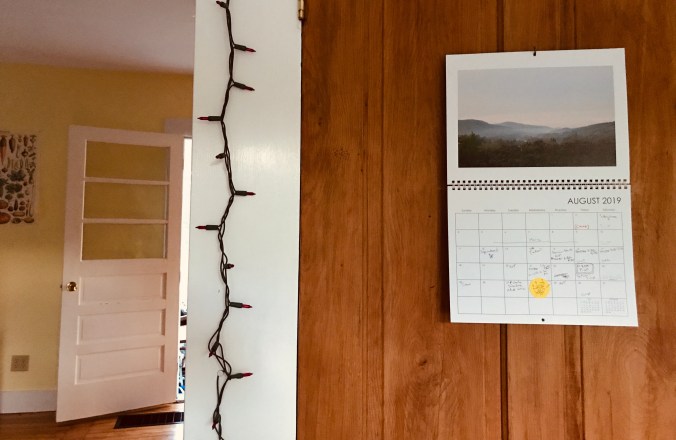
The days are jammed, too, with all the pieces of work, crammed in with When will we paint the barn? Fix the car’s exhaust. Mark when property taxes are due on the calendar. — All things I consider so important but will have forgotten in weeks, perhaps months.

The girls lean over the bridge in the sunlight, talking quietly, glancing at me and wondering if I’m listening. I am. I’m watching and listening, until I dive in and swim away, with only the lapping water against my ears.

On a branch
floating downriver
a cricket, singing.
— Issa

IMG_6306.jpg

Irritable and Not So

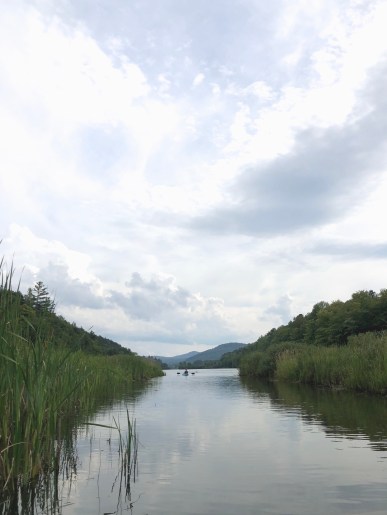
At the northern end of the reservoir, we kayak north, where the water flows into the Black River, crossing the Canadian border on its meandering way to the Atlantic.

Surrounded by cattails, we stop at a beaver dam, listening to the spilling water. The late afternoon is sticky, the water’s too mucky and weedy for swimming, the girls who have been up early either for soccer practice or work are out-of-sorts, irritable.

What’s on the other side of that beaver dam? I edge near, curious, but there’s no way I’m getting around.

Back on the wide reservoir, we spread out. At the far end, a loon calls, which fails to impress either daughter. The teenager says, I’ve heard that before.

And yet, hungry and tired as both daughters are, neither seems in any rush to leave. Clouds jostle against Buffalo Mountain in the distance, promising rain, but not too quickly. The girls’ paddles lie across their kayaks as we drift.

Later that evening, as I lie on the couch, reading, rain begins to patter down. The older daughter goes out for a run. The younger daughter and I pull on raincoats and cut through the thorny blackberries, silently, our faces wet.

IMG_5656

Photo by Molly S.


Buried Treasure

I look out the upstairs window where I’m working and see my teen and her friend busily digging a hole where young lilacs are growing along the cemetery fence.

They’re planting a half-gallon mason jar — their time capsule — carefully filled with things like a map of our camping trips and lists of their favorite things to eat. I watch them talking, and then they tie a pink scrap of fabric on the chain link fence, as if that marker will weather through the years.

Right there, I think, is childhood in a nutshell: a world that intersects with my grownup days, and yet lives busily — in fun and in seriousness — in their own. I haven’t seen what they stashed in that capsule, but I expect to see what emerges, whenever that may be….

A person isn’t who they are during the last conversation you had with them — they’re who they’ve been throughout your whole relationship.

— Rilke

img_1844.jpg

Things on My Kitchen Table

In my email in-box, these lines from Toni Morrison’s Paris Review interview appear:

I have an ideal writing routine that I’ve never experienced, which is to have, say, nine uninterrupted days when I wouldn’t have to leave the house or take phone calls. And to have the space—a space where I have huge tables. I end up with this much space [she indicates a small square spot on her desk] everywhere I am, and I can’t beat my way out of it. I am reminded of that tiny desk that Emily Dickinson wrote on and I chuckle when I think, Sweet thing, there she was. But that is all any of us have: just this small space and no matter what the filing system or how often you clear it out—life, documents, letters, requests, invitations, invoices just keep going back in.

For a single mother who often works at home, clutter is a major issue — and I don’t mean the Marie Kondo kind of clutter with too many piles of perfectly fine clothes or an overstocked kitchen.

I simply mean the clutter of living. On our kitchen table when I came home from work yesterday were bowls of just picked blueberries and green beans, a full coffee thermos I had forgotten, opened mail including a jury summons and a pay stub, a tube of hand lotion, an unopened packet of spinach seeds I intended to plant that evening, a $5 bill, a list I wrote for the 14-year-old (mostly checked off), what appeared to me as a random assortment of dates on a scrap piece of paper, a wildflower identification book, a half-eaten cucumber surrounded by a sprinkling of salt. And a fingernail clippers.

My daughters were cooking dinner, and the dining room table was set and (mostly) cleared of clutter. Life without clutter would be sterility, boredom, an emptied-out house. Or so I tell myself.

IMG_6292.jpg

Wandering, Mid-August

Three boys loop in circles on their bikes, eating popsicles and talking. Walking by, I note one boy rides an old banana-seat bike, not unlike my brother’s when he was a kid.

Monday evening, the neighborhood I walk through is unusually busy with people — a woman yanking yellowing pea vines from her garden, a young man powerwashing his deck, two women deep in conversation walking tiny dogs.

I pause at a woodshed where friends have built a tiny house to raffle for the local library addition project. The raffle’s this weekend, and we speculate about who might win. Kids, we hope. Not simply a cute toolshed.

We’ve hit mid-August when the cricket songs have shifted to a longer, slower sizzle, that gradual unwinding of their energy until the singing simply dwindles away in the fall. August is the season of gardens gone rogue — this year my enthusiastic nasturtiums have nearly eclipsed my peppers. The mornings are dim now; the mist moves back into the valley for the cool night hours.

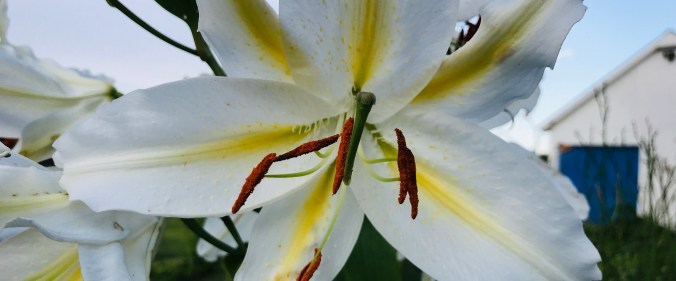
In the rose bed, whose flowers have long fallen, a single trumpet lily blossoms, and I wonder whose hands planted this beauty? Walking by, its fragrance pulls not only the pollinators but myself.

Here’s a line from a fascinating book I found in Maine — Don Kulick’s A Death in the Rainforest: How a Language and a Way of Life Came to an End in Papua New Guinea.

A language dies by contracting, by having its layers of complexity peeled off like an onion skin, getting smaller and smaller until there is finally nothing left.

IMG_6286