Journeys, More Journeys

Near the end of the last century — which really wasn’t all that long ago — my then-boyfriend and I spent a lot of time driving around the country. We were so young, and time seemed like an endless well we might draw from forever.

The other night, driving to the airport in the descending dusk, I remembered blood-red sunsets as we made our way across the midwest.

I think of the decades of my pre-children life as two-dimensional, although I know that’s not true. But when I became a mother, my own life grew, too, in ways I had never imagined.

In Burlington, I looked for a cup of coffee, but in that end of the city nothing was open but a Shell station where I saw a man bent over, mopping the floor. I stood in the new spring warmth and didn’t go in.

At the airport, two taxi drivers were laughing outside, talking in an accent I couldn’t recognize. Inside, it was just myself for a while, leaning against a wall and reading, and then slowly the airport filled up. Neighbors unexpectedly met each other, and I heard the update about a maple tree, blown over in a recent thunderstorm.

Then from that infinite night sky, my two daughters appeared, one tanned and one sunburnt, bursting with stories of their journey.

The only journey is the one within.

— Rilke
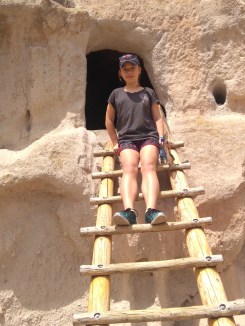
IMG_20180506_135507133.JPG

Frijoles Canyon, New Mexico

Zeke, the New Friend

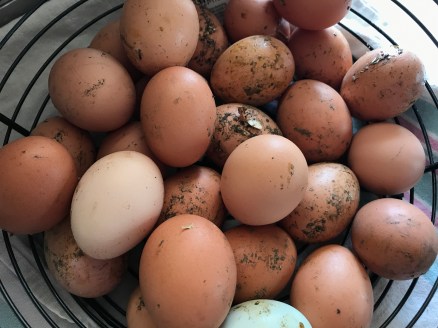
My 12-year-old returns from the southwest with the story of a bobcat who slept in the raingutter in her grandparents’ roof. She’s worried about the wild cat, who she thinks is too thin, unlike her own glossy, well-fed kittens.

The cat is my daughter’s main story of her faraway trip — this wild beast who seems remarkably tame and drinks from her grandmother’s bird bath.

Driving home in the dark, I’m listening to my two daughters’ disparate conversations about enchiladas and pueblo ruins and a stranger’s delayed flight. My daughter in the backseat keeps mentioning Zeke.

Who’s Zeke? I ask.

She answers, We named the bobcat Zeke.

IMG_1767.JPG

Metaphors

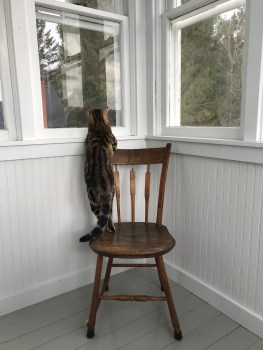
The front of our house has two small glassed-in porches, one on the first floor and one on the second. Since the windows are single-paned, we closed them off for the winter, leaving them as darn cold storage.

Our last house reminded me of a clipper ship, especially under the stars at night, with its tall and windowed cupola. This house, instead, on a hill, reminds me a lighthouse, its windows a beacon we can see all the way down into town.

The cats are happy to have the doors open to other rooms, coffee and laptop a portable office.

Aristotle, on the other hand, saw poetry as having a positive value: “It is a great thing, indeed, to make proper use of the poetic forms, . . . But the greatest thing by far is to be a master of metaphor” (Poetics 1459a); “ordinary words convey only what we know already; it is from metaphor that we can best get hold of something fresh.” (Rhetoric 1410b)

— George Lakoff, from Metaphors We Live By

IMG_1776

Acer on chair courtesy of Ben Hewitt

This Old Book

Walking with my friend through town, we find a cache of free, reeking-of-basement-mold books — a strange collection of Zen and psychoanalysis and car repair that might have come from my own  jammed shelves.

I pull out a skinny book with no title on its cover, only a black-and-white photograph of a long-haired girl in a white dress on a pile of rubble. An early edition of Brautigan’s The Pill versus The Springhill Mine Disaster.

For the rest of our walk, I hold the book loosely in one hand, past the the old granite cutting sheds, houses well-tended and houses abandoned, through the wet woods and blossoming bloodroot and a hillside of trout lilies just beginning to open. I keep thinking about my second book I’m finishing now, how I’m lacing together the connections within that story: a stolen jar of farmers market cash, a dead dog, a torn crimson scarf.

That night, reading the book, I discover a bookmark jammed in the book’s pages, from the Bedford, NH, bookstore of my childhood.

In a Cafe

I watched a man in a cafe fold a slice of bread
as if he were folding a birth certificate or looking
at the photograph of a dead lover.


— Richard Brautigan

IMG_1779.jpg

Black-Blue, Turquoise-Blue

Sharing poems with little kids this week, I keep reading this one:

I’m glad the sky is painted blue,
And the earth is painted green,
With such a lot of nice fresh air
All sandwiched in between.

While Long Winter in Vermont has its endless permutations of snowfall and cold, Spring in the Green Mountain state yields treasures every day — coltsfoot in this unexpected place, emerald so luminescent it seems nearly impossible. How quickly this season sometimes moves.

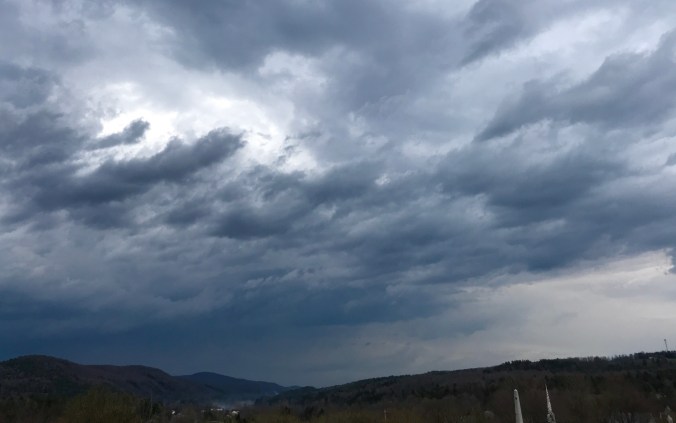
Last night, from the windows at the top of our house, I saw blue-black thunderheads far down the valley, and white curtains of rain. Rapidly, dead leaves blew against the glass, and handfuls of hail.

This is the morning for the other poem the kids especially liked, about a rain-glazed red wheelbarrow and white chickens.

IMG_1727.jpg

Waking

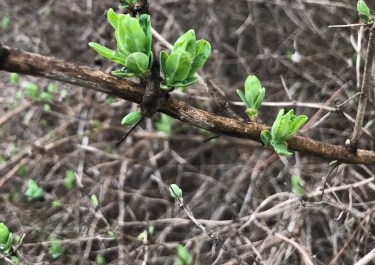
Not plausible, perhaps, but last night the current bushes still appeared as a handful of sticks. Early this morning, the world still damp with dew and rain, green leaves have emerged from those brown sticks, their tender folds already beginning to open.

No other words for this: spring in all her viridescent beauty.

She is working now, in a room
not unlike this one,
the one where I write, or you read…

Let her have time, and silence,
enough paper to make mistakes and go on.

— from Jane Hirshfield’s ‘The Poet’

IMG_1723.jpg