Yes.

When I moved to Vermont, Madeleine Kunin was governor — a particular point of pride for the state. Many years later, as a young mother, I took my small daughter to hear Kunin read at the packed Galaxy Bookshop in Hardwick.

Afterward, standing outside on the sidewalk, a female acquaintance remarked unhappily that Kunin emphasized the need for child care and greater economic opportunities for women. I’ve often wondered what my acquaintance wanted instead — this woman whose own family economics were provided by her husband’s salary. Putting bread on our children’s table is neither masculine nor feminine, but the power to determine some tenor of the shape of our lives.

Last night, I heard Kunin, at age 85, speak again — how surprisingly funny and how gracious. At the end, an audience member asked the expected question: what do you think of the world now? Kunin stepped back from the podium and raised her hands, meeting this question with just a fraction of silence, before she answered. Be engaged. Listen. Converse. Be persistent.

At the end, she amended her answer: Make trouble.

Poor privilege white men. Their stranglehold on power is slowly being loosened.

— Madeleine Kunin

IMG_1043

Photo by Molly S.

Beautiful Travels

Reading Daniel Mason’s new novel, The Winter Solider, I’m reminded of first reading Russian novels — Tolstoy, Dostoyevsky, Turgenev — when I was a teenager. How hungry I was for those books — what will these characters do? — in their snow-buried landscapes. Tender green shoots of spring poked through the gritty ice.

This reading mirrors the kind of life I carved out as an adult. Live on a hundred acres of woods, work outside in all weather, pull your toddler along the backroad in the sleet, just because…. Know that where the moon rises above your house is essential. Be afraid; know that the snow and the long-toothed northern cold can and will maim and kill, but how beautiful this world is…..

They were five hours east of Debrecen when the train came to a halt before the station on the empty plain.

— Daniel Mason, The Winter Soldier

IMG_3580.jpg

Cambridge, Vermont

The Moral Arc

The fall after I graduated from Marlboro College, I was living in Brattleboro and working at Omega Optical where I crafted tiny round glass disks used as high-tech light filters — a strange and short-lived job for me.

That fall, David Souter was nominated for the Supreme Court, and on NPR we listened to every word of the hearings. A bachelor, Souter lived in Weare (pronounced where), New Hampshire, not far from where I grew up, a little town I knew well. Brilliant and witty, Souter made New Hampshire proud.

That fall, young as I was and newly in love, I rightly considered myself an adult. I walked to the company’s enormous building, not far from where I lived, and whose back doors opened to the weed-flanked railroad tracks, just above the wide Connecticut River. Before the winter, I knew I was unsuited that job and moved on. By the next spring, I was living in a tipi, and then my boyfriend and I packed up our old diesel Rabbit and a rusty Saab and moved west to graduate school.

I was glad to join adulthood, even though, as any young person, I had no idea how difficult that would be, how piercing a price the world would extract for my share of wrongdoings. My teenage daughter once urged me not to take our arguments personally — terrific advice. Step back; breathe. Justice isn’t personal to me, or anyone else, either. Watching her sister’s soccer game yesterday, in a row of women talking about Kavanaugh’s confirmation, I’m still astounded that she’s now one of us, more grownup than teenager, with all that means.

My fury about people is based precisely on the fact that I consider them to be responsible, moral creatures who so often do not act that way.

— James Baldwin

IMG_1005

Photo by Molly S.

Hopeful Strings

In the night, the cold moves in. The evening before, returning after work in Vermont’s “big city” of Burlington, the frogs chirped, and the air, drenched with a heavy rain, was suffused with the hummus-y scent of soil and leaves beginning to turn and rot.

This morning, the crescent moon shimmers.

Against the noise of the news these past few weeks, as I’m feeding the cats, I think of Leslie Schwartz, in Los Angeles County Jail, tenderly nourishing tiny sprouts from apple seeds, the slenderest of life, nonetheless growing within concrete.

So I fell in love with the apple sprouts the way one might a newborn.

— Leslie Schwartz, The Lost Chapters: Reclaiming My Life, One Book at a Time

IMG_3533


Vermont Dawn

It’s autumn here. Better — Vermont autumn — a landscape hordes of people drive and fly hundreds, thousands, of miles to see.

Because the world is dying down, my prolific garden beginning to crumple, autumn always seems to me the season of memory.

A memory of pulling beets and carrots in an enormous garden while my friend’s husband lay in the house, dying of skin cancer. More happily: a memory of my older daughter’s first Halloween costume, a piece of a sheet I cobbled into a baby ghost costume.

Tricia Tierney directed me to Leslie Schwartz’s The Lost Chapters: Reclaiming My Life One Book at a Time. Late nights, I lay awake reading, thinking how glad I am not to be jail. Early one cold morning, I pull on my down jacket, a beautiful turquoise hand-me-down, now worn thin and stained at the cuffs, and follow the path behind my house, disappearing into the darkness and walking all through the sunrise, the ebony sky streaked through with endless ribbons of luminescent pink.

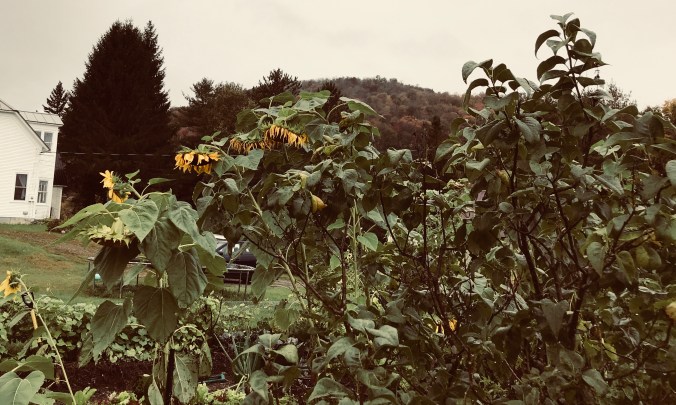
Schwartz writes, “Writing is survival.” Surely creative work of any kind carries us along. Like the Vermont landscape I live in, creativity has its cycles, too, my garden’s sunflowers shedding their golden petals, bending down for winter’s dormancy.

IMG_3553

Gathering Kindling

My daughters and I watch New York Times clips of Dr. Ford, my 13-year-old’s eyes wide, her hand paused over her algebra homework at the kitchen table. My 19-year-old and I talk and talk, and then she replays Kavanaugh’s testimony. The 13-year-old says, in wonder, Someone is lying. She ponders this, then says, Why would someone lie?

Tomato vine by cauliflower plant, I empty the garden, exposing black earth, finishing the final coat of white paint on a few patches of clapboards, eyeing the porch windows and gauging when I’ll plastic those for the winter’s duration.

In the dark this morning, my daughter and I talk briefly in her room, rain beating on the roof. Cold October rain illuminates foliage colors, tugs out the very best. I mention I’m going to paint the dining room a sunflower color this weekend, the window trim Santa Fe blue. Cool beans, she says.

What concerns me even more, though, is the loss of those values the (communal) fire precipitates and reinforces… How will the affirmation by others of one’s own necessity in the world be validated? What will be the opportunities for profound courtesy and for ceremony, of which there is such a dearth in the modern world?

We can lose the communal hearth and survive, but survival without the values of the hearth… seems a brutish prospect, a retreat into intolerance.

From Barry Lopez in Hearth: A Global Conversation on Community, Identity, and Place

IMG_3523.jpg