10,000 Years of Pollen: Storyline

An expert in New England’s ancient forests shares the story of taking a core sample from a pond not far from my library — easily within a few hours’ walk — and extracting 10,000-years-worth of planetary history. 10,000 years of pollen!

I’m standing in the dark in the back, while a few latecomers step in, carrying the cold on their coats, kicking snow from their boots. I’m also coincidentally near the hot tea, which I urge my guests to take.

10,000 years. His chart graphs the fluctuation of trees in this plot of Vermont — the persistence of beech, rise of rock maple. Exquisitely, I think of a larch not far from the library, how cool and welcoming that forest is in the summer, how brilliantly yellow its autumn needles. The extremely large view and the absolute specific.

Afterwards, finally home with my girls who are in an especially good humor, I think of the UVM museum my youngest and I just visited, chockfull of very ancient human artifacts, a variation of pollen — and in particular the arrowheads found along Lake Champlain. Whose hands made these?

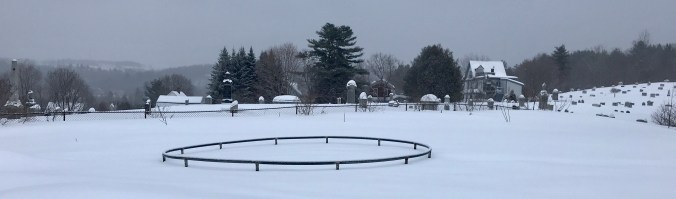
Still socked in by winter… no pollen in the wild wind in the conceivable future…

IMG_4786

Specific child, specific 5 degree day, Burlington, February, 2019.
The Lion, and The Lion Again

These days, I’m always writing about the weather and here’s why — with a vengeance, winter hurls at us.

In a select board meeting last night, someone paused and said, The wind. Soon afterward, the lights snapped out. In the utter dark, I stood talking, bodiless, about agenda. The town clerk appeared with two battery lanterns, her face flickering with shadows.

The 13-year-olds pulled me into the town vault where the clerk had shown them a book of vital records, each certificate in a plastic sleeve. The girls had gone wild about the death certificates, reading aloud cause of death: thrombosis, carcinoma, asphyxiation from car exhaust in a closed garage.

I read about a woman who had shot herself in the chest, in the 1950s, down the road from where I once lived. In my mind, I repeated her name and age.

The town clerk showed me handwritten ledgers from when the schoolhouse was built in 1914. Nails, $6.50.

At home, the power was out, too, and I finished knitting a baby sweater by candlelight. Before we went to bed, we looked out the second floor bedroom windows at the dark valley, a snowplow carrying its own light along Route 15. I reminded the girls of reading about wartime, in so many other times and places, when families shut off their lights, in fear of bombing. Three degrees. The wind shrieked around our house.

I lay on my daughter’s bed, listening to her day of babysitting and kid stuff. She knitted by her little lantern while I watched the shadows of her moving hands on the ceiling. A cat curled between us and slept.

6rI36jhT

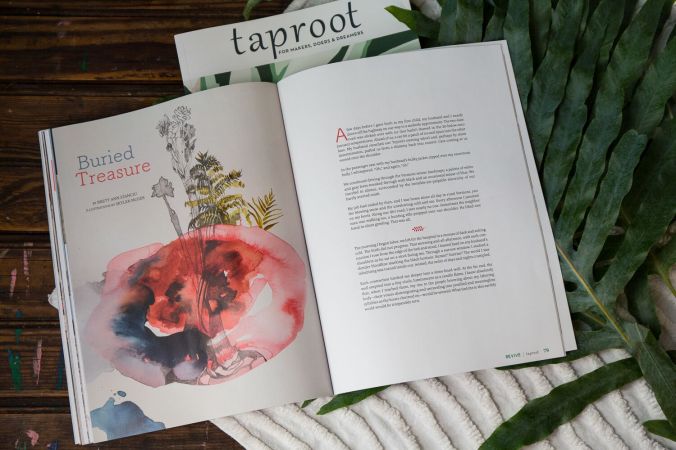
Artwork from the recent Taproot issue — appropriately titled Revive — where an essay of mine appears.

Wander with Laughing Teens

The girls put effort into dressing for a walk through the sugar woods — hair up and all in black, save for a borrowed pair of colorful leggings. In capitulation to winter (which remains), I exchange my holey and holy jeans for a better pair and pull on a raggedy sweater.

We’ve stretched into Sunday and into winter school break, with waffles in the shape of maple leaves and needlepoint projects the girls have pulled out of drawers. I’ve finished my taxes and offered what was apparently an incredibly dull overview of federal monies — who profits, who doesn’t. It’s no loss — the girls shake off the warmth of our kitchen and greet the wet woods and sprinkling rain with joy.

The woods are misty and ghostly, crisscrossed with animal tracks. The maples bend overhead, whispering their secret language. The 13-year-olds jump on each other’s backs like puppies, giggling, and empty snow from their boots.

After reading Donald Antrim’s harrowing essay in the recent New Yorker, I picked his memoir, too.

People are fond of saying that the truth will make you free. But what happens if the truth is not one simple, brutal thing?

— Donald Antrim, The Afterlife: a memoir

IMG_4779

Hardwick Town Forest, tapped in for sugaring


Running Icicles

Birds are singing this morning when I step out on the back deck, and walk barefoot to the edge of the covered porch to see the blue layers of mountains and valley, the gray clouds from horizon to horizon, thin enough that sunlight might emerge, later this morning. It’s 3 degrees, and I don’t linger long, lacking socks and all.

It’s winter break for Vermont school kids, the week that straddles into March’s first Tuesday Town Meeting Day. While a surprising number of families I know are flying elsewhere — warmer climes, assuredly sunny beaches — ironically, I’m writing an article about parenting on the cheap, a topic I’m intimately familiar with. The writing will be creative and even informative, but the 2,000 or 2,500 words might as well be compressed into don’t spend, my general roadmap.

If economy is my roadmap, though, the compass points are not in the least money-related. Years ago, I walked around the halls of the Dartmouth Medical Center, baby in my arms. We were really merely passing through — our stay was so minor — but the stay of many, many others was not. I stood in one cathedral-ceilinged lobby, baby girl sleeping with her tiny head on my shoulder, listening to a man play a Mozart sonata on a grand piano. On a wall hung a painting of a red tulip in a flowerpot with take joy written below.

Those two words? A challenge, perhaps, but a reminder of sheer possibility. Yesterday, icicles dripped from our roof, all morning.

And, as always, it’s a pleasure to appear in State 14 again, sending out a Postcard from Hardwick.

(Happiness comes) ….to the clerk stacking cans of carrots
in the night.
It even comes to the boulder
in the perpetual shade of pine barrens,
to rain falling on the open sea,
to the wineglass, weary of holding wine.

—Jane Kenyon, from “Happiness”

IMG_4755

Midwinter Mail

On a day when winter seems determined to seal over our house in a re-emergence of the Ice Age, the mailbox yields something interesting besides the usual jumble of instant recycling.

My daughters collected the mail and left it on the kitchen counter. When I walk in from work, the girls tell me about their days. One daughter fries bacon, the other presses pecan halves in a geometric pattern in a pan of brownie batter.

I toss out the junk assortment of credit card inquiries, a bank’s repeated request to sell me life insurance. The state has kept us on their health insurance, and announces this in three different envelopes. Glossy Taproot magazine sends two copies of their recent issues with an essay of mine, utterly satisfying me. At the stack’s bottom is a fat envelope with court papers in my attempt to collect child support. Earlier that morning, I’d decided to walk away from that battle, but perhaps not. I toss the envelope on my desk.

The jumble of mail, I can’t help but note, reflects a tiny facet of our life, and I’m wondering what jammed up the neighboring mailboxes. The girls are full of energy about a walk they took that afternoon on the local trails. Well after five o’clock, daylight hasn’t given up yet, and that seems a kind of promise, despite the snow surrounding us in a mimicry of Shackleton’s ice. A better ritual than mail is dinner. One daughter lights the candles. The cat mews an inquiry for bacon scraps.

Living with two teenagers through a prolonged winter, with heaps of snow and nearly endless cold has likely brought me to this same and extremely familiar place: what the heck, exactly, am I doing? This has been a philosophical winter, but, good lord, I’m ready for some barefoot weather. But enough. We’re warm and well, and did I mention a collection of essays about schizophrenia came in the mail, too…..?

All I see in hindsight is the chaos of history repeated, over and over, reenacted, reinterpreted, the world, its fucked-up heart palpitating underneath us, failing, messing up again and again as it winds its way around a sun. And in the middle of it all, tribes, families, people, all beautiful things falling apart, debris, dust, erasure.

— Valeria Luiselli, Lost Children Archive

IMG_4726.jpg

Kids’ trampoline, hibernating on the lawn….

Why Read?

February — surely the freaking longest month of the year in Vermont.

Unable to endure the unremittingness of winter, I’ve taken over the couch with my laptop and Valeria Luiselli’s Lost Children Archive. Unableto tell my friends and library patrons about this book — as then I might be forced to hurry, hurry and read, read, to pass this novel along — I’m sunk down deep in this story. What to love? The book is the American road trip (and I’m a sucker for road trip stories, a veteran of innumerable mishaps along my own blue highway adventures), told by a mother who understands the importance of buying coffee for grownups and cookies for the kids, of unrequited lust, of a marriage bending, of the thrust of creative work, of how all those pieces fit and don’t fit together.

I slept on this couch for over a year after my husband left, unable to sleep in our former bed, the room we built with the balcony and double glass doors, the windows on three sides, the moon rising over my prolific garden. The couch, I discovered, was enormously comfortable, and the (former) marriage bed a possible remnant from the Middle Ages.

I purchased this book with library funds, with actual property tax dollars from the taxpayers in Woodbury, many of whom I know. When I’m finished with the novel, I’ll pass it along, happy to hand it over to my reading friends. But in the meantime, I spy many February days on the calendar remaining. I’m in no particular rush to finish. The brighter and warmer days of spring are most likely an illusion — and I’m hoping for a breathtaking ending to this novel…..

But the sea
which no one tends
is also a garden…

William Carlos Williams

IMG_4720.jpg