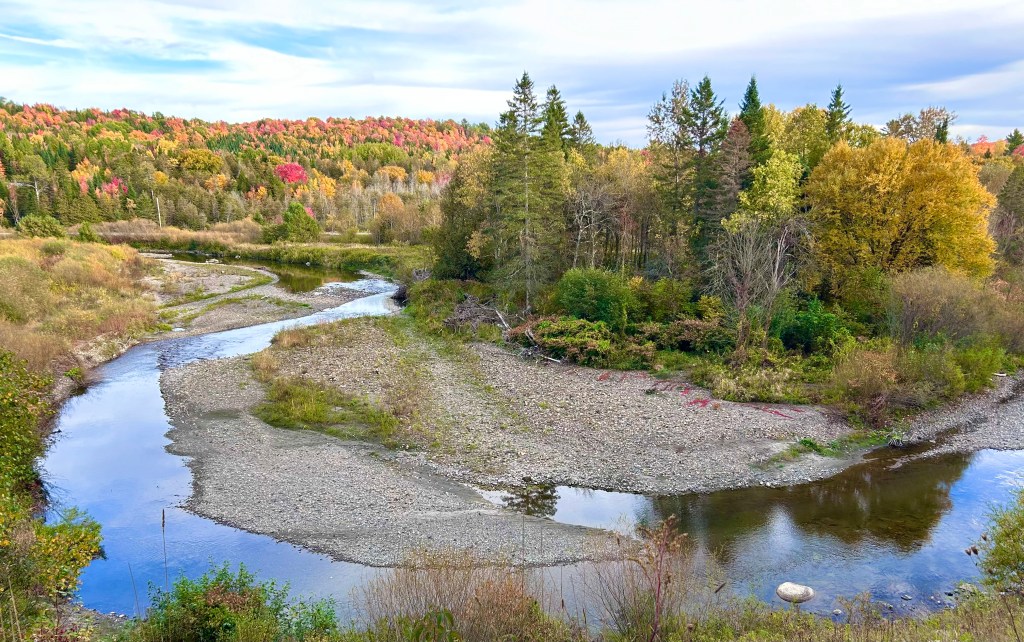
Intertwining: Beauty and Broken.

Three afternoons in a row, I run along the rail trail and pause at this ox bow in the river. The Lamoille is beginning to gather its water might here, a handful of miles from its northern headwaters at Horse Pond. The dry air smells of pine needles heating in the sunlight, a scent that reminds me of camping in childhood. My parents, rich with wanderlust, never hesitated to tie sleeping bags and tents on our old green Jeep’s luggage rack, pack a family duffel bag, and head out for a month or two of open air living. Those days, a dollar would get us a night in a national forest.

This run is a flat span, nothing remarkable in distance, a path through evergreens, along farms, across a few dirt roads. Late afternoon, I’ve seen no one here but little yellow butterflies, the crows of course gleaning in the cornfields, three swimming otters. The tourist at the trailhead with his watercolors and brush.

I’m a collection of shoulders, hip bones, ankles, a jostle of organs and tendons and my own unceasing thoughts, curious to see this river in the foliage that shifts and mutates each afternoon. Again, disease taught me how strength can fetter me, fetter you, more fiercely to this mortal world.

Returning, sweaty, I pause at the bridge where the man is painting. Each afternoon, we admire this season’s extraordinary beauty: gold and crimson. “Little patch of Vermont wild,” he says.

The night before, under a waning moon, a friend and I walked along this trail. The night folded around us. The starlight thin threads on the running river. How far will we go? we asked each other. Owls called. The night spread around us, infinite. Forever, I thought.
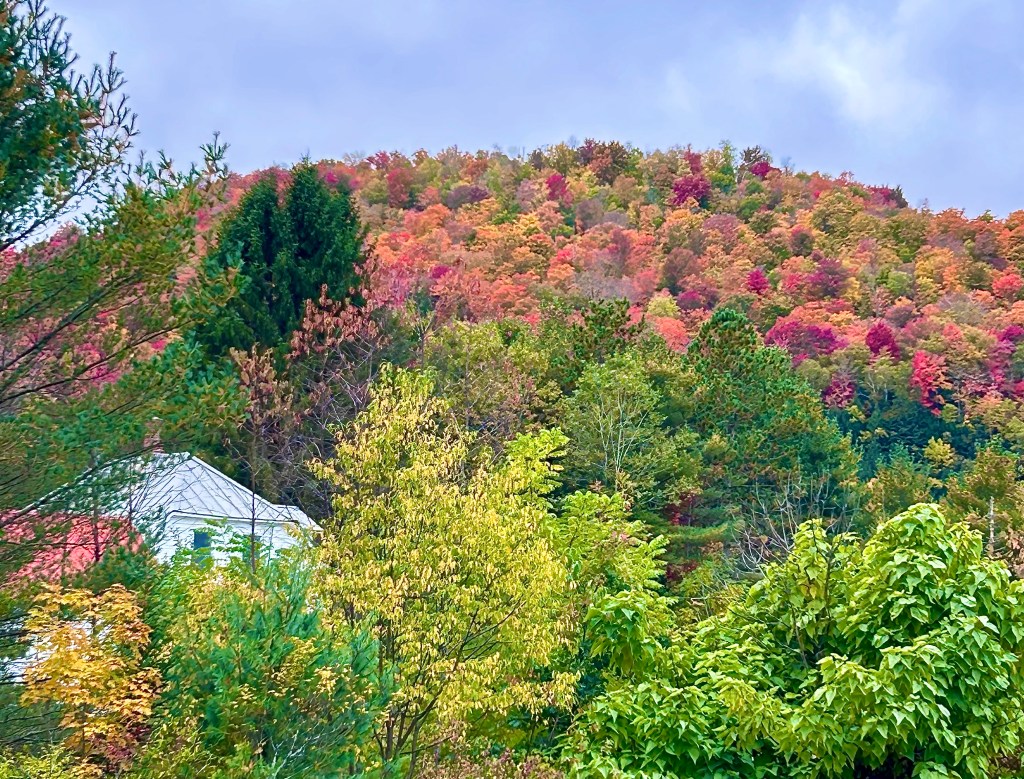
….. and thanks to another walking companion who introduced me to Lyanda Lynn Haupt:

“Hope is not a remedy or even a substitute for the despair and anxiety we face in the modern world, but a companion to these things. Mature hope involves a willingness to allow that brokenness and beauty sometimes intertwine.”
Looking into the Longevity of Our Stories.

Writer Tom McKone called me last week for a CALL IT MADNESS interview. We spoke for longer than either of us had expected, as I leaned over my back porch railings. His review ran in yesterday’s The Bridge. McKone is my ideal reader: curious, thoughtful, precise. Writing a book requires years—years of labor that has zero relevance to a time clock; labor that demands writing through doubt and kismet; labor that gleans from ebullience, nihilism, and that broad plain of gray uncertainty. There’s a splash when a book is released, a flurry, but the goal? The real desire? Have a reader sink into a hammock or lean against a swaying subway wall and read.

An excerpt follows.

“Our memories, where and when we’re born, and our family, social environment, and economic situation can shape who we are,” Stanciu said. Mentioning the work of mythologist Joseph Campbell, she said it is very hard to “step out of that repetition of the past,” especially when that past is burdened with poverty and alcohol.

“One of the things I hope people get out of this book is the ability to ask questions (and) to be curious,” she said. “Why do people act the way they do? What do I not understand about them — both when they behave well and when they behave in infuriating ways? I think it’s always been a relevant question, but it’s super relevant right now — not to see each other in two-dimensional ways, but to really look into the longevity of our stories.”

Domestic Chaos, Evening Pleasure

We’re eating pumpkin pie made with not enough maple syrup. In the scheme of things, that’s pretty darn minor. The kids, I’ve noticed, have stored the maple syrup in the cabinet above my head — which, no biggie, I could easily stand on a chair per usual and help myself. Nonetheless, why bother?

The bathtub drained is plugged, the chickens wandered on the back porch and shit, we’ve eaten brown rice for three days now and no one seems in the least interested in leftovers. It’s autumn, sometime, pretty leaves all fallen and withering.

Dusk, I walk a few loops around the high school. A flock of starlings sweeps over the sky and perches in the bare branches of a maple tree, chittering. Back at my car, my daughter and her friend are on the hood of my car, laughing at something — maybe me? — hungry. They’ve been making “guts” for a Halloween project, but ran out of red food dye to mix with their Vaseline and corn starch.

Really? I say. What’s the recipe? In the thickening gloaming, I sit on my car hood, too, listening, as if there’s all the time in the world.

…we are everything, every experience we’ve ever had, and in some of us, a lot of it translates and makes patterns, poems. But, my God, we don’t even began to touch upon it. There’s an enormous amount, but we can touch such a little.

— Ruth Stone

95F74A8B-4FAB-4E26-A0CD-FAB248875865.JPG

Teen World

This blog has been jammed with soccer, soccer and even more soccer all fall — a little odd, from a woman who ducks every time the soccer ball heads even anywhere near me along the sidelines.

But the soccer field and the locker room and the school bus is the terrain of my teenage daughter this year. The night of the game under the lights I walked across the field afterward — in a coat and hat and scarf, the first snowflakes tiny glitters — and realized I was treading in her familiar space.

It’s such a cliché — the days crawl and the years fly — but there’s truth in all these clichés, too. When she was an infant, I realized — busy as I was then with another child and that relentless maple syrup business — that this was all I was going to get in this life. Just this second time around of being a new mother. That sentiment has carried all through her life, crazy and jumbled as it’s been, defined as a single parent household. And yet here she is, on a soccer field, laughing and happy with girls and their ponytails. I can’t help but wonder curiously, Where will all these running steps on those soccer fields around Vermont carry her in this life?

We create meanings from our unconscious interpretation of early events, and then we forge our present experiences from the meaning we’ve created. Unwittingly, we write the story of our future from narratives based on the past…

— Gabor Maté, In the Realm of Hungry Ghosts

IMG_6682.jpg

Neither Wolf Nor Dog

My daughter looked up from her geometry homework and asked why I was laughing. I shared with her a few lines about soup and dogs from my library book — a book one of my blog readers and commenters had recommended —Kent Nerburn’s Neither Wolf Nor Dog: On Forgotten Roads with an American Elder.

I’m lucky enough to scavenge time to read — and I read fairly quickly — but this particular book I wasn’t in any particular rush to finish. So much of our world is talk, talk and words, words. This book is filled with silence, too. Sometimes in life, too, you’re fortunate to read a book at precisely the time in your life you need to meet that book.

Many thanks for the recommendation. I’m dropping this book in the library return box this morning, passing it along to another friend.

Everything happens for a reason. You’re here for a reason. It’s time you stopped worrying about some damn truck and got figuring out what that reason is.

IMG_6669.jpg