One Life Instruction, via Mary Oliver

Last summer, we were eating dinner with friends who have young children, and two couples compared notes about their toddlers drinking dirty bath water. I laughed and assured them, yes, someday their kids would brush their own teeth. The real challenge, I claimed, was when the teenagers take off in the Toyota.

As I often am, I was wrong. What about when a child decides to disappear into a remote mountain wilderness? Or head down her own path of parenthood?

In my forties, now, I’ve reached the point where life is no longer that amorphous, endlessly murky terrain, but indeed life stretches out, far more winding than I ever would have imagined when I was twenty. Perhaps it’s the decade of my life, but now separations, cancers, loss and loss again, is no longer uncommon – which perhaps is why good news is so much sweeter. Every one of these babies born well, a new house, a book published, a journey completed in good humor.

Or this: my girls with their long legs sprawled on the couch, laughing about silly things, nothing more, just silliness. Long life is made of little tiny moments: soak up the sweeter ones.

Instructions for living a life.
Pay attention.
Be astonished.
Tell about it.

– Mary Oliver
IMG_2047.JPG

The Jungle Between Us

Although in Vermont it’s a beautiful August right now, in winter the snow piles awfully darn high, and when I had little kids, we were often snow-bound for days. When I was pregnant with my second child, I read every bit of many New Yorker issues, all the way down to the ads. It was one long winter. In an essay years ago by James Wood, he wrote wondering who read his book reviews, and I wanted to answer: me! They’re my personal literature course.

It’s such a pleasure to get reading material in the mail. This issue of The New Yorker has an article about an isolated Amazonian tribe. It’s a story of two tribes with a shared history, and the two different paths they chose. One came nearly out of the forest, the other retreated more deeply within. It’s fascinating journalism, and a perfect metaphor for how profoundly we don’t understand those nearest to us. 

This word compassion comes up over and over this summer in my life. What does a quality of heart mean? Perhaps compassion demands a measure of acceptance that we’ll never truly know another, that the immensity of jungle permeates much of human life.

It is easy enough to be friendly to one’s friends. But to befriend the one who regards himself as your enemy is the quintessence of true religion. The other is mere business.

– Mahatma Gandhi

IMG_2037

Greensboro, Vermont

The Stars

I first fell in love not with Vermont’s pastoral landscape but its nightsky. I grew up in a New Hampshire village, so the New England terrain was intimately familiar to me, but the constellations were dimmed by the town’s lights and curtailed by roofs and wires. When I was eighteen, I moved to rural Vermont, and the first night there, I lay in bed, staring out the uncurtained window at all those stars. Uncountable. I was beyond smitten.

In America, a country of such material excess, the whole force of the culture often seems to push for more, more, more. Of course, I understand as much as anyone the mathematics of economics, of raising children and hard work and a driving need for stability; none of that necessarily excludes our human need for the stars. Shouldn’t we encourage our teenagers to envision their adult lives as productive within the real context of earth beneath the soles of your feet, stars arced over your head?

Early August in northern Vermont: the children are tanned and healthy, the asparagus has shot taller than any 11-year-old, our pockets sag with lake pebbles, and the cucumbers are crisp and profuse on the vine. That’s something.

On the white poppy,
a butterfly’s torn wing
is a keepsake

– Matsuo Basho


FullSizeRender

Knowing

When my daughter was five, she took Red Cross swimming lessons at Caspian Lake in Greensboro, and at the end of the two-week session, her coach guided the little kids to the deeper waters where they could then stretch down with their bare feet and touch a large flat rock named Big Yellow.

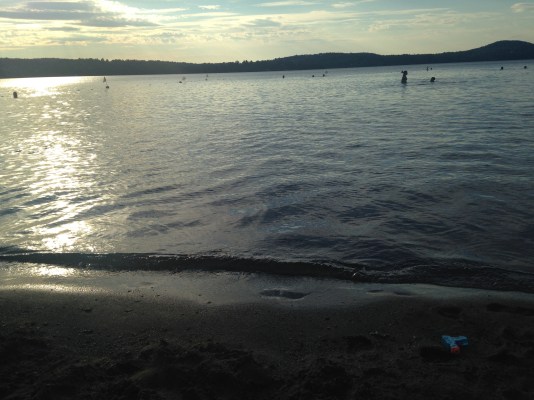
For my younger daughter, this is the summer of Big Yellow, a time of swimming with her friends to this nether region, flipping over in this gorgeously cool and clean lake, diving down with goggles, and surfacing with handfuls of smooth lake pebbles.

For generations, kids and adults have known this place in the lake through name and through experience. Watching the girls this late afternoon, I reminded myself again that knowing is both language and action. The name is essential, but so are the water-logged fingertips digging into the sandy lake bottom. As a writer, I often take that combination into the less sparkling areas of adult living; as a mother – and a woman – I’m taking my turn in these pristinely August Vermont waters.

But what is the way forward? I know what it isn’t. It’s not, as we once believed, plenty to eat and a home with all the modern conveniences. It’s not a 2,000-mile-long wall to keep Mexicans out or more accurate weapons to kill them. It’s not a better low-fat meal or a faster computer speed. It’s not a deodorant, a car, a soft drink, a skin cream. The way forward is found on a path through the wilderness of the head and heart – reason and emotion. Thinking, knowing, understanding.

– Laurence Gonzalez, Everyday Survival (a book well worth the read…..)

FullSizeRender.jpg


Book Group

For years, my daughters and I have been eating peppermint stick ice cream at Cassie’s Corner in Greensboro, Vermont, while admiring an immense red barn just across the side road. Who lives there, we wondered?

This sun-filled afternoon, I was lucky to sit with a group of women who had all read my novel and asked stellar questions. What a gift for a writer. Often, I imagine myself straddling the outside ledge of a cupola, my fingers hardly holding a grip, my toes clenching a ballpoint pen, while I fervently ponder plot and backstory and spy on passersby. The truth is, maybe I just need to get out more.

Many doors have opened to me via Hidden View, but to sit with a group of smart women, talking about craft and literature, is an especially savory bit of summer. Who knew open barn door would reveal such a stunning view of the lake  – and couple that with conversation? – terrific.

One has to be just a little crazy to write a … novel. One must be capable of allowing the darkest, most ancient and shrewd parts of one’s being to take over the work from time to time.

– John Gardner

FullSizeRender

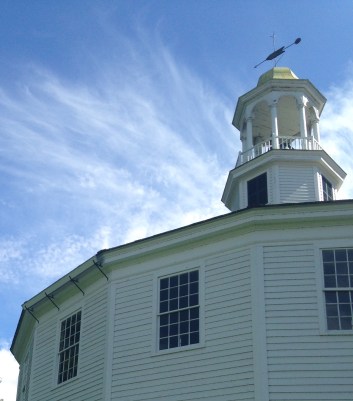
Round Church in Richmond, Vermont


Singing Season

We’ve reached the point in the summer where the crickets’ song is gaining the upper hand, slowly rising in volume and intensity and the songbirds’ melody dwindles, and then, eventually, the crickets fade, too.

End of July is lush and full; end of July is swimming season.

In the last week, we’ve swum in four lakes. Beneath our bare feet, the sand varied from pebbles to smooth as wet dust; the water murky or clear from our shoulders to our toes. Ever present are the Vermont mountains, from Craftsbury’s smaller hills to the sheer cliffs of Willoughby.

Sonorous is the word for this season; let it ring.

Here’s what I’m reading these days:

But there was something there, something imperfect, something sharp and bent and rusty, that tore into him somehow, that made him believe the human condition was one great and mournful but still achingly beautiful cry.

– John Gregory Brown, A Thousand Miles From Nowhere

IMG_1942

Lake Eligo, Craftsbury, Vermont