The Making of Things

If you write about Vermont, you’ll write about rain. There’s a myriad ways to know rain: lying in bed on a summer evening with the windows open, relishing the needed watering of thirsty garden greens, or the unwelcome tear of November ice in your eyes.

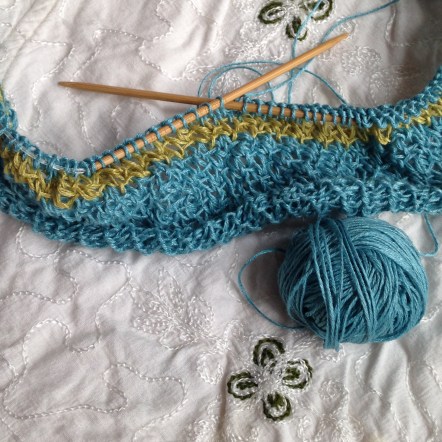
In knitting, my hands know how to create using wool (or linen or hemp) and needles. I can read a pattern, measure and gauge, but the bulk of that knowledge is through the experience of my hands and eyes. My fingers know if the tension is right, or whether to rip apart and begin again.

My daughter draws beautifully; something I cannot do at all. When I ask her, how do you do that? she says she doesn’t know. But yet, clearly, on some level, she does know. She just hasn’t yet articulated it. Writing, too, is that fascinating mixture of craft and raw, direct experience. Rain is a handful of soil so sodden it runs between your fingers, or lies heavily over fields and lakes, so dense and unending it might as well be a territory unto itself. Like Janisse Ray’s lovely line: Sometimes all day, days, rain falls.

But once I held
a kingfisher
in my hands,
I touched its blue power.
That may be the only time
I ever do.

From Janisse Ray’s “Kingfisher”
IMG_1544

Cutting Wood and Soul

The first piece of writing I ever published that I made any kind of money from was titled “Maple,” and it was about the intense labor of cutting wood. As a family of sugar makers, for years we cut and split wood at far greater amounts than almost anyone else we knew. Particularly through my older daughter’s life, cutting, stacking, and hauling wood, has been a constant.

In that autobiographical essay, I wrote: “Perhaps it’s that Puritan streak driven so deeply in my soul, but I believe that living demands its toll: that creation is lockstep with destruction. As such, wood forms the crux of our life, the cycle of our turning days, months, years. And yet this rural life has also bequeathed my girl her wild wood.”

Today, undergoing yet more repair of a tooth broken twenty years ago when a piece of firewood fell from a pile stacked too high, I realized, again, our souls may be fierce, but we live and die by the body. It’s a marvel to realize something as small as tooth may do in a body. In the chair today, with my eyes closed, I smelled an antiseptic that reeked of bleach, and then…. cloves. Cloves? Exotically rich, sensual, nourishing. Could there be a greater juxtaposition?

The young endodontist showed me the film of my tooth, its root illuminated like a miniature splinter of lightning. In his pleasant, southern accent, he advised me to think good thoughts. I intend to. But I will also never stack wood higher than my shoulders again.

…When I was ten
we lived in a bungalow in Indianapolis…
Once I got up and went outside.
The trees-of-heaven along the track swam in white mist.
The sky arched with sickle pears.
Lilacs had just opened.
I pulled the heavy clusters to my face
and breathed them in,
suffused with a strange excitement
that I think, when looking back, was happiness.

Ruth Stone, from “What We Have”

IMG_1542

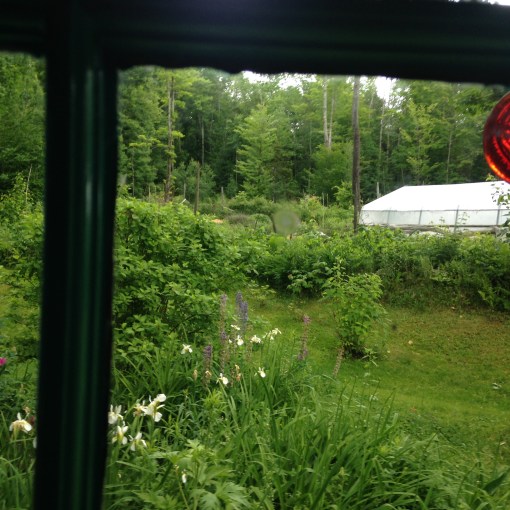
the kitchen window


Girls Under the Influence of Moonlight

The moonlight shone mightily last night. My daughter and her friend made a bed beside the large living room window and lay watching firefires through the screen. They were hot, satiated after a day of soccer and lake swimming, roasting marshmallows outside over a fire.

In the evening, a breeze flipped the leaves upside down, a sure sign of a rainstorm coming in. Reading The Little Red Chairs upstairs with the windows and balcony door open wide, the frogs and owls sang. I listened for the little girls to quiet, but they kept whispering, and I heard them laughing as they played cards by flashlight. Later, they ran up the stairs, enormously excited as the teenage sister had snagged a mouse in the live trap, and could they, please, they begged, hands folded beneath their chins, drive the mouse down the road to find a new house in a field?

We were at that point in the night where I wasn’t sure whether anyone would sleep at all, but the night was so magically alive, just brilliant with moonbeams, and the little girls were so excited at this mouse adventure, that the older sister of course took them along, too. Why not?

Later, when the thunderstorm broke, I walked around the house with the lightning flashing, the girls curled motionlessly in sleep, and I quietly closed the windows over their pillows. In the morning, sleepy-eyed, wrapped in the blankets against the cool after-storm temperature, they didn’t recall a drop of that midnight storm.

…The garden is very still,
It is dazed with moonlight,
Contented with perfume,
Dreaming the opium dreams of its folded poppies….
– Amy Lowell, “The Garden By Moonlight”

IMG_1528

Summer Song

On this first day of summer, my daughters and I swam in Caspian Lake, the cold and beautifully clear water where we’ve swum for years. The earliest, this far north in Vermont, that I’ve swam there has been April, a month where the ice sometimes still knocks up against the shore. The latest was a sunny first of October, and that evening I knew I was pregnant with my second child.

Everyone must have their sacred spaces on this earth. Here’s one of mine, singing eternally the melody of the changing sky, water or ice, some measure of wind, and the children – happy, happy, happy, to be there. Yeah.

Juana sang softly an ancient song that had only three notes and yet endless variety of interval. And this was part of the family song too. It was all part. Sometimes it rose to an aching chord that caught the throat, saying this is safety, this is warmth, this is the Whole.

– John Steinbeck, The Pearl

FullSizeRender

photo by Molly S./Greensboro, Vermont

Writing Dialogue

There’s this odd word gnomon in James Joyce’s story “The Sisters” which is used in the mathematical manner: it’s a way of knowing a physical void by what is visible. That returns to that notion of understanding ourselves as creatures of change: not full and certainly not complete.

A writer once pointed out to me the gnomon is a way of writing dialogue, too. Truest dialogue always reflects the sub-story of what we’re not saying. We live in worlds of stories we create: the spoken story we share, and then all those winding sub-stories beneath.

Isn’t that partly what makes us so infuriating to each other at times, and, conversely, also so intoxicatingly fascinating? Behold, then, the strawberries, the nasturtiums, sun rising through a scrim of fog, the Milky Way arching through the black of a moonless night – this exquisite world we inhabit – and us, with our endless stories…. essence of our humanity.

 If a writer of prose knows enough about what he is writing about he may omit things that he knows and the reader, if the writer is writing truly enough, will have a feeling of those things as strongly as though the writer had stated them. The dignity of movement of an ice-berg is due to only one-eighth of it being above water. A writer who omits things because he does not know them only makes hollow places in his writing.

–Ernest Hemingway, Death in the Afternoon

FullSizeRender

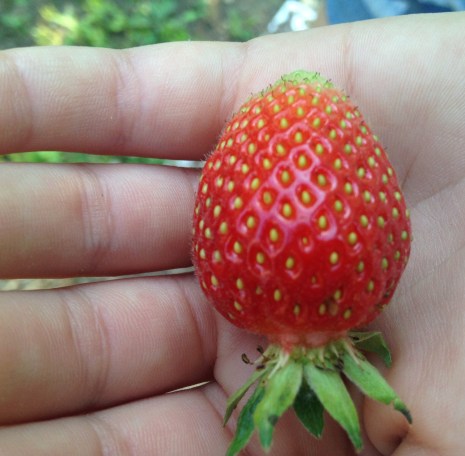
first berries from our garden

The Rapture of Becoming

A friend from a very long time ago, who now lives 3,000 miles away, took the time to write me an email the other day. It’s quite possible I would now walk past this former lover and not recognize him; the years have been that many.

In this email, he wrote about recreating his house during a tough time of his life. The best damn wood floors you’ve ever seen…. Later, he remarried, sold that house and bought a different one, fathered a daughter, and joined into happier days.

That house he poured his body and soul into, and yet he realized it was not loss; it was one long step of a journey as his life moved on. As my teenage daughter becomes her own young woman, I’m wistful at times for those innocent summers when a kiddie pool brought such pleasure. How good it was to cradle the sweet-smelling heft of a sleeping child in my arms. At yet… how could I not revel in this girl and her friends, bright-eyed and eagerly taking the reins of their lives?

This summer, I’ll heed my friend’s advice well and swim in the cold lakes more with the kids, cook outside over the fire while listening to frogs, worry less about money, and don’t mind so many weeds in the garden.

People say that what we’re all seeking is a meaning for life. I don’t think that’s what we’re really seeking. I think that what we’re seeking is an experience of being alive, so that our life experiences on the purely physical plane will have resonances with our own innermost being and reality, so that we actually feel the rapture of being alive.

– Joseph Campbell, The Power of Myth

FullSizeRender-12

June, Woodbury, Vermont