Farmers Market Females

On a bike ride today, my daughters and I stopped by the Stowe Farmers Market, where I was known for years as the Root Beer Float Woman. I also peddled one heck of a lot of maple syrup there. I vended there for 14 years, beginning when I was pregnant for the first time and ending when that daughter was 13. That girl pretty much grew up summers in the market, and I spent awful lot of Sundays serving up homemade ice cream with a baby either on my back or nearby, underfoot.

Today, we were merely visitors, buying sausage and cookies. I stopped to talk with a woman whose own children are long past the toddler years. I knew she and her husband had bought a farm, worked themselves as hard as humanly possible, and ended up downsizing, downsizing, downsizing, overburdened by debt, and eventually selling the greater chunk of the farm. I remembered the day they signed on that farm. I served on the board then, and we drank champagne in celebration.

Lying on the grass, later today, with my teenage daughter, staring up at Stowe’s pristine church steeple, I told my daughter that story – and more, many more. As I did, I realized just how hard so many of these farm women I knew worked. Over and over, I came up with names of women who were savvy and creative, and believed in the saving virtue of hard work with their hands.

Like everyone, all of these women have met hard times, but I would consider none of these females failures, each meeting her fate with some kind of rugged grace. It’s been a handful of years since I sold a drop of sweet stuff – maple or ice cream – at the farmers market, yet it’s also a place I still think of as home.

Only 8 percent of the country’s farms produce 72 percent of the national harvest. This is where the subsidies go. Agribusiness is concentrating so quickly that in the near future our global retail food system may be controlled by five or six firms  – in America perhaps it will be WalMart…. So why fight it? Why not? And that’s what the farm women of Vermont and America are involved in….  In the face of agribusiness intent on controlling the global food supply, you could call these women working activists.

– Peter Miller, Vermont Farm Women, 2002
IMG_2139

Stowe, Vermont


Moon Rise

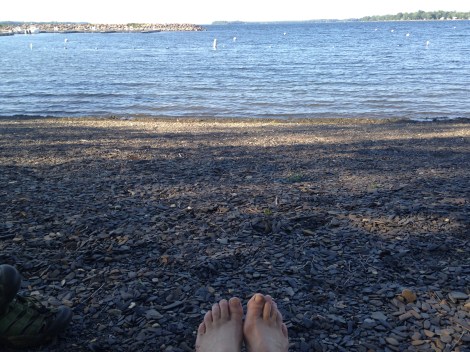
Camping these past few days on a island in Lake Champlain, the kids and I were biking back from the south end in the dusk when a crimson full moon appeared over the horizon, startlingly beautiful.

A 100 years ago, this mile-long island was farmed by tenant labor, sending out vegetables, dairy, wool. Now, those once-upon-a-time farm fields run rampart with goldenrod and stinging nettles. Sumac trees branch over paths for enchanting tunnels. The mighty lake, like so much of our world now, is polluted, but even so, the beauty of water and sky, singing cricket and chorusing frog, blue heron and turtle, is mesmerizing.

The next night, the children and I canoed into the dusk, and then walked out on a rocky jetty as dark filtered in. We perched there, watching the moon rise over the horizon. I’ve been reading Howard Axelrod’s The Point of Vanishing, a book about his two years in Vermont solitude, and I kept thinking of his line near the end: you are human. Not solitary, not a discrete entity, but part of the moving, changing landscape, in all its infinite beauty.

I wanted to see through all surfaces and to see through myself, but I wasn’t a transparent thing. I was bone, sinew, skin. If I lost depth perception when it came to life, if I removed every line so there was no difference between near and far, I’d never survive – maybe as a ghost or as a cipher but not as a human being.

IMG_2114.JPG

Burton Island, Vermont

We Hold These Truths To Be Self-Evident

A little over four years ago, my 7-yr-old and 13-yr-old daughters and I spent all day in Newport, VT’s county courthouse; their father was on trial with five others for criminal trespassing. The six defendants – self-named the Lowell Six – had been arrested in a dispute over constructing 21 enormous wind towers. Green Mountain Power claimed they had rights to the property. The Lowell Six claimed the property belonged to the Nelson family. The case’s details I wrote about in VTDigger.

The top floor of that beautifully built old courthouse had enormous windows with a view of Lake Memphramagog. Birds came and went about their avian business, all day. While the jury was out, the sun edged down.

In the end, the Lowell Six were found guilty. Five of them served some variation of community service for a crime none of them believed they had committed; the sixth was arrested for contempt of court and spent a weekend in jail, three years later. Green Mountain Power’s 21 wind towers were built, constructed out of sheer material greed and cloaked in a smokescreen of green energy. 

Like everyone else, I inherently believe in MLK’s arc of justice bending around. Yet, after all this, I see, instead, the complexity (and perhaps the length) of what justice might mean. Where is the bend of justice in this case? I don’t see it yet, but that doesn’t mean I’m not looking.

Some days, all day, days, it rains.

-– Janisse Ray

FullSizeRender


Girl with Confidence

My 11-year-old daughter woke up this morning, searched for a particular pair of shorts, and ran down our dirt road. She ran for the first time beyond the road’s well-travelled end and down the narrower section, where woods and wild blackberries flank either side.

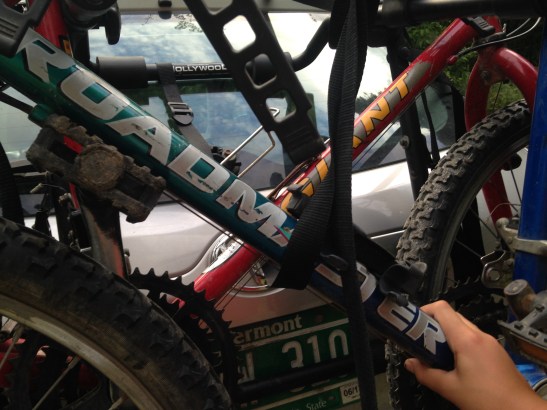
In the afternoon, she took her sister and me on a tour of Morrisville’s rail trail where she’s sprinted this summer with a friend. With delight, she showed us a bridge over a narrow road, the brewery where we later ate dinner, a tiny house with a glass front, a cluster of ramshackle trailers.

The ride, fragrant with August’s lush goldenrod, scottish thistle, honeysuckle, was a three-dimensional map of her childhood world: a unique, dear  gift.

Summer was our best season: it was sleeping on the back screened porch in cots, or trying to sleep in the treehouse; summer was everything good to eat; it was a thousand colors in a parched landscape; but most of all, summer was Dill.

Scout, in Harper Lee’s To Kill A Mockingbird

IMG_2092

Morrisville, Vermont

Living Literature

My kids and I saw a live theater production today of one of my favorite books, To Kill a Mockingbird, a novel I tutored to high school students years ago. At one point, I had taken that novel apart in all kinds of ways, knew it backwards and forwards, in and out: mad dog, camellias, serving lemonade in times of stress.

Listening today, for the first time I realized compassion (that thread I’ve returned to, over and over this year) is at the heart of this novel. Tom Robinson, poor Southern black man, is the only person who has compassion for Mayella Ewell, a young woman about as white trash as could be, with a nasty father, too many little siblings and no mother, and scant means all the way around.

Tom Robinson did what Atticus advised; he imagined walking around in another’s skin, not because he desired anything from this woman, but purely from the decency of his own heart. If for no other reason, that’s why we need literature more than ever now: we desperately need that imagination.

Boo was our neighbor. He gave us two soap dolls, a broken watch and chain, a pair of good-luck pennies, and our lives.

– Harper Lee, To Kill A Mockingbird

IMG_2072.JPG