September 1

Every September, Stowe, Vermont, hosts The British Invasion, when a bunch of folks fly over the Pond and spent some early foliage time motoring around in their nifty little cars. A few years back, a particularly chatty group appeared in our sugarhouse for a hike into our woods.

Afterwards, the leader began some good-natured ribbing about the general dearth of American knowledge of history, and asked when World War II began, apparently expecting Pearl Harbor to be our answer. When I offered September 1, 1939, he was appeased enough to open wide his wallet and buy some syrup.

On this September 1, 2016, our family made dinner together while talking about the girls’ first week at school. Our kitchen filled with garden sun gold tomatoes, arugula, and garlic, the table strewn with school papers and Lake Champlain shells from our last camping trip.

September is summer fading, the emerald hills fading to light gold, the air sweeter with a crispness creeping in. The real autumn isn’t far off now. Before long, I’ll be digging into our carefully stacked wood pile, and Sunday afternoons the house will be suffused with the scent of baking apple pies.

This September 1, my house doors are open to cricket song. The sun has been warm all afternoon, but as evening ambles in, the shadows are beginning to chill. This would be a fine weekend for hiking.

Sparrow singing –
its tiny mouth
open

– Yosa Buson
IMG_2220.JPG

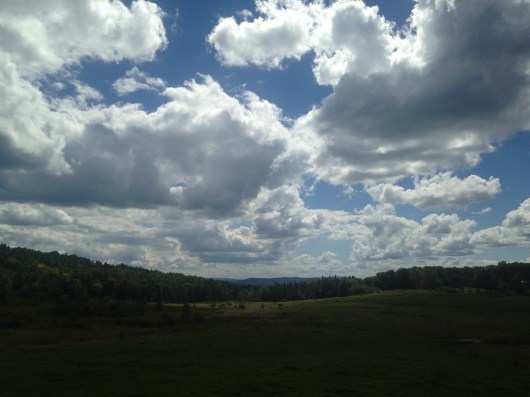
County Road, East Montpelier, VT

Raw Hearts

Like so many other New Yorker readers, I’m glad to check out what my favorite writers have produced, and early this morning I was drinking coffee while reading Adam Gopnik‘s piece on the 1971 Attica uprising. A terrible story, to be sure, suffused with bloodshed and out-and-out misery, a graphic illustration of this country’s inability to confront profound racial history, separation, and hatred – a story so presently alive today it’s painful.

More and more, I understand the human saga as overspilling with a pulsing heartbeat of fear, real as veritable night armies of marauders, drunken and desperate for satiation. Yet, in the morass of this story, a few clear voices rise ringing with the truth, courageous precisely at the time when courage matters most.

Gopnik raises that difficult question I return to over and over again: when to act and when to hold back? When is the time to speak forth, and when is restraint the wiser course? When is patience the most courageous and beneficial course, and when does patience bleed over into the waters of cowardice? There may be few times in our lives when great courage is demanded, like Warhol’s 15 minutes of fame. At what cost, perhaps, that courage may come.

There are sins of omission but there are also virtues of patience. Many of the wisest things we do, in life and in politics, are the things we don’t. Affairs not started, advice not given, distant lands left uninvaded—the null class of non-events is often more blessed than the enumerated class of actions, though less dramatic….

At moments of crisis, the integrity of our institutions turns out to depend, to an alarming degree, on the fragile integrity of individuals.

– Adam Gopnik

FullSizeRender

Montpelier, Vermont

How You Know Yourself

Watching the Olympic swimmers, my daughters wondered what went through the swimmers’ heads while they spent endless hours practicing their watery strokes. Intense concentration, or sometimes a grocery list?

I imagine that must be way they know the world, I answered. My older daughter at 17 uses photography as her own personal lens of knowledge. From a very young age, I knew the world through fiction, with an insatiable desire to read. An essay of mine about writing just appeared in Green Mountains Review, chock-full with the sun and the moon, wood stove ashes on the floor, a toddler and her tricycle. It’s my own particular story, my own grain of sand reflecting this bit of the universe.

And so I think of Michael Phelps and his teammates, male and female, their arms mightily stroking through the water, breathing in their knowledge of the world, sublimely sacred at times, no doubt profound to the bone at others.

When was writing ever your profession? It’s never been anything but your religion.

J.D. Salinger, Raise High the Roof Beam, Carpenters & Seymour: An Introduction

FullSizeRender


Murky Matters of the Heart

I’m in the firewood chore time, a task I’m embracing with gusto. Wood stacks satisfyingly, drying for toasty winter evenings sprawled before the hearth, with tea and books and board games. The chore is pretty much zero-loss; if the piles fall down, I’ll restack, a redoing with little loss but of time – perhaps even a gain in the muscle category.

Not so, in other aspects of human life. Last night,  I lay awake late, sucking lemons and reading Jung Yun’s Shelter, a novel about specific family actions with that extremely gray subtext of what I can only call ‘matters of the human heart’ – the moral (or immoral) meanings of our actions, the elements of our lives that mean the very most to us. The novel reminds me of Steinbeck’s East of Eden, a family saga about human choice: the uniquely human element that often seems so baffling. What the heck must I do now?

Hence, the pleasure of stacking wood on a balmy August day, with the bittersweet scent of freshly-drawn sap, the dryness of dust on split logs, and the tidy wisdom of ordering a piece of my land for the colder days to come.

Of all the people in the world, he (Kyung) never expected Reverend Sung to be a source of comfort, the first real sense of comfort he’s felt in so long. He’s thrown by it, stunned silent by the possibility that he isn’t so underserving of kindness as he believes himself to be. Kyung sits down and takes the reverend’s hand, squeezing it to convey the volume of things he can’t, and the reverend, in another act of kindness, simply stands there and lets him, saying nothing in return.

Jung Yun, Shelter

FullSizeRender

Woodbury, Vermont


Technological “Advances” in Rural Vermont

Living in Vermont and relying on a cell phone means knowing the best reception landscape around you – precisely which few feet along your dirt road have enough bars to dial out.

Yesterday, with our home reception reliably lousy these days, I parked behind the Greensboro Garage’s yellow barn, opened my notebook, unstrapped my sandals, and went to work. The crickets were singing, and the sun was a peachy end-of-August temperature. I spread my notebook on the dash, with the doors open, in a little breeze that moved along that valley. As a writer, I’ve worked in all kinds of places, from cemeteries to a hospital closet, and this was prime territory, but I’m not sure this represents all that much of a technological advance.

I once used a landline at my own desk; now the phone fits in my hand, which is good thing because I sometimes need to hold it up, believing that will improve reception or send off an email I’m anxious to move along.

Admiring this substantial barn reminded me of Salinger’s Raise High the Roof Beam, Carpenters. Remember Seymour Glass calling his fiancée in World War II?

The connection was so bad, and I couldn’t talk at all during most of the call. How terrible it is when you say I love you and the person at the other end shouts back “What?”

– Salinger, Raise High the Roof Beam, Carpenters & Seymour: An Introduction

Yesterday evening, parked at the top of Kate Brook Road, near a meadow storybook-beautiful with wildflowers and ringed by mountains, neighbors stopped and asked if I had a flat tire. When I held out my phone, they said, Use our landline anytime. The door’s unlocked. If I stopped by, chances are, I’d leave some of my tomatoes, and sample some of theirs.

FullSizeRender

Hardwick, Vermont


Yearling Bear

Driving alone up Vermont Route 12 this morning, in a forested area that winds between two ridges and along dead-tree-choked swamps, I spied a young bear on the pavement ahead of me. There was no one but me and the bear, and I coasted to the side and got out of little car. Overhead flew a single crow.

The bear, too young to see me at all, was small enough to be round in its four limbs and soft paws, walking in a circle, and I looked for the creature’s mother, as it seemed to be searching as well. Then, the youngster ducked beneath the guard rail and was gone, simple as that. I was back in my car and on my way. I passed no other traffic.

150 years ago, bear and deer were nearly extinct in what was a nearly deforested Vermont. The wildlife has surged back in strength, both in the dearness of its young, and sometimes in what would be the fierceness of its parents. I hadn’t seen a bear in a few years, and I was glad to see this one. I’m hoping its mother was just beyond my sight.

In late winter
I sometimes glimpse bits of steam
coming up from
some fault in the old snow
and bend close and see it is lung-colored
and put down my nose
and know
the chilly, enduring odor of bear….

From “The Bear” by Galway Kinnell

FullSizeRender