End of One Road….

After a summer of chaos and bitter heartbreak, tears, the Vermont state police, too many times through the county courthouse’s metal detectors, I crashed my car yesterday. The impact came at slow speed, and when I got out of the car, I knew instantly I was uninjured. The woman in the car I hit also assured me she was fine.

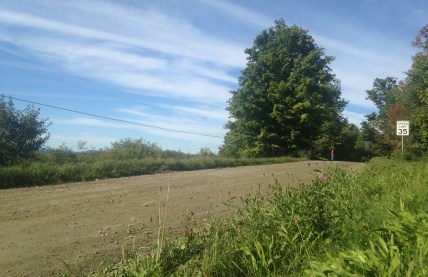
I stood on the road, my vision caught for some reason at the sun shining in the canopy of an immense maple nearby. I stood staring upward for a moment, admiring the brilliant September afternoon. In every sense of the word, I had been driving blind, the inside windshield of my car smeared greasily, never tended to, and I had been crying. I hadn’t seen the woman who was at a standstill, until after I hit her. By sheer grace of luck, I had managed not to hurt this stranger, and then she spent three hours sitting in the grass with me, infinitely patient. This morning, an apple pie bakes in my oven as a meager gesture of my gratitude.

My publisher, Dede Cummings, describes herself as a glass-half-full woman, a feature I’ve tried to emulate. That afternoon, my glass foamed over. All the things I had held coiled so tightly within me – my daughters’ well-being, lack of childcare, too many demands for money and too little lucre – released from me when I stepped out of that crumpled car. Standing on the road, I felt strong, resilient as a birch sapling, and immensely calm, expansively alive as the nearby hayfield. Oddly, I had been returned to whom I was once, soles on the ground, my eyes sparkling and full of sunlight.

It had been a very long time since I had hoped for more than that my daughters and I accept and endure their father’s apparently unbreakable descent into a place where we cannot reach him. In that brief moment, I realized we would thrive, too, that our lives would unfold further in a vibrant tapestry, and the goodness of the world was, truly, yet at my hands, there for the taking. The world hadn’t turned its familiar back to me.

In my novel, the moon in all her various faces – crescent, gibbous, cloud-strewn – appears repeatedly as a talisman to my main character. Yesterday’s geometry of sunlight descending scattershot through leaves, dusty road beneath my clogs, and the  September afternoon with its darting dragonflies wound together as my own unbidden talisman.

I never accomplished what I intended that afternoon. That evening, the moon rose full, the hue of spring-grass-tinged cream. O, sweet lady moon, traversing her patient path across the heavens. We slept with the windows open to the night, moonbeams moving across our cheeks as we slept.

Come, see the true
flowers
of this pained world.

Bashō, On Love and Barley
fullsizerender

Woodbury, Vermont

Leland Kinsey, Vermont Poet

A few years ago, when I was a bookseller at The Galaxy in Hardwick, I was reading a book of poetry, Winter Ready, when the poet himself called to order a book for a relative. The book was a gift for a child, and in his polite way, he took great care with the order.

The poet, Leland Kinsey, crossed over into the world beyond last night, no longer part of this slowly-golding-to-autumn realm where the rest of us around here still dwell.

Leland Kinsey, premier among Vermont writers, exquisitely gifted, a man who wrote of the myriad ways the earth giveth – and the earth taketh.

Here’s his lines…

…. His mother’s pickles, whose recipe
he thought would, perhaps should,
die with him. A crock in a cool place
that holds enough for a year.
The ripe smell when fishing
The doubly ripe pieces out.
All this is your heritage now,
as it is preserved here,
make of it what you will.

Leland Kinsey, “An Old Man’s Recipe for Tongue Pickles” in Galvanized

fullsizerender

September, 2016, Vermont


Go Outside

One of the cool things about seeing your writing appear in a magazine is reading what writers your words butt up against. Taproot, always a lushly artistic production, has an essay by Milla Prince (what a knock-out name) about what I’ve been ruminating upon: our need for immersion in nature is so primal and so necessary – for all of us, infants to the truly very old. Far beyond the antidote to whatever may be ailing my own waning soul at times, I crave unfettered sky, cold clouds, an unfenced expanse to walk, frog slime on my fingers.

Which brings me back, again, to my recurring theme that, much as we might perceive ourselves as separate entities – beings complete in ourselves – we cannot be lifted from our landscape, cut out and pasted like stick figures. I’m as much part of the mountain I live on as I am a woman at my kitchen table.

There is some integral part of us that is nourished only by interacting with nature, some part of us that longs for our ancestral home, before our fall from “paradise,” before making ourselves the outsiders in our natural environment… Separated from the mycelial networks that connect all life to itself, severed from other beings by the walls of our houses, our paved-over streets, we truly are lonely.

– Milla Prince, “A Ritual of Woods & Fields” in Taproot: Wander

fullsizerender

Womanly Arts

Cleaning out a storage room in our sugarhouse, my daughters found two large wooden shelves, intricately crafted from small pieces of wood hammered together. Who made these? the girls wanted to know. Decades ago, their grandmother scavenged slender strips of wood from a mill, and created these shelves, and also an entire ceiling in a kitchen she remade.

The girls washed dust from the shelves and set them to dry in the sun. Later, a friend of mine stopped by and asked about the shelves again. She ran her thumb over the wood still smoothly polished after decades and said, Nice work.

Without thinking, I began a list of my mother’s skills: besides her handiness with a hammer, my mother redid an old farmhouse; she sewed quilts, knitted aran sweaters, opened a children’s store in the ’70s, cooked about a million meals, planned extensive cross-country camping trips. An R.N., she dressed in my childhood evenings in a white uniform and nylons and drove off in the dark to a hospital, returning at breakfast with stories, and, one Fourth of July, an orange kitten who had been abandoned by the side of the road.

There’s a story from Elizabeth Gilbert about her aunt, who cut up her prized clothes and resewed them into baby outfits. It’s the same old story of women chopping up the finer parts of themselves and handing those gems right over their children. Unacknowledged and, doubtlessly, unthanked. The raw truth is that gender is not a label, that the pulsing lives of mother and father are inherently different, in a way that’s neither good nor ill: simply different.

In my own all-female household right now, one morning I found a word from a magnet set we had used on the refrigerator. I must have vacuumed the piece and then emptied the dusty bag on my woodstove ash heap. The word was woman. I pulled the word from the dirt, shined it up with my spit, and laid it on the center of my kitchen table.

The cold ugly fact is that marriage does not benefit women as much as it benefits men. From studies, married men perform dazzingly better in life, live longer, accumulate more, excel at careers, report to be happier, less likely to die from a violent death, suffer less from alcoholism, drug abuse, and depression than a single man…The reverse is not true. In fact, every fact is reverse, single women fare much better than married women. On average, married women take a 7% pay cut. All of this adds up to what Sociologists called the “Marriage Benefit Imbalance”…It is important to pause here and inspect why so women long for it (marriage) so deeply.

– Elizabeth Gilbert, Committed

fullsizerender

Interlude of Merriment

My daughters are like me this way: a difficult week? Pack lunch and retreat into the woods.

Yesterday found us hiking along a series of cascades, then walking barefoot through a shallow, boulder-strewn stream. Among mushrooms, we walked on cushy pine needles in a shaded forest. At the end, chilled from swimming in the mountain stream’s pools, my car didn’t start, tossing me that curve with its recurring electrical problem.

In those two hours we spent by the side of a not-well-travelled road, at some point I began laughing at everything humorous and absolutely not-humorous in our lives, verbally listing, and once I began laughing, I laughed so hard I sat down on the graveled roadside. More than any words, my daughters found my laughter exquisitely reassuring.

In times of acute family duress, I’ve laughed with my siblings and father until tears have run down our cheeks. The people I am most aligned with (whether I know them well or not) wield the same two practical tools I return to, over and over: the inherent (and physical) need for comedy and an awe of beauty.

Afoot and light-hearted I take to the open road,
Healthy, free, the world before me,
The long brown path before me leading wherever I choose.

Henceforth I ask not good-fortune, I myself am good-fortune…

– Walt Whitman, Song of the Open Road, I

fullsizerender

Bingham Falls, Stowe, Vermont


The Girls’ Landscape Widens

The school day was unexpectedly cancelled for my sixth-grader this week, and so, while I was working in the air-conditioned world of Burlington, my daughter spent the steamy September day at a friend’s house, doing what she described as “all kinds of things.” Those things included cribbage and trampoline, but also biking down the dirt road to Number 10 Pond to swim.

At the day’s end, I drove out of Burlington’s traffic, along I-89, and through Montpelier’s end-of-day busyness, and then I was in some of my favorite local terrain, the small but steep hills of Calais and Woodbury, where the land rises right out of the myriad ponds, and forests abruptly give way to valley views, where old stone walls mark tended fields, and gardens with giant sunflowers, their heads bent down down, are profligate at this time of year.

I passed almost no traffic on these dirt roads, until I met the two 11-year-old girls, sweatily pushing their bikes up a final slope, soaked and sandy towels wrapped around handlebars, their faces radiant.

These two friends had biked a fair distance, zipping down hills, surrounded by the beginning of autumn’s easing-to-gold beauty, to the pond surrounded by woods where “only old ladies” were swimming. I could imagine the water’s stillness, and how sweet and cool it would feel on hot and dust-covered skin.

Those were my two pieces of Vermont that day. Before leaving the friend’s house, the girls and I talked for a little while, the humidity thick, drawing up the scents of soil and plant, the girls’ faces flushed from their travels and ready for more adventure.

… I don’t write out of what I know; I write out of what I wonder. I think most artists create art in order to explore, not to give the answers. Poetry and art are not about answers to me; they are about questions.

– Lucille Clifton

fullsizerender