Sunny Sunday on Skis

Goodbye, running shoes, and hello, ski boots! It’s the sparkle season.

Winter days like this one – twenty degrees, dazzling light, new-fallen snow in exquisitely formed flakes – embody the season’s perfection. No need to worry about battling weeds in the garden. With the woods’ closed-in canopy dispersed, mountain ridges luminescent with frosty snow shimmer all around our horizon.

At the moment, we’re not hemmed in by the endless varieties of ice or gray, falling sleet. Our cheeks glow with exercise and merriment. The girls are home, and pie warms in the oven. These clear days open up our horizon. Chickadees dart from the apple tree.

The Snow Man

One must have a mind of winter
To regard the frost and the boughs
Of the pine-trees crusted with snow…

Nothing that is not there and the nothing that is.

– Wallace Stevens

img_2925

Backyard Skiing in Woodbury, Vermont

Appetite

When my teenager was an infant, I peddled maple syrup, homemade root beer, and ice cream at what was then the very tiny Hardwick farmers market, so sparse that some Friday afternoons it was just me and another vendor.

In those long hot afternoons, the vendors got to know each other. My friend Charlie Emers, of Patchwork Farm, had an enormous orange, rust-eaten Suburban, that would eventually head to the junkyard with years’  worth of debris inside. Son of an artist and an artist himself, Charlie grew the best peppers I have ever eaten. In late summer, he began pickling my favorite variety – Habanero Hots – in small jars he called Poker Peppers after his favorite game.

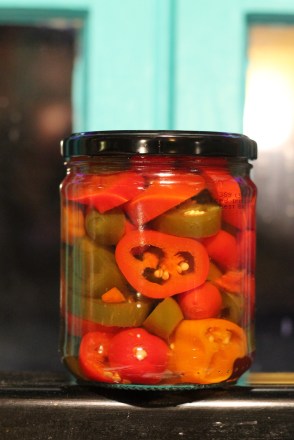
Yesterday, in a Williston store I’d never entered, I found a jar of bright red peppers that reminded me of those Poker Peppers: jalapeños, but deliciously fragrant with the spicy summer season. I might eat the whole jar myself.

‘Eating is an agricultural act,’ as Wendell Berry famously said. It is also an ecological act, and a political act, too. Though much has been done to obscure this simple fact, how and what we eat determines to a great extent the use we make of the world – and what is to become of it.

Michael Pollan, The Omnivore’s Dilemma

img_4354

Photo by Molly S.

Magical Math with Mittens

My sixth-grader ended her school day yesterday with rosy cheeks, sweaty hair, and an enormous smile. With their teacher, the class had hiked into the snowy woods and built what she described as an enormous snowman.

There’s more, though. She described this cold creation as a Fibonacci Snowman. You know what the Fibonacci numbers are, right, mom?

Indeed, I do, but I had missed that these mysterious numbers fit into giant snowmen. One hat, two stick arms, three rocks for eyes and a nose, five buttons, and eight pieces of birch bark for a mouth. What I also missed was the love of much larger numbers, the centimeters of girth and height that went into the hundreds.

With such gusto, this girl relayed the small class’s adventure, involving mathematical calculation and joint herculean strength to lift heavy snowballs.

With these short days, I sometimes cast my vision elsewhere, envying light-filled territories. Then my tousled-hair daughter reminds me implicitly why we’re Vermonters, and why winter is wildly lovely. As we narrow through this time of sparse light, our table is lit each night with a single red candle, in this sacred time of impenetrable night, waiting for the earth to turn around and make her slow, eternally patient way back to the season of mammoth sunflowers.

Looking through my bedroom window, out into the moonlight and the unending smoke-colored snow, I could see the lights in the windows of all the other houses on our hill and hear the music rising from them up the long, steadily falling night. I turned the gas down, I got into bed. I said some words to the close and holy darkness, and then I slept.

Dylan Thomas, “A Child’s Christmas in Wales”

fullsizerender

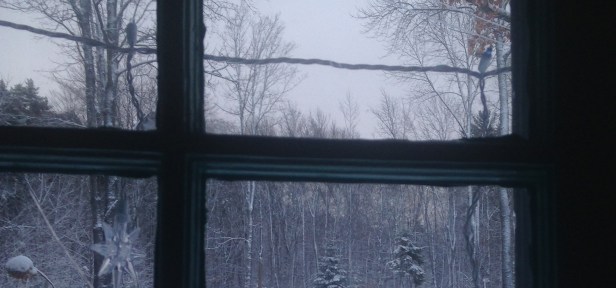
Our kitchen window view over the December garden.


On the Rails

When my daughter was eight, her teacher asked what magic power she would choose, if she could. I’d fly, of course, she said, as if, of course, what else? She wanted not particularly to travel, but to sail weightlessly, like a bird, acquiring a wide vision of her place on earth.

Not long after that, the children and I went on an extended Amtrak journey, thousands of miles, through territory we had never visited: steep and beautifully wooded West Virginia, up through the nighttime sprawl of Midwestern cities, all across the plains to the luminescent southwest.

The morning we left for a three-day leg of the journey, I braided my hair at a mirror in my sister’s dining room, wondering when I would unravel those braids, with so much yet ahead of us.

While I’d take that trip again in a heartbeat, train travel is long, encumbered to the earth with rails and wheels, grinding to halt after halt, and waiting for folks to clamber on and off, weighed down with bundles, the elderly, small children. The travel comes slow and hard-earned, in what my daughters discovered is a very large country.

Here’s a few lines about rail and America’s Great Migration in  Isabel Wilkerson’s The Warmth of Other Suns.

… the railroads, running between Florida and New York, and the Southern Pacific, connecting Texas and California, had become the historic means of escape, the Overground Railroad for slavery’s grandchildren. It hurtled its passengers along the same route and under the same night sky as the Underground Railroad, the secret network of safe houses leading north that had spirited slaves to freedom the previous century.

fullsizerender

West Woodbury, Vermont

Luminescence

In the backseat yesterday, my daughter’s friend suddenly looked around and asked where I was driving.

I told her I changed my mind; we weren’t headed to Waterbury, Vermont, but were on our way to I-80 and the midwest. In less than a heartbeat, she said, I don’t mind. I’m glad to go anywhere.

Instead, we went to Waterbury, once famed as home of the Vermont State Asylum for the Insane. Bundled in their warmest clothes, the kids and I were there for a procession of illuminated paper lanterns, dancing, live music: primal at its heartbeat.

The girls and I followed at the parade’s end, behind a man who held up a white clipper ship decorated with tiny white lights. Over our heads, a light snow fell from the impermeable darkness. At the end, the girls sprawled in a slushy field and watched the dancers with spinning handfuls of fire.

All the way home, through the night and then brilliantly-lit Stowe, following the familiar road around Elmore Mountain and up the maze of slushy dirt roads home, I thought of that stranger’s arms held over his head, that radiant ship a sailing beacon.

Before going to bed
After a fall of snow
I look out on the field
Shining there in the moonlight
So calm, untouched and white
Snow silence fills my head….

May Sarton, “December Moon”

IMG_4018.jpg

Waterbury, Vermont

We Are the Past

Remember the Turkish Delight in The Lion, The Witch, and the Wardrobe? The sweet that bribed Edmund to betray his siblings? My daughters were fascinated by this candy. Could it really be that good?

For years, I’ve been looking for this confection; yesterday, my daughter returned from a field trip with a small box. I found it, she said triumphantly.

Betrayal is far from my child’s intent – it’s not the Turkish Delight, of course, to be blamed for Edmund’s ill deed, but Edmund himself, and the story of his own particular unhappiness that carried him to that point.

I know people who insist the past is irrelevant, that what matters is only the here and now, the very present before our eyes, as if our unique stories could conveniently be swept into a dustbin and abandoned. As a writer, I think the most natural questions are of inquiry: what’s your story? How else can we understand ourselves and each other, without knowledge?

For good or too often for terrible ill, history is always with us. Standing Rock is clearly about the bitter present and an iniquitous past.

In Lewis’s novel, the Turkish Delight is not merely a square of candy in a child’s hand, but a child with a tangled past dragging behind him and a choice posed to him. Betray or refuse? I can’t help but think that’s a tantalizing element of this story: each reader can’t help but ask themselves, which way would I chose? Which way will I write my own story?

Does that story matter? Yes.

My Dear Lucy,
I wrote this story for you, but when I began it I had not realized that girls grow quicker than books. As a result you are already too old for fairy tales, and by the time it is printed and bound you will be older still. But some day you will be old enough to start reading fairy tales again.

C. S. Lewis, The Lion, The Witch, and The Wardrobe