Two Bears

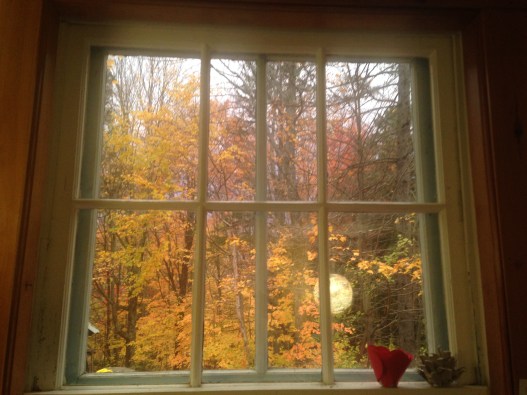
Driving down our curvy back road the other morning, a young black bear loped before my car, coal-dark against the morning’s gold leaves woven through with mist. The creature faced us, then, in no particular rush, disappeared over the edge of the steep road. Behind me, a pickup rushed up in my mirror, missing the scene.

Midday, the kids were out of school. When I returned at dinnertime – full dark already in these shortening days – my older daughter told me the younger girl had lain on her back with her enormous teddy bear all afternoon, staring at the sky. She was fine, the teenager relayed. She just wanted to lie there for a while before we put the trampoline away for the winter.

Two young creatures – the bear cub and my child – at ease in the glowing woods.

….didn’t October do
A bang-up job? Crisp breezes, full-throated cries
Of migrating geese, low-floating coral moon.
Nothing left but fool’s gold in the trees.
Did I love it enough, the full-throttle foliage,
While it lasted?…
– Maggie Dietz, “November”img_2591


Truth? in Dialogue

My teenager came home today excited about a major disagreement in her senior high school English class. Is it okay to lie? Is it acceptable to lie to prevent harming someone? Or absolutely, categorically never?

What do you do? I asked her.

The truth is, when you write dialogue in fiction (or when you listen, really listen) to how people use language, you quickly realize the lines of truth are blurry – in fact, remarkably unclear.

At seventeen, my daughter sees herself as mistress of her own fate, and while I certainly don’t want to unsteady my girl, I encourage her to keep her hands steady on the wheel. Listen, I urge: that unbelievably difficult challenge I butt up against, over and over. Listen.

I’m reading Margot Livesey’s Mercury in these early, dark mornings. Here’s a few lines from a previous novel:

If someone tells you a lie, they’re not telling you the truth, but they are telling you something. It just takes longer to figure out what.

– Margot Livesey, The House on Fortune Street

img_2586

This eternally warm, long and lovely autumn, Woodbury, Vermont

Treasures

In the middle of last night, wind blew in a scattering of rainshowers. Without turning on any lights, I stood on the kitchen porch, amazed at the midnight balminess. The apple tree shed a few yellow leaves.

My teenager had left a screwgun on the deck, a piece of unfinished cleanup from putting up the storm windows. I lifted the heavy tool and held it in both hands, remembering when this girl was a baby and a screwgun like this one had fallen out of the back of our pickup. We’d loaned the screwgun to a relative in Montpelier, who must have merely slid the tool in the back of the truck. When I returned home, the case was missing.

With my baby in the truck cab beside me, I drove those miles back to the capital city, looking all along the road, but didn’t find the blue plastic box. I remember weeping over what was a very expensive tool for us then, and how badly I felt at its loss, caused by my own carelessness. That tool, in the early days of my husband’s carpentry business, meant so much to us then – or perhaps it was more the potential, the life ahead, that tool promised.

In the end, a neighbor found the screwgun and returned it to me.

Seventeen years later, how many thousands of dollars worth of tools have now passed through our hands, used hard, their finite lives consumed. I thought of all that with the gentle autumn rain falling, and how happy our neighbor was, returning to us what we considered our lost fortune.

Poverty’s child –
he starts to grind the rice,
and gazes at the moon.

– Bashō

fullsizerender

garlic planting, Woodbury, Vermont

Light and Shadow

While doing errands in Barre, Vermont, today, my younger daughter groaned when she saw a huge new building. More stuff. Where does it come from? Like everyone else, we’re consuming our share of stuff, coming home with a case of paper, a metal leaf rake, and the eternal grocery shopping.

As if to contrast, all afternoon we’ve been outside in this glorious sunlight, readying our piece of world for winter: washing windows, slashing perennials, my rearranging of the woodshed. When the girls disappeared to bake an apple pie, I stood back and admired my woodshed, crammed full with ash and maple, drying incrementally yet steadily.

In autumn, by afternoon’s end, shadows and cold creep in. I yanked out the frost-killed squash vines today, left the sunflower heads for the birds. The wood stove is likely lit for the duration. Our kitchen greets visitors with spicy cinnamon and baking butter.

The roadside plants go right on growing. Everything is fulfilling its part in the whole. Such is life – and of such are the realities of life. Harmony comes in understanding things on their own terms, and in a compassionate and humorous acceptance of the way they fulfill their roles.

– Stewart Holmes and Chimyo Horioka, Zen Art for Meditation

fullsizerender

Books, Given and Taken

As a teenager, I raided my father’s bookshelves, skipping over that dull-looking Leviathan for the far more tantalizing Huckleberry Finn, Henry Miller, and Alan Watts. Looking back now, I think, What better could I have read?

Recently, my daughter opened an envelope with a book my father mailed me, Zen Art for Meditation. She looked at this little book, and asked if I was really, truly going to read it.

I answered, With great pleasure, and, with almost a crazy kind of happiness I’m reading this slim volume in these early, autumn mornings. Mystified, my child asks what’s in the book. Mountains, I answer. RiversThings we love. But the book is also full of Huck Finn’s raft, Miller’s restlessness, and Watts’ cloud-wreathed peaks. In haiku’s odd sense of timelessness, I might be a teenager again, reading these lines, rather than a grown woman, or, perhaps, simultaneously both. And I didn’t even have to steal this book.

The salt of the sea is in our blood; the calcium of the rocks is in our bones; the genes of ten thousand generations of stalwart progenitors are in our cells. The sun shines and we smile. The winds rage and we bend before them. The blossoms open and we rejoice. Earth is our long home.

– Stewart Holmes and Chimyo Horioka, Zen Art for Meditation

fullsizerender

Hardwick, Vermont

Revision in Yarn

I learned to knit from my daughter when she was an 8-year-0ld Waldorf student, and I really wanted to knit. Then a friend taught me more, and I read books, stopped in at the local yarn store for free advice, and turned hand-knit sweaters and hats inside out to discover the wherefores of how they were put together.

The pattern of this most recent sweater is a skeleton – a skeleton minus a few bones. When I arrived at joining the sleeves, the pattern was curiously empty. By experience and guesswork, I’ve put this sweater together in a semi-decent fashion. But I did take apart that first sleeve a half dozen times.

Unlike life, that’s the beauty of knitting: take it apart, again, again, and again. I suppose that’s not entirely true. All those revisions made this creation; I intend to wear it happily, with only myself in the true knowing.

One has to be just a little crazy to write a great novel. One must be capable of allowing the darkest, most ancient and shrewd parts of one’s being to take over the work from time to time. Or be capable of cracking the door now and then to the deep craziness of life itself—as when in Anna Karenina, Levin proposes to Kitty in the same weird way Tolstoy himself proposed to his wife. Strangeness is the one quality in fiction that cannot be faked.

John Gardner, On Becoming a Novelist

fullsizerender

West Woodbury,  Vermont, Wednesday