Birthday Cake.

March 7 is my father’s 87th birthday. My daughter, the oldest grandchild, visited my parents a few days ago and asked what to do for my parents’ birthdays. Cake and flowers. And be sure to eat the whole cake.

At town meeting, on the fly, I had to add a few numbers, tally a total. Writing with my pencil, the 100 or so audience members looking at me, I thought of those childhood evenings when I handed my dad an algebra or calculus problem and asked for help. He always made me sharpen my pencil, align the numbers so the problem made sense, and exhibit some respect for mathematics, please. These three things have stuck with me my entire life.

Every year on my father’s birthday, I think of this Hayden Carruth poem. My father — a man who taught his kids about Arkhipov Day and Ancient Greek philosophy, and spent so many nights in the desert, playing cards with his kids at a picnic table lit by a battery lamp….

Birthday Cake

For breakfast I have eaten the last of your birthday cake that you
had left uneaten for five days
and would have left five more before throwing it away.
It is early March now. The winter of illness
is ending. Across the valley
patches of remaining snow make patterns among the hill farms,
among fields and knolls and woodlots,
like forms in a painting, as sure and significant as forms
in a painting. The cake was stale.
But I like stale cake, I even prefer it, which you don’t
understand, as I don’t understand how you can open
a new box of cereal when the old one is still unfinished.
So many differences. You a woman, I a man,
you still young at forty-two and I growing old at seventy.
Yet how much we love one another.
It seems a miracle. Not mystical, nothing occult,
just the ordinary improbability that occurs
over and over, the stupendousness
of life. Out on the highway on the pavement wet
with snow-melt, cars go whistling past. 
And our poetry, yours short-lined and sounding
beautifully vulgar and bluesy
in your woman’s bitterness, and mine almost 
anything, unpredictable, though people say
too ready a harkening back
to the useless expressiveness and ardor of another
era. But how lovely it was, that time
in my restless memory.
This is the season of mud and thrash, broken limbs and crushed briers
from the winter storms, wetness and rust,
the season of differences, articulable differences that signify
deeper and inarticulable and almost paleolithic
perplexities in our lives, and still
we love one another. We love this house
and this hillside by the highway in upstate New York.
I am too old to write love songs now. I no longer
assert that I love you, but that you love me,
confident in my amazement. The spring
will come soon. We will have more birthdays
with cakes and wine. This valley
will be full of flowers and birds.

Don’t let your cow get the upper hand, er, hoof…?

Ah, February, the month with the strange “U” that children stumble to spell. Two inches of a sugar snow this morning when I carried out the stove’s ashes, the cardinals whistling the day alive, a buttery full moon charming the evening sky. For the past few weeks, my life has overflowed with the challenges of faraway aging parents, with details mundane and immense, and all very very real. There’s that Tolstoy saying about families unhappy in their own way. Carrying in firewood, I remind myself: families endure the unspeakable in their own particular vernacular, swaddled in the way of all human life.

Sugaring season is hustling into Vermont now. The years I spent sugaring with a husband and two young daughters taught me to strip away the unnecessary, to bend into work when bending is required. It’s a habit I’ve carried to writing, and I’ve managed now to write three books against odds that even now seem not in my favor. But it was single parenting that honed my skills to grasp the nourishing in times of hardness, suck hard the marrow of the real. In a conversation with a young homesteader and poet today, she offers me a line of wisdom so pithy and wise I laugh out loud: Don’t let your milk cow get the upper hand on you. Yeah, think that one over.

Here’s a David Goodman interview with Elizabeth Price, mother of the young Palestinian man Hisham Awartani who was shot with two friends in Burlington, Vermont, last November. The family epitomizes courage, knowledge, and depth of heart — highly recommended.

House of Glass and Copper.

Albuquerque

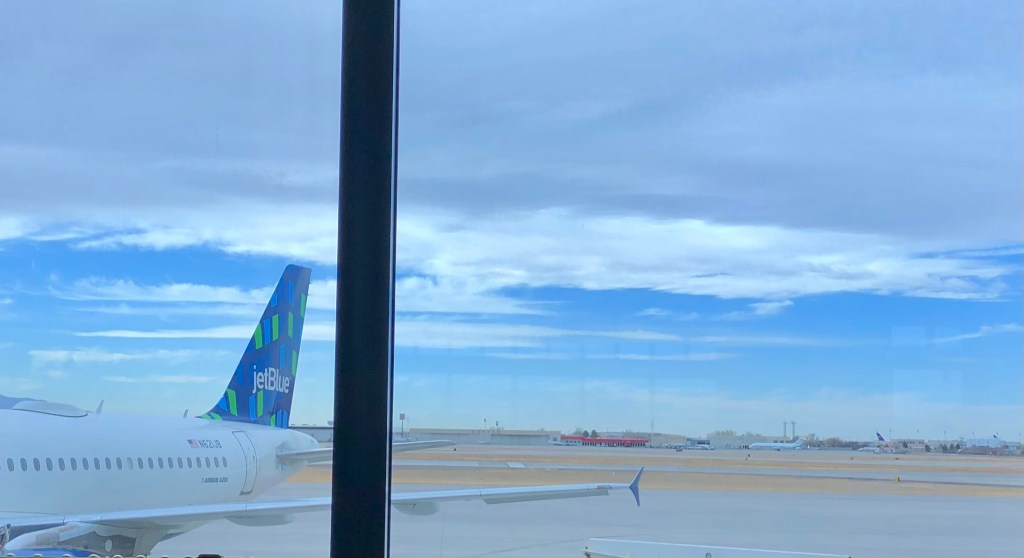
I sit between two strangers in the stratosphere between Newark and Denver. In the plane’s window seat, a young man reads The Habits of Seven Highly Effective People and encourages me to read it, too. He tells me he’s twenty-one and has begun reading books. Then he offers to adjust the window shade in whatever way I prefer. He asks how I can knit and read. I demonstrate how to do a knit stitch.

On my other side, a man is headed to visit his son. The three of us share pieces of why we’re flying, little scraps of our complicated stories. As we begin the long descent into Denver, the man to my left shares that this date is the third anniversary of his wife’s passing. He shows my seat companion and me photos of the slate and copper memorial he made for his wife. As his camera roll unfurls, glass conservatories appear. He builds these custom houses of copper and glass across the country.

The plane lands, and we exchange good wishes for our different journeys. The Colorado sunlight streams in through the window. Tired, I lean on the setback in front of me. We’re in a vessel of metal and glass, too, not so pretty as the stranger’s creations, but just as miraculous.

The Denver airport is suffused with sunlight from overhead skylights, too. I stand beside a potted tree, talking with my daughter about her plans for giving blood for the first time the following morning. Crowds part around me, looking up at the timetable on a screen, parents herding their little children. The line for my next flight forms. All of us are coming and going, joining and separating. I say goodbye to my daughter, walk to my gate, and head back up into the sky in that metal craft.

Small Things.

With a teenage daughter and another grown daughter, I’ve long ago sunk ruggedly into a mantra of and life goes on that has ferried me through plenty of turbulent waters into smoother waters, always determined to seek calmness to keep my head together and keep working. Life and work have so long been synonymous for me, with brief forays into the pleasantness of family, of friends, of just life itself.

But I woke this morning thinking how impossible that mantra really is. Life is “going on” for so many people in such harder ways, so far away from me.

This week, I’ve been with my own family, sorting out the challenges of aging. Meanwhile, ordinariness reigns around me, with people coming and going to work, maybe buying bread and sausages for dinner, a bouquet of sunflowers for the table. How dear family life is, mine, yours, the families in bombed apartments in Ukraine.

In the end, of course, how much do our small thoughts and complicated opinions matter, anyway? Here I am, a small woman in a small Vermont village. In the face of bleak nihilism and despair, I return to the things that have made the truest sense to me — the sky that exquisitely changes from sunup to sundown, the liturgy of human language, laughter. There’s no answers here, only a reminder to myself that the wind brushes over my cheeks, and the wisdom that turns the globe is wider than my own imagination.