Weeding

Before I’ve barely begun planting the garden, wilderness has taken hold of this ground. This afternoon, with my weeding tool and hands, I dug in hard. The younger daughter came to see if asparagus tips had emerged, then wandered away. On this Saturday afternoon, I listened to the frogs rocking  out in the hidden woodland pond.

Maybe this reclamation via weeding should be a battle. But it’s not. Surrounded by woods, the wilderness spreads into my garden through an infinity of ways, in a weed I can’t name, a wildflower I’ve never seen. Every year, my obscure patch of this earth surges with life – the geese winging overhead, the peepers’ chorus, ten thousand variations of green that shift and mutate daily. Not so long ago, I planted a garden with my baby cooing sweetly, laid on her back on a blanket spread beneath an apple tree, her bare toes stretching out toward the sun. This earth is so much larger then me and mine, and that knowledge is as steady as the tool in my hand, a knowledge to take comfort in.

When we marvel at that blue marble in all its delicacy and frailty, and resolve to save the planet, we cast ourselves in a very specific role. That role is of a parent, the parent of the earth. But the opposite is the case. It is we humans who are fragile and vulnerable and the earth that is hearty and powerful, and holds us in its hands. In pragmatic terms, our challenge is less to save the earth from ourselves and more to save ourselves from an earth that, if pushed too far, has ample power to rock, burn, and shake us off completely.

– Naomi Klein, This Changes Everything

FullSizeRender.jpg

my garden/Woodbury, Vermont


Reflections

Long after sunset last night, my daughters and I went walking, in that thick rural dark broken only by the lights of the single house across the road, the lights of our kitchen behind us, and overhead all those stars. The little girl, fearful of the dark, walked between her sister and me. Those glimmering, oh-so-bright stars twinkled in the treetops, still bare and leafless at this time of year.

Earlier that day, the younger girl had dug quartz pebbles from the roadside mud, washed them clean in a puddle, and gave them to me to put in my pockets for safekeeping. My diamonds, she called them.

Shiny bits of stars, bright bits of stone.

As we walked back to our house, guided by the compass of our kitchen light, the older daughter told us she parted her curtains every night and slept every night with a windowful of stars over her bed.

I asked my daughters to imagine our world without stars, with only darkness, none of the constellations cartwheeling across the sky, no dipper pouring luck over our roof, no Orion standing sentry through those bitter winter nights, no Milky Way – that mesmerizing arc of the eternally and ever-beautiful mysteriously ineffable. What kind of world would this be without the lights of the great heavens that have endured, before and after, any human stirrings on this green and blue planet?

My daughter, age 17, pondered this as we stood with our faces tipped upward. Then she said, That would suck.

Indeed, daughter.

I experience a period of frightening clarity in those moments when nature is so beautiful. I am no longer sure of myself, and the paintings appear as in a dream.

– Vincent Van Gogh

IMG_0485

Montpelier, Vermont/Photo by Molly S.


Surprise

On a lark, my daughters and their friend found a lacy fern today, pressed it over a hard-boiled egg, wrapped it in a piece of tights one of the girls had worn to ballet class, and buried the egg in a nest of red cabbage leaves in a pot. I added vinegar and water. When it had boiled and cooled, the older daughter pushed away the soft cabbage leaves.

She held the wrapped egg in her hands for a moment while we guessed what would happen.

The egg was a beautiful shade of blue, the fern hazy enough to be clouds in a summer sky.

Could this be the appeal of egg hunts, beyond the chocolate? A wholly unexpected bit of beauty, sized to fit your hand? At the time of year in Vermont when all is variations of mud, scattershot with slushy snow?

…Nothing is so beautiful as spring —
When weeds, in wheels, shoot long and lovely and lush…

Gerard Manley Hopkins

FullSizeRender.jpg

Koyaanisqatsi: Unbalanced Life

Not long ago, one of my daughter’s friends remarked that everyone desires the warm feeling of home. And yet, why is it so darned hard to keep the home in balance? The stuff of literature is family, never wholly at ease, always shifting and turning, brimming with hunger and unmet desire…. the stuff of life: this material I write about; this very matter I live.

This winter, even a mouse came to die beneath my wood stove, spreading out its little furry body, relinquishing fear of us in its desire to expire on the hearth. The snow is all gone but the hard ugly leavings of dirtied lumps. Vermont in March should be heavy winter, sun bright over fresh snow, and we should be skiing in t-shirts, sunburning. The wind has been blowing every night, bringing neither spring nor storm. It’s off, all of it, this winter that never was.

Long after dinner tonight, the girls and I sat at the table, talking, myself knitting, pulling together through language. They tell me, this happened today, and we did that, while I’m thinking of those sunny faces of coltsfoot, the deep yellow blossoms that push up through the rockiest and poorest of soils. When will they return? I rely on language and story, yes, to bind us together, and my other old stand-by – resilience – thinking…

Surely some revelation is at hand…

– Yeats

FullSizeRender.jpg

March, Vermont

A Starlit Night

Last night, my daughters and I walked the neighbor’s child home in the dark. We had been outside for a while, playing a variation of tag with flashlights and laughter, resulting in the older daughter slipping on ice and lying elbows-down in mud. With the flashlights off, we walked along the muddy road beneath the starlight. The night was balmy for mid-March, suffused with the scent of thawing earth: a rich odor so pervasive it was a constant companion. The moon, a white curve, shone a pure, yellow-white light.

On the way home, we saw our house through the bare hardwoods, the strings of little lights the girls nailed along the eaves twinkling. We passed just one house along our road where a single light shone; they must have been gone. It was just the girls and the star-and-moonlight and the mud and I. The peepers are not stirring yet, and none of the woodland creatures called. Beneath our boots, the earth shifted, softening, giving up its winter frost. My older daughter said, I could walk forever, on a night like this.

This morning, watching a single robin tugging at our lawn, I thought of my older daughter, and how, before long, this girl will be on her womanly journey, walking different patches of earth – in boots, or sandals, or heels – beneath this same exquisitely beautiful sky. I opened the window and listened for birdsong, relishing the season we’re in.

What a strange thing! to be alive beneath cherry blossoms.

– Issa

FullSizeRender

Vermont, Mach 2016

Icicles as Building Materials

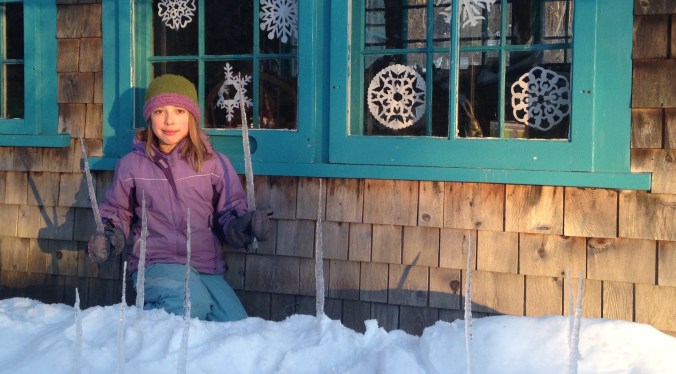
This afternoon, my 10-year-old daughter studiously collected all the icicles that she could reach from the house’s eaves. She then began her winter project of icicle house-building. The icicles have been slim pickings this year, and not for lack of interest. She cajoled her older sister, who had just returned from running, to stretch up and grab a few more.

Returning from a walk, I stood on the road, listening to my daughters at the house, discussing the different colors of ice. This weather, so pure and cold, reminded me of those long walks I took in those last few weeks before my first daughter was born. Every afternoon, I’d bundle up – me and the unborn baby I carried – and walk in what I remember as an especially sunny and cold winter. More than anything, I was most curious to meet this baby, to see this tiny person’s face: my child!

Our relationship has long since grooved into the varied terrain of mother and daughter relationships, far deeper, far richer, far more full than I ever could have imagined, sprawling beyond any cliched confines.

I have one daughter emerging into young adulthood, the other enmeshed deeply in the middle of her childhood. In the end? Who knows? How will these girls look back upon these years? But I hope they remember the loveliness of these ephemeral ice creations.

I do not miss childhood, but I miss the way I took pleasure in small things, even as greater things crumbled. I could not control the world I was in, could not walk away from things or people or moments that hurt, but I took joy in the things that made me happy.

–– Neil Gaiman, The Ocean at the End of the Lane


FullSizeRender

Mid-February, West Woodbury, Vermont