On the Road.

On a rainy Saturday, I pause on an empty road and snap a photo. I’d been listening to NPR’s coverage of the January 6 insurrection, one more plot point along the disintegration of the American Empire.

For June in Vermont, it’s darn cold. I’m wearing a winter hat, and the damp wind reminds me of the ocean, how the salt air cuts into you. Listening, I remembered August 1974 when Nixon resigned. My family was moving that day, and my father, fixated, insisted on setting up our tiny black-and-white television. My sister and I asked what the word resignation meant. My father, dealing with movers and three little children and a curious pack of new neighbors, paused to teach us the meaning of that word and gave a comedic impression of I am not a crook, and then explained what that meant, too.

Decades later, and a whole lot of crooked politics later, I still think of the open road as my family’s version of Huck Finn’s Mississippi River. Not long after we moved that August, my parents drove their three little kids in our green Jeep to the ocean. We had lived in the southwest and never seen the ocean — so much water, so much sky, the impossible proved possible. My father taught us how to fly a kite, its long tail fluttering in the wind.

...Yet I like driving at night
in summer and in Vermont:
the brown road through the mist...
— Hayden Carruth, "The Cows at Night"

Acquaintance. Full Moon.

In an evening walk, I meet a woman I haven’t seen in years. We stop and talk for a few moments. She’s hardly been anywhere for the past two years, and we talk about how that feels. In the balmy evening, little bits of tree pollen float through the sunlight.

Never tall, she’s about my height now, and I’m really short, and I’ve gotten shorter in the past two years. But here we are, talking about lupines, happy to be alive. We exchange a hug — something that seemed forbidden, utterly scary, not that long ago.

Later, as I close up the house for the night, I walk across the dark lawn to my garden. The round moon, like a perfect drop of cream, rises. Frogs chirp.

Here’s one thing: the pandemic has made me think of each day as each day. A whole day — filled sometimes with hard things, or dull things, sweetness, or all kinds of things. But what does a day mean? A night? Nothing more, perhaps, than this: full and frogs and a moment to revel in this.

Foxes. Writing.

Foxes set up kit-making and housekeeping in a den behind our house again this year. Last year, three kits scrambled around. This year, two kits tumble over each other, already growing long-legged.

Their den is in the woods not far from our yard and garden, beyond a patch of weeds and across a stretch of sand. On a recent hot afternoon, I saw a kit stretched out on the sand, sleeping or half-sleeping, soaking up the rays.

A naturalist and his class make arrangements to stop by one evening and see my wild neighbors. Before they arrive, I’m reading outside when my friend stops by. The foxes appear. Near my garden, the neighbor’s gray cat watches, too, in the disdainful way cats do so well. My friend and I marvel at the juxtaposition of wild and domestic, and then the foxes scamper away. We’re knitting and talking when the others arrive. Not on the human agenda and with other things to do, the foxes do not re-appear.

Besides myself and my daughter, I’m not sure who else has seen these foxes. I’ve witnesses these creatures roll over each other and hunt baby woodchucks. They’ve doubtlessly seen me wander about, doing my garden chores. For long moments, we’ve stared at each other over that distance of milkweed and pin cherries, sizing each other up as a potential threat. Each of us appears to have drawn conclusions.

When the naturalist and his companions disappear, I’m slightly sorry they haven’t met and admired the foxes. But there’s also a part of me that relishes this secret world, this relationship devoid of human words.

Last…. here’s the essay I finished reading just before my friend appeared. This is from the final essay (‘On Becoming an American Writer’) in Alexander Chee’s How to Write an Autobiographical Novel.

‘Only in America do we ask our writers to believe they don’t matter as a condition of writing… To write is to sell a ticket to escape, not from the truth, but into it… All my life I’ve been told this isn’t important, that it doesn’t matter, that it could never matter. And yet I think it does. I think it is the real reason the people who would take everything from us say this. I think it’s the same reason that when fascists come to power, writers are among the first to go to jail. And that is the point of writing.’

Small Kindness.

I buy a battery at the auto parts on my way home from work. The young man there asks if I want him to install the battery. Heck, yes, I do.

The afternoon is sunny and breezy, not too cold, not overly hot at all, just about perfect weather. An acquaintance follows me outside, asking about work. A few years back when I asked for a used trampoline on our neighborhood virtual bulletin board, he sent me links for a few, and I found one. His grandsons were some of my favorite readers in the library where I worked. The boys have grown and moved on, too.

The three of us talk about land and taxes, whether rain will fall tomorrow, and how everyone seems short of help these days. Eventually, as often happens these days, the conversation winds around to the price of land in Vermont and what that means for our future.

The young man pulls out my old, nearly given-up-the-ghost battery. He tightens in the new battery and has me start the car. I’m in the kind of rush I’m in too often these days — running from here to there — the kind of hustle I do between work and parenting. The engine starts easily. I thank him profusely for this small gesture of kindness. He gives me a thumbs up. I wish him good luck with his project, and that’s it. We’re each off to our ways.

“Writing is work. Anyone can do this, anyone can learn to do this. It’s not rocket science; it’s habits of mind and habits of work.” 

— Alexander Chee

No Mow May…

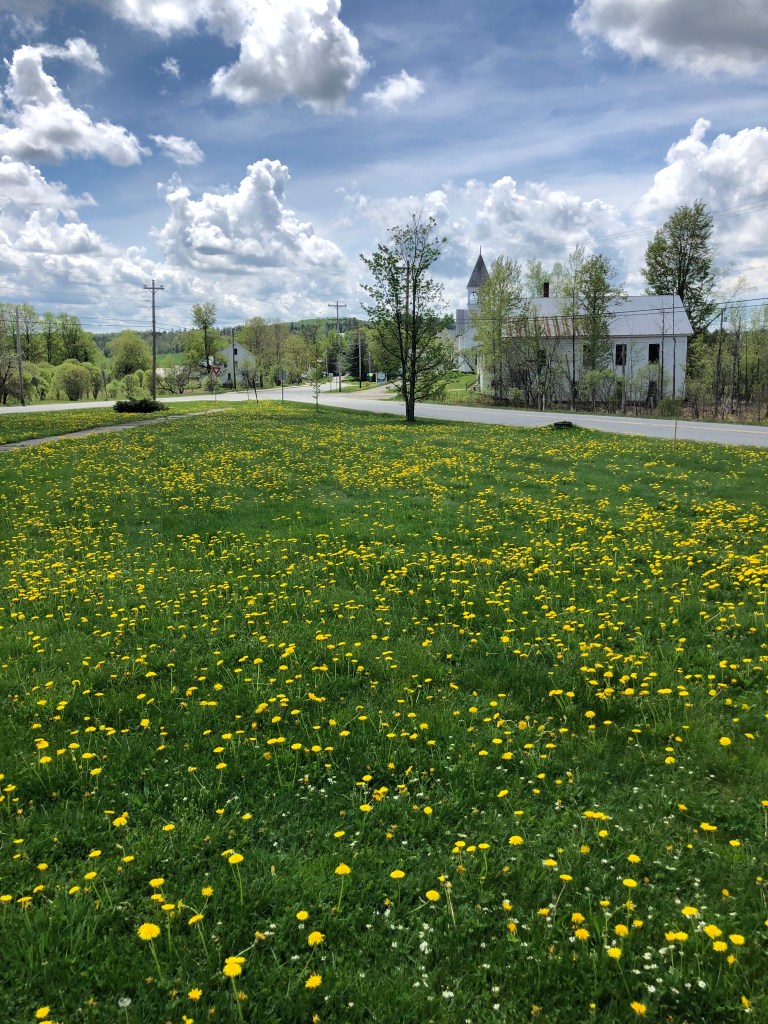
Days like this — or even hours or moments like this (see dandelions above) — remind me that the human world is poor shakes compared to the universe around us. All these things that nag and nip and plague me — from inspecting a car to wondering if my daughters are happy — fall into some kind of place on a sunny May afternoon in Vermont. These things are important; not for a moment am I trying to belittle our human days.

But this is, too. As I crouched in the field to take a photo, a woman bicycling by called out to me. “What gold! It’s cheeseburgers for bees!”

She got off her bike, and we stood talking to each other across the field. I suggested she look at the marsh marigold behind the grange. She mentioned the spring beauties in the woods.

Overhead, the clouds morphed and shifted. Come January, the field might be passable only by snowshoes. But for now, she and I called back and forth, the wind lifting and tugging our words.

 “No creature is fully itself till it is, like the dandelion, opened in the bloom of pure relationship to the sun, the entire living cosmos.”

~ D. H. Lawrence

In the Garden.

Sunday morning, a light rain falls. The rain is a gardener’s dream, a light but steady enough drizzle, interspersed with sunlight. Our world grows. I stayed up late the night before, reading The Year of the Horses, and maybe it’s nothing but exhaustion — and who isn’t exhausted these days, anyway, but the kids — but I keep wandering around, in and out of the house. To the garden to move this or that. Then back inside to wash a window or sweep away some winter cobwebs.

Washed by rain, the colors in my garden are vibrant. I have this strange feeling that I’m inhabiting the Middle Ages, the realm of chivalry and honor, a time when art is justly valued.

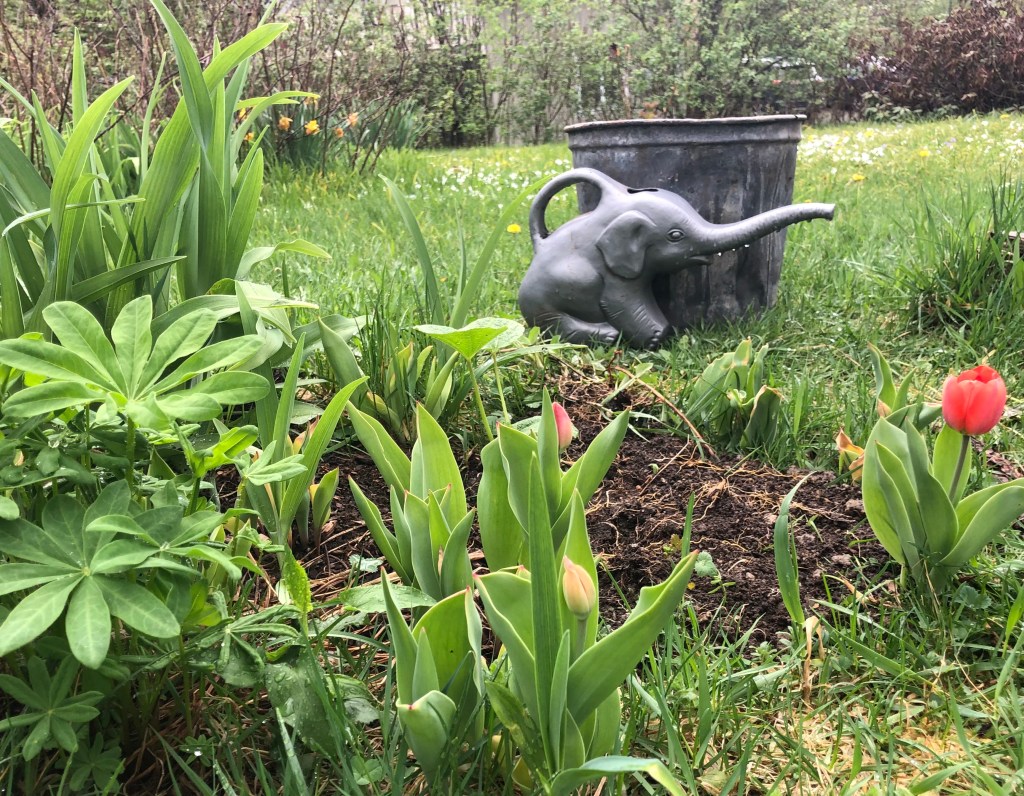
All day long, I work at this, back and forth, making some kind of order in my raggedly life. Before too long, I know, the weeds and the black flies will swarm me. I might be overwhelmed with the messiness of gardening. But for now… just this potential. Just this moment. A single tulip, blooming.