Hot, in the best kind of truly humid summer heat, the heat that brings me back to those endless childhood summers when a summer was endless and not merely a few heartbeats. In a strange kind of way, the heat rejuvenates me. I wake early, work hard, then finish my chores as the day funnels down to swimming.
At a nearby garage, I pick up my car. There’s no one there in the empty building, the side doors rolled all the way up to ceiling. I stand there, listening to traffic and watching shadows from the trees flicker over the cement floor.
Two women come in and tell me they’re limping along a Toyota Rav with a flat tire. One woman wears wool socks and winter boots, and I think, Of course you’re from Maine. They’re both much younger than me, nearly bouncing with excitement, and I ask what brings them here. They’re checking the world out. Their excitement is the brightest thing I’ve seen all day. The woman with the wool socks says with a smile, Could do with some rain.
I answer, It’ll rain. She looks at me as if my assurance is farfetched. I add, Eventually, and then wander behind the garage looking for the man to write a check. The garage is on the riverbank. I look at the shallow water. Get a move on, I think. There’s plenty to do. But I live in Vermont. There aren’t that many days in a year I can wear a sundress and not wish for a sweater.
I was at a political forum last night where two lead candidates for Peter Welch’s US Rep seat each took their turn answering questions from moderators and the audience. The forum was held at Jenna’s House, an empty church transformed into a community space and recovery center. Naturally, the questions centered on addiction and recovery. The space is beautifully redone, warm and welcoming. I pulled into the parking lot and spoke with a founding family member. He was standing in a warm rain beneath an umbrella, welcoming in guests. He said, I hope you enjoy yourself tonight.
Here’s the thing about the recovery world: all pretense has long ago been stripped away. The recovery world so often is portrayed as the unfortunate, the damaged, the weak, the outsiders. But these people in one way or another have lived through terrible things. Loss is no stranger to anyone here, and that changes the social landscape. I’ve met a generosity and openness and — honestly — kindness here that often seems absent from the take-care-of-your-own-family-first middle class realm.
The church’s inside was well-lit. I sat with a woman I’ve met here and there, and we talked about knitting and cancer and working. All the windows and doors were open. Rain fell. In a little while, a man would speak about the death of his sister when she was 26. I keep returning to this sweet place because I like these people — they’re funny and wry and warm — but I’m also amazed by them. In their own terrible grief, they chose to open their hearts.
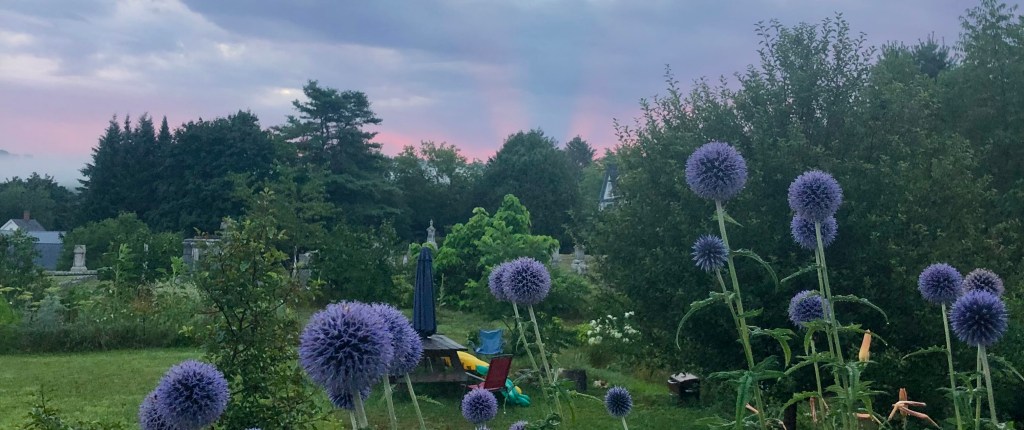
Afterwards, I drove back to Hardwick along the river valley — so green in midsummer — listening to the radio and in no particular rush. The rain had passed by the time I was home, and the world sparkled for a bit before the night set down in earnest. Five years into living at this house, the hydrangeas I planted that first summer have finally blossomed magnificently, profoundly here for the duration.
My teenager was eating blueberries and talking on the phone with her sister. In a year, I’ll expect she’ll be shortly headed into her young woman life. But for this evening, I cleaned up the cat’s lettuce vomit and boiled water for tea. I had about ten things that all seemed important. Instead, I walked barefoot through the wet grass to the mint that escaped my herb garden and plucked a few leaves for tea. Washed with rain, the air smelled ineffably sweet.
“But along with the feeling of ineffability, the conviction that some profound objective truth has been disclosed to you is a hallmark of the mystical experience, regardless of whether it has been occasioned by a drug, meditation, fasting, flagellation, or sensory deprivation. William James gave a name to this conviction: the noetic quality. People feel they have been let in on a deep secret of the universe, and they cannot be shaken from that conviction.”
On my way home from work, I stop in to visit a small building just recently finished. Inside, the room smells of freshly cut cedar. The visit is a pleasure, with a building well-designed and completed. Its owners will take joy here, that’s nearly certain.
I’m at the far end of the lake, and so I take the long way home over dirt roads. I make one more stop, where someone I knew years ago has finally begun building a long-planned retirement house. Building is both fast and slow these days — a craze to build and a shortage of materials. There’s no one at this site, and I stand for bit, admiring the view of the Black River valley. I hope this place gives the owners their share of joy, too.
Where I work now is the town where I spent so much of my daughters’ childhood summer days, swimming and hiking. There was plenty of joy in all those things, too. The afternoon is redolent with humidity, exactly as I remember in my childhood.
In this steamy afternoon, I have a little pocket of time before an evening meeting. In my garden, I pick two zucchini, some lettuce that’s gone to sour, and a red coin onion. My garden grows as tall as my shoulders, more wild than not. A light rain patters down. I weed a little.
A thousand things I’ve done today. Or nearly a thousand. In this little moment, I let my own racing mind go. The snails have gotten into the lettuce. I lift one and then, gently, set it back down again.
Let it eat on, I think. I’ve plenty to spare. Don’t be greedy, I admonish myself.
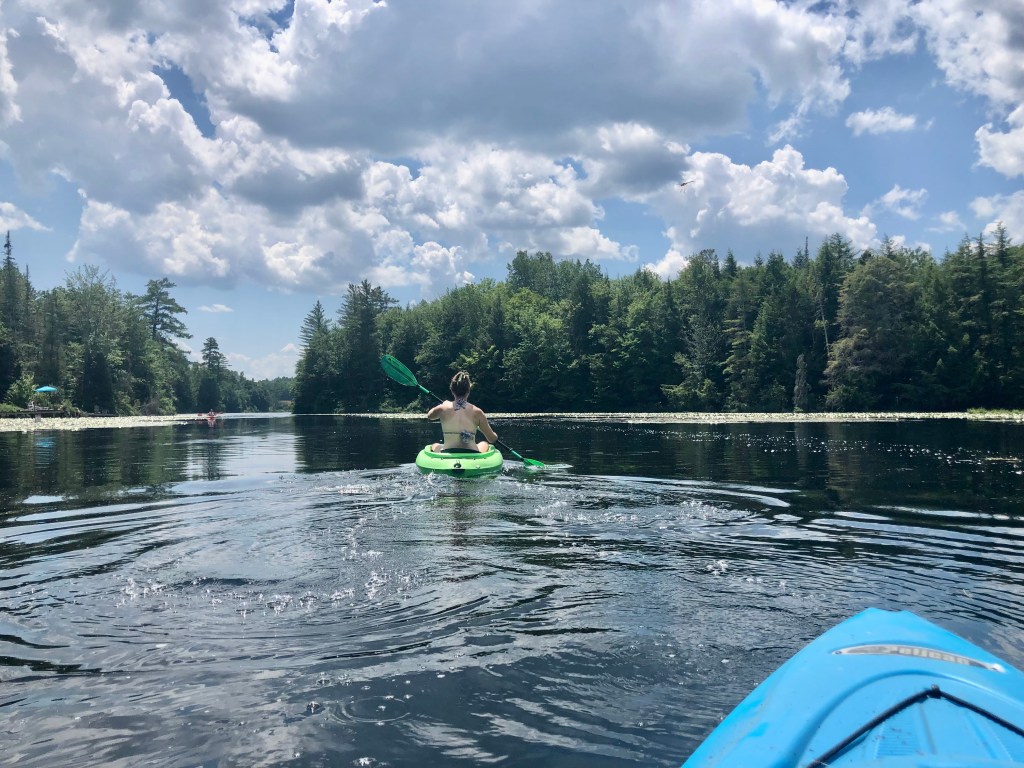
Sunday morning begins hot and out-of-sorts in our house. As antidote, we load the kayaks on the car. We paddle through a passage between floes of waterlilies in a breathtaking landscape — clouds reflected in water and all those perfect flowers. We’re not far from home, but the kayakers and canoeists we pass are all strangers who raise hands in quiet hellos.
In no rush at all, we paddle to the pond’s far end, where we drift for a long while, talking and handing a box of crackers between us. A loon and a single chick bob nearby. The other loon parent appears with a string of lunch in her or his mouth.
Later, we pull our kayaks on a shore and swim out to a raft where we lie in the sun and talk about where we might be five years, ten years, down the line. A man swims out with his two daughters, and we talk a little with him about the raft and the sun and the waterlilies that cover the pond.
I’m reminded of William Blake’s line about seeing the world in a grain of sand as we slowly paddle back to where we began. I’ve walked across sections of this pond in the midwinter around ice fishing holes. A number of years ago, a teenager drowned here, a boy I knew as a baby. His parents were vendors in the same farmers market where my husband and I sold maple syrup and ice cream. We all had little ones in those days. On those hot afternoons, we shared stories while swaying with babies on our backs.
The pond this July day reflects only sweetness and beauty. At the shore, my daughters load our kayaks back on our car. I rinse off my bare feet at the water’s edge. A little boy runs to the end of the dock. His father stands waist deep in the water. He raises his arms and says, Jump. I’ll catch you.
In the classic scenario of Saturday plans waylaid, I end up driving here and there this morning, for errands that may or may not make any difference at all. That seems to be where we are these days — maybe, maybe not.
July has warmed, and I work on the back deck, in the shade of our table umbrella, drinking cold coffee.
An acquaintance I haven’t seen in a while stops by. We stand in the shade of my house, talking. He found my book in a yard shade and bought it. Then he tells me his own story of drinking and how he rose up against it. I’d known a few strands of this story, little bits, here and there, that he’d freely given me before. But his telling and my listening slips me back into that sacred space of stories. The telling. The listening. Nothing maybe about that at all.
“A story has no beginning or end: arbitrarily one chooses that moment of experience from which to look back or from which to look ahead.”
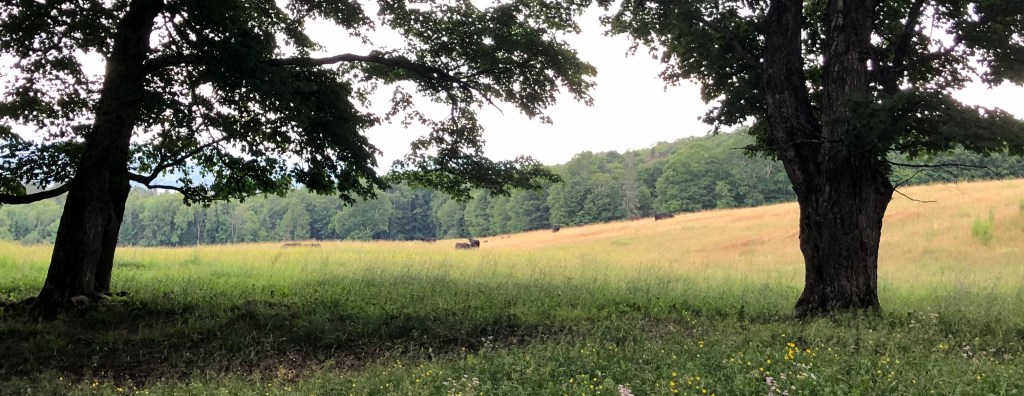
I take a hurried walk on Nature Conservancy land in a slot of time between working hours and a planning commission meeting. I duck beneath the electric fence and wander up an old farm road and discover the most enchanting sight I’ve seen in a long time.
Bright blue forget-me-nots sprinkle the unmown road. Heifers graze in pasture on the other side of enormous sugar maples. The pasture glows amber in the late afternoon, humid light. It’s cool enough this afternoon that I’ve pulled on jeans beneath my dress, and my sandals have been switched for hiking boots. The woods are deep and lush.
This is Wallace Stegner land. He loved this Vermont town and lies buried in a town cemetery on the other side of the lake. As I walk, I’m reminded of his famous lines.
“We simply need that wild country available to us…. For it can be a means of reassuring ourselves of our sanity as creatures, a part of the geography of hope.”
~ Wallace Stegner
This space of wildness wraps all around where I live, winding in and around these Vermont towns. Mighty — these trees and fields — but just as dear are these tiny blossoms, sprinkled all through the forest, far up in the woods where they disappear from sight.


 Stony Soil Vermont