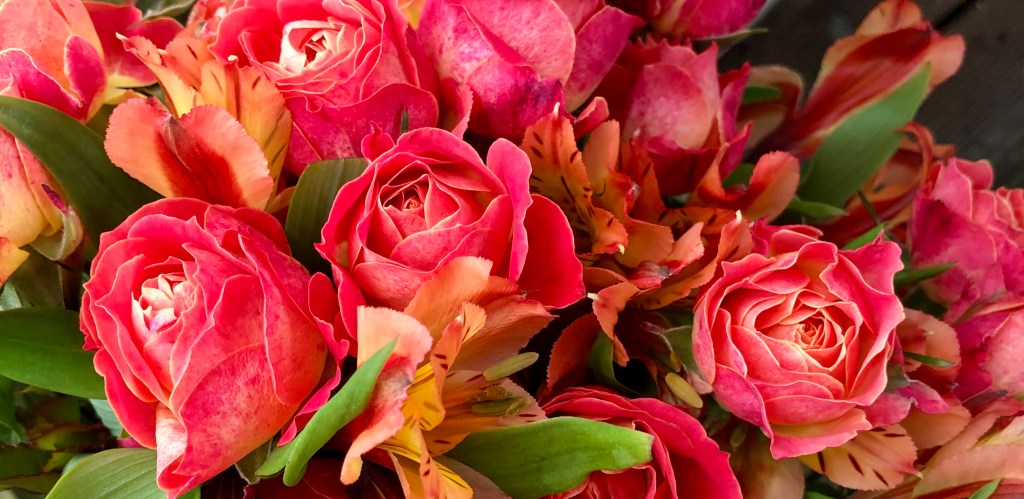
Peak Foliage, Thursday 1:35 p.m.

… or so I predict. Such a silly thing. The branches of some trees have already blown bare, others are just beginning their radiance. It’s later that the torches of tamaracks will begin.

On these stunningly beautiful autumn days, the cats and I wake early. They’re easily satisfied with a few morsels of cat food, a rub on their furry heads, a few more sticks in the wood stove. The two of them stretch on the rug before the stove, worshipping.

Daughter and I go about our day. Coffee and dishes and firewood. At night, I dream of spring peepers.

Here’s not the famous lines from Robert Frost that rattle through my mind these days. Instead, Ezra Pound:

IN A STATION OF THE METRO

The apparition of these faces in the crowd:
Petals on a wet, black bough.

— Ezra Pound

October 1.

I spend the better part of Saturday stacking wood, beginning bundled in a sweatshirt and hat, and quickly stripping to a tank top and shorts. A black cat wanders by and appraises my work which, admittedly, is uneven but certainly sufficient. I breathe in fresh sap, wet earth, dusty bark crumbles.

The month of September — all thirty days — disappeared in a few heartbeats. I’m still pulling in frost-choked parts of my garden, the dead lily stalks, putting away the clay fairy house in the rock garden my daughter made so many years ago.

Friday, I’m at a summit all day that brought together people, who, in one way or another, are enmeshed in healing from addiction. Here’s the thing: a few years ago, I never would have attended a summit like this, let alone speak to a large group. For years, I said nothing about my own struggles with addiction. But publishing Unstitched acknowledged in a very public way my own miserable struggles with drinking. Because I had written the book, I had to answer questions publicly about this, and I needed a surprising amount of time to acknowledge this, to really accept what this meant. But I heard — and I kept hearing — from people I both knew and complete strangers — about their struggles, or a friend or family member’s struggles.

The Rumi line I quote in Unstitched is “the wound is the place where light enters.” When I returned Friday evening, my daughter asked me why I go to these sad things. And it’s true; there’s such grief that’s shared. But now I understand that there’s my own grief — still much of it in a private place in my heart — but grief is our human commonality, too. The wound is what renders the light possible.

When I step out, three hot air balloons are rising.

Nearby the expo where the summit is held is a hair salon named The Rusty Clipper where I dropped off maple syrup wedding favors about twenty years ago. The father of the bride gave me a check. When the bride opened a box, she told me I had given her the wrong bottle — hearts instead of leaves, or leaves instead of hearts. I gave the check back to the father. I put the boxes back in my car. I buckled in my three-year-old and drove home. At home, I redid all the favors and drove back the next day. When I got the check again.

I stand there under the hot air balloons and wonder about that bride whose name I’ve long since forgotten. Then I follow the crescent moon home over the mountains as the light gives way to twilight.
Gifts.

Before I leave for the North Danville Library on Tuesday, I sit for a moment with my daughter at our kitchen table. She eats a quesadilla, and we talk about things that matter — who’s behaving in what way and why that might be. The rain has knocked off for a bit, and I drive the way I often knit, more by feel and memory than anything else.

At this time of year, the farm fields are their deepest green. Sunflowers appear in gardens and along houses, their yellow leaves weathered by cold nights. I passed the house where my former sister-in-law lived when her four children were little. In the backyard, we built a playhouse. Her oldest daughter slept in the upstairs bedroom, and milk trucks rumbled down the road in the very early mornings.

The Brainerd library is housed in a former schoolhouse. I parked and stood for a moment in the lot shared by the library and a church. Cows ambled in the field behind the parking lot. Across the street, children pushed each other in a swing hung in an enormous tree. I imagined these were a few after-dinner moments gleaned in the falling twilight before bedtime.

I had been generously invited to talk and read a little about my book Unstitched. Driving over, I remembered the two years I spent writing this book, much of these hours at my kitchen table. Writing a book can be such a long and lonely process. So these moments of connection and resonance, of meeting readers and other writers, are manna to my soul. The library was well-cared for and had a real sense of so much living that had happened in those walls.

Unstitched is about hard things — addiction and guilt, poverty and illness. But I left that night and drove back home along the roads that had no traffic with my heart full of happiness kindled by an evening of literature and discussion and homemade cookies in a beautiful library with kind people. At home, the stars sprinkled over the sky, and the night was still warm enough that I could pretend winter was not in the near offing. Inside, my daughter and I picked up our conversation where we had left off.

Some Miles.

So many miles passed this weekend. Two trips to Vermont’s big city of Burlington for the Green Mountain Book Festival — Saturday as a participant, Sunday as audience. One trip alone, one trip with a friend. This past summer, I put some genuine effort into what I named my own personal healing project from the isolation and sadness of the pandemic — a project I admittedly dabbled in, without real expectation of success.

Here’s what I did: I gardened, spent as much time outside as possible, swam whenever I could, slept under the stars, and basically tried hard not to care very much (or maybe be distracted) by things that don’t mean very much.

What a pleasure to be back among the literary world, where people walked in and out of rooms in the lovely Fletcher Free Library, listening to poets and writers, the young and the very old, talk about writing. In an innate kind of way, these are my people.

Outside, rain fell in a dismal September day. I’m not a cardholder at this library and have only intermittently walked through its doors. Sitting in the main reading room in my raspberry-jam-hue sweater, I could have kept listening to the stories, language pared down and muscular, judicious with adjectives, evocative of Vermont and the people living here.

Media spin notwithstanding, the pandemic hasn’t vanished. Our world has been upended. And yet we move on.

A few lines from Jay Parini who graciously read beside me this weekend:

“It is not an easy thing to alter the trajectory of your life. People have expectations on your behalf. You come to believe them yourself.” 

And, last, I’ve kindly been invited to the North Danville Library this coming Tuesday, 7 p.m.

Lost, Not Lost.

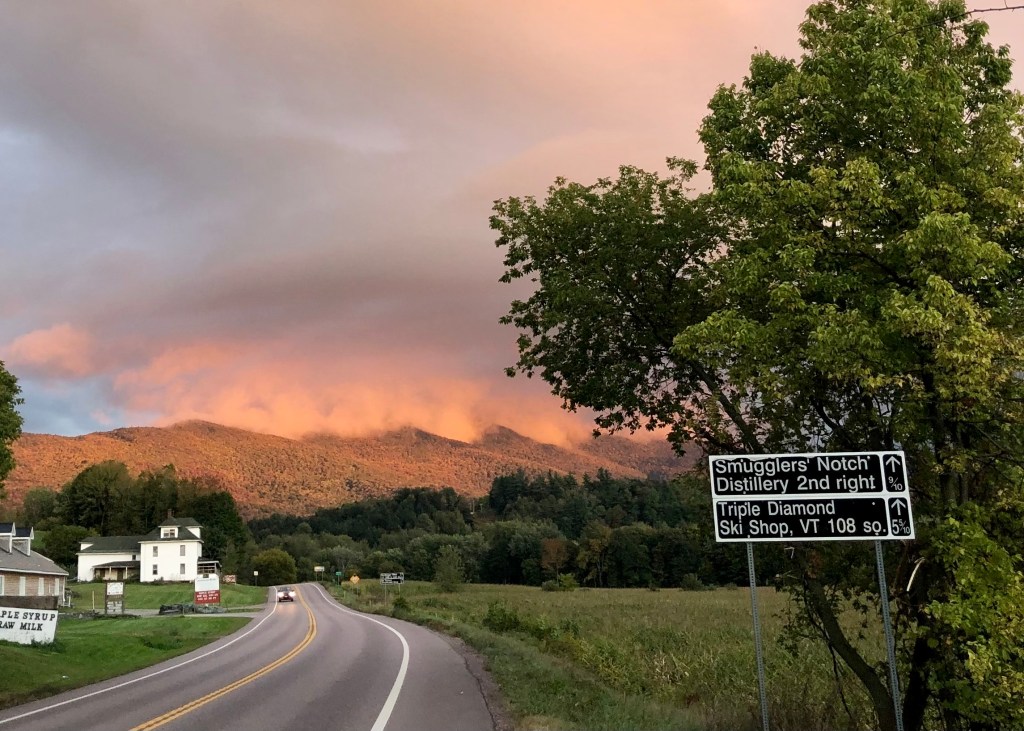
Tuesday afternoon finds me somewhat lost on the way to a soccer game. In a rush, I glance briefly at the map, take a mental note, and head off. My cell phone has given up its ghost, and I know I have a paper atlas in the back of my Subaru, jammed beneath a box of oil, if need be. I drive the way I knit — by feel — and generally that gets me there. In this case, driving by feel gets me to Hazen’s Notch, a twisty dirt road climb. The road has been recently graded; it’s slick with falling rain.

I’m headed to a town where I haven’t been in nearly 25 years. The last I was here, my then-husband and I were following a lead on a vacuum pump for maple sap. We pulled into a two-story house that was recently built. A pregnant woman dialed her husband at the town garage, and he drove up in a moment. That afternoon, I wanted to be pregnant. While our husbands talked about the pump, I asked her about the pregnancy. She wanted to buy a crib with the money from the sap pump.

We paid in cash. The pump remained one of the most reliable pieces of equipment in our sugarhouse. It became my nemesis, too, with the absence of housing around the belt. I feared for my hair and scalp, my fingers. It drank oil like crazy. It worked hard.

This Tuesday, I’m not really lost. I know, enough, where I’m headed, how to read the sky and rivers, the mountains, to get me in the right direction. I pull over near a swamp where maples are in full red already. What do you know, I think to myself, that sight is worth the drive.

Here we are…

Above pretty much sums up where we are now. 23 years into this parenting gig, it’s now me and the teen, and if a housecat has moved into a box on the kitchen table for the winter? Well, so be it. And the other cat refuses to drink water except on the kitchen sink? Well, so be that, too.

As a young mother, I read a literal library of parenting advice and made a trillion mistakes. I take my (diminished) reading time much more seriously these days. I continue to make mistakes. And I’ve decided the cats are fine companions, even on the table.

In so many versions of my previous life, this wouldn’t fly. Now, listening to Biden talk about his proclaimed End of the Pandemic, I wonder, What’s all that about? Who gets to decide what, anyway, and why believe anyone else when your experience doesn’t jive?

Rain comes down in buckets. A friend gives us a bucket of apple drops. I cook bacon in the oven and buy the best loaf of bread I can find for our dinner. Our tomato and basil plants are still churning out their delectables. Sure, winter is in the near offing. Much more than winter, too. Our cat is the happiest creature I’ve ever loved. We offer him drops of milk on our fingertips, licks of butter from a smooth silver knife, tender kisses on his head.

As the cat
climbed over
the top of

the jamcloset
first the right
forefoot

carefully
then the hind
stepped down
into the pit of
the empty
flowerpot

— William Carlos Williams