Soundtrack.

My oldest plays Noah Kahan as the soundtrack to her life, the young man who sings of loving Vermont in all its bareness and glory: I love Vermont, but it’s the season of the sticks

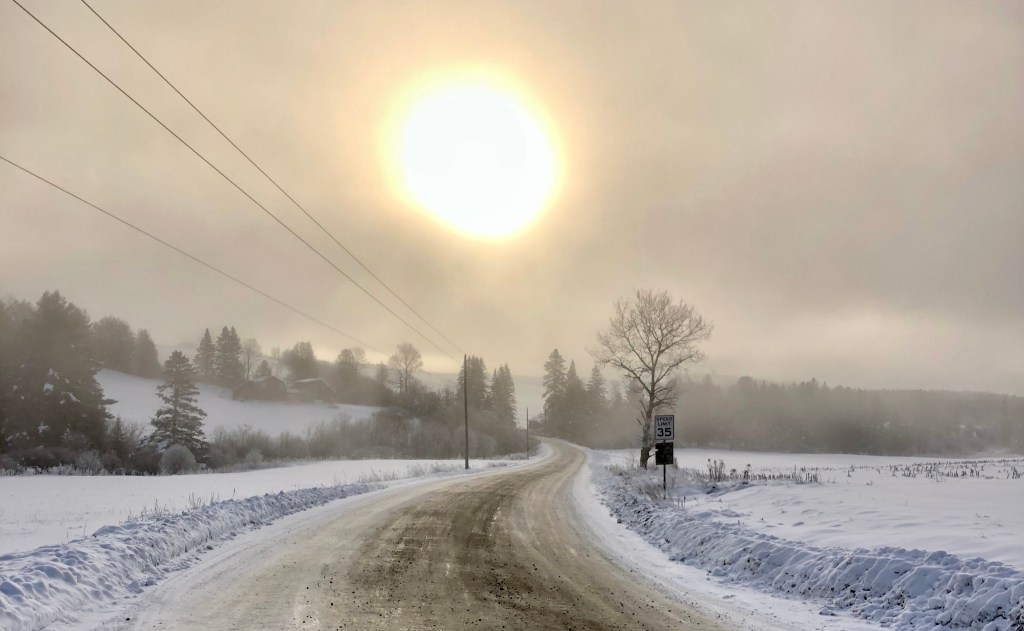
I pull over on the roadside. There’s no one around, not even a crow keeping me company. Solstice season, the precipice of one thing tipping into another, the darkest of the season tipping over into the real winter yet to begin. I am decades into my own love personal affair with Vermont.

Winter is the perfect season for a writer with its shocking beauty, the looming threat of frostbite, the profound metaphor of darkness and light, heat and cold, stillness and the edging-in resurrection of spring. On the deepest level, perhaps, winter reinforces the need for patience.

Noah Kahan sings: So I thought that if I piled something good on all my bad
That I could cancel out the darkness I inherited from dad…

How’s that for a variation of an Eugene O’Neill play?

Curious about this Kahan character? Check out Vermont Public Radio’s story.
The Present, the Forgotten.

Midday or so, I jam on my boots and head out for a walk down to the lake, leaving behind my desk with piles of hard questions. I’ve forgotten my mittens, so I walk with my hands in my pockets while the wind tears over the lake. The summer people are all long gone, houses boarded up against the elements and thieves. Ahead of me on the road, a stranger walks with a little dog who leaps in snowbanks.

The sunlight is clear, sparkling on the snow, the lake white-capped and simultaneously blue and gray and the green that copper turns after rain.

Last winter, the town began plowing the sidewalk that cuts through the old school’s green. A woman had snowshoed a labyrinth in the snowy lawn for years. The sidewalk divides that space. She protested. The plowing continued. I see she’s marked that labyrinth behind the church. Ahead of me, the little brown dog stops in the road that no one else but us is traveling, its head cocked to one side, staring at me. A gust of wind blinds me with snow for a moment, and then drops just as quickly.

As I walk up to the little dog, I bend down and say hello. The man explains that the dog has rules about people walking behind them — not allowed — and then the three of us walk together, the dog now happily flipping itself into snowbanks. “It’s a bit of an inconvenience,” the stranger tells me, “especially when I have work to do.” At the main paved road, traffic is sparse. A lone Subaru passes with salt-streaked windows.

We part ways. I walk along the short stretch of pavement and turn at the old maple tree that I begged the Selectboard not to cut last year, arguing that the breaking branches were falling only on the grass. “Give it one more year,” I asked, secretly hoping the tree-cutting plans would drift into forgotten things.

At the door, I stamp snow off my boots: a walk with a handful of immutable things.

Snowy Days.

Socked in by snow, I wander through the neighborhood where kids are usually outside. Two boys ride along the unplowed street, the back wheel of one bike just a metal rim, no rubber tire. The wheel leaves a trench behind the boy. The boys are talking seriously, their words muffled by snowfall. Down the hill, a little boy, maybe five or so, stands in his too-big snowsuit, mouth open to catch falling snowflakes. The moment feels intimate, as if I were staring through a window. I pick up my pace a little and keep on.

“One winter morning Peter woke up and looked out the window. Snow had fallen during the night. It covered everything as far as he could see.” 

— Ezra Jack Keats

Glass. Packages. Blood.

My daughters spent years playing with glass containers. Sure, we also had the usual endless assortment of empty yogurt containers, the odd plastic collection, the paper cups such as the beloved Easter bunny cups (known lovingly as cups-with-bunnies), but we made and sold maple syrup for years.

At one point, wedding favors in leaf or heart bottles was a chunk of our livelihood. I made endless trips to different maple distributors, loading up the back of my station wagon and often around my daughters in carseats with cardboard boxes of glass. That 8oz maple leaf with a gold foil top? Top seller.

I packed and shipped maple syrup in the PO’s flat rate boxes. Those boxes made shipping syrup a viable family endeavor, and I knew all the post offices in my small sphere of travel. Headed to story hour at the library? I swung by the Greensboro post office. Picking up more glass? East Montpelier post office. Need bike parts? Morrisville.

I had a “well, duh,” moment this week at the post office when I weighed a package to my parents. The clerk kindly handed me a flat rate box, tape, and a mailing label. I asked for use of a pen, too, then stripped off my winter coat and hat, and went to repackaging work in the PO corner. I sliced my fingertip on the blade of the knife dispenser and bled on the label and then on my check. All those years, so many bottles filled with sand and pebbles, with colored water and concoctions of leaves and flower blossoms, and I don’t remember a single glass cut on my daughters’ little hands.

I ripped up the check I’d bloodied and wrote another, left-handed and nearly illegible.

Cutting into with the ax,

I was surprised at the scent of.

The winter trees.

— Issa

The Mail is a Real Thing.

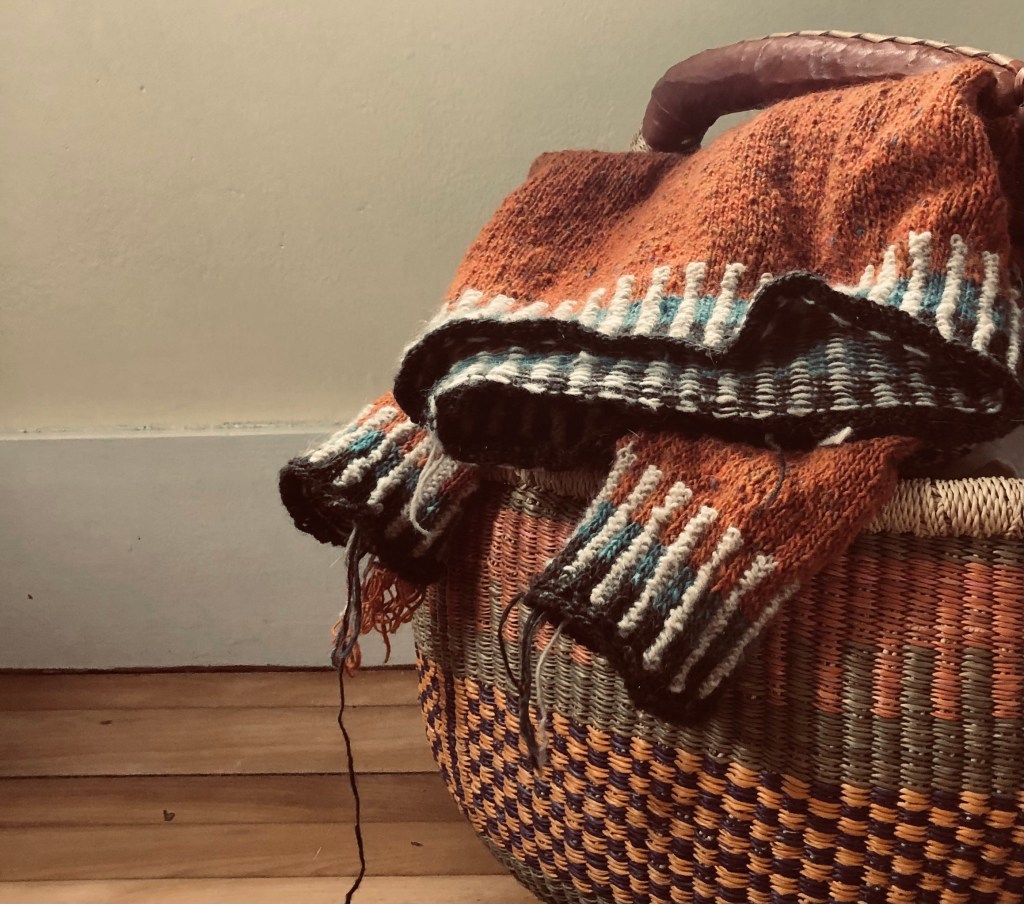
Our post office box is crammed with mail. It’s been a few days, and I tug the mail out to see what’s there. Late afternoon, the PO has a steady stream of locals, some shuffling, others rushing. I take my turn at the table in the corner, chucking away what I didn’t request and don’t want, the sale flyers and offers. I keep a holiday card and the electric bill, The New Yorker. While I wait in line for two packages, the woman beside me strikes up a conversation about knitting hats and then we’re in the world of cables and color and yarn weight.

The PO is in the post office’s standard squat brick building, not at all quaint or cutesy. When staff changed over a few years ago, someone planted a flower garden in the front bed. By late summer, I kept admiring the flowering elecampane, taller than my head, bristly and mighty, a flower after my own heart. Late July is a long way off, but still. Elecampane is lodged in my garden plan.

“No two people knit alike, look alike, think alike; why should their projects be alike? Your sweater should be like your own favorite original recipes – like nobody else’s on earth. 
And a good thing too.” 

— Elizabeth Zimmerman

Winter Koan.

I stop in at the former Hardwick Gazette building, now turned into the Civic Standard, an organization trying to figure out itself. An acquaintance and I stand at the windows in the building’s rear, staring down at the Lamoille, where ice feathers only along the edges. The water is low enough that the rocks are mighty in the rushing current.

I drink coffee and sit crosslegged on the couch, and we talk for hours. I finally vaguely inquire if we haven’t had enough of our own words, and then we go on and on again. The building itself seems marooned in the 1970s, and even in 1972 the building likely felt stranded in 1957. An old printing press hulks beside us. One of us has an Hungarian immigrant family, and our conversation inevitably weaves in the first half of the 20th century.

December in Vermont is as good a time as any to ponder the Zen koan chop wood, carry water in the pieces of my life. Sunlight on the living room floor. Kim chi and brown rice. Reading Ruth Ozeki’s The Face on the rug.

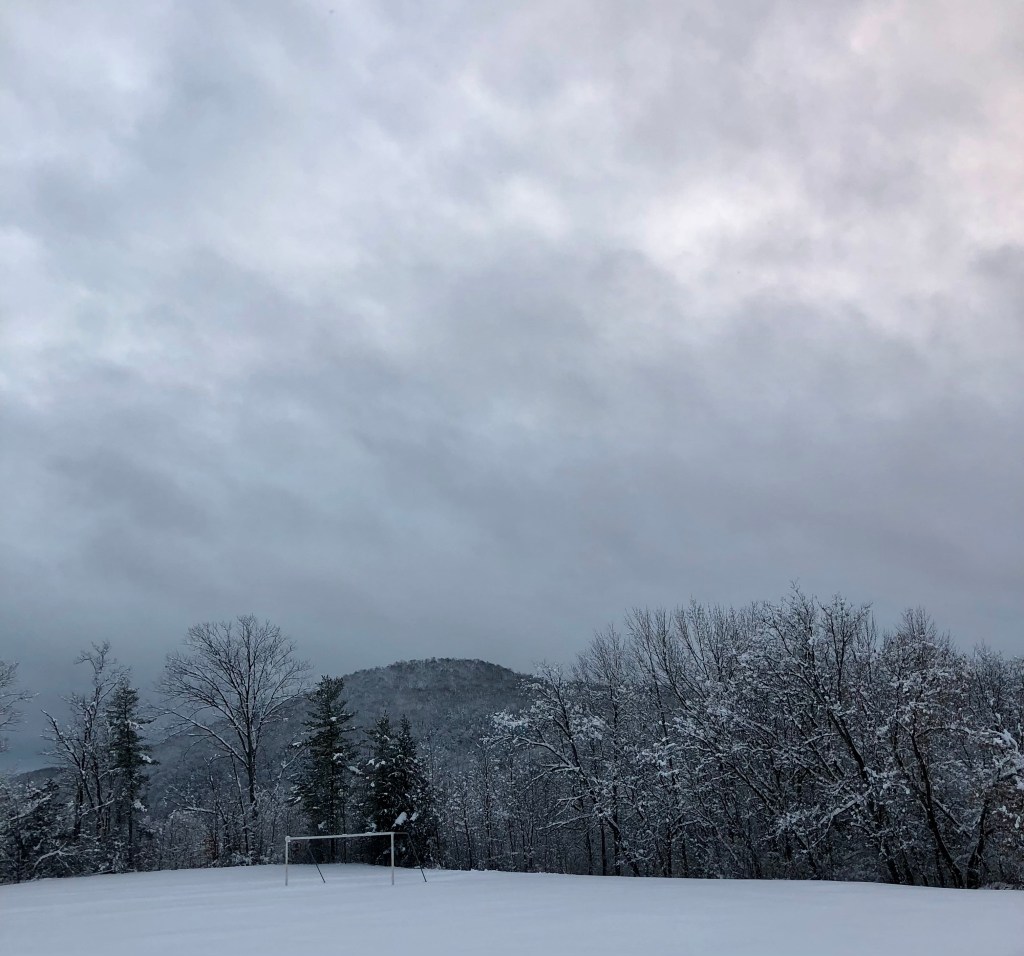
Sunday afternoon, light snow sifts down, the sweetest gift, its fresh cold sweeping away our stale human layers of mind and emotion. I carry in an armful of wood to feed our little stove for the night. The snowflakes melt in my eyebrows. Finally, I think, finally, a scattering of snow. Then I quit thinking, close my eyes, and listen to the falling snow.

“The past is weird. I mean, does it really exist ? It feels like it exists, but where is it ? And if it did exists, but doesn’t now, then where did it go ?” 

— Ruth Ozeki