Post-Flood, More Rain.

Nearly a week into Vermont’s floods, I’m surely not the only one in this town awake at night, listening to rain through my open windows. Lush, lush, our world is. Sunday, I trim the rose bushes that thornily cover a window, then discover moss creeping towards the house. I snip and scrape, then dash inside beneath a sudden downpour.

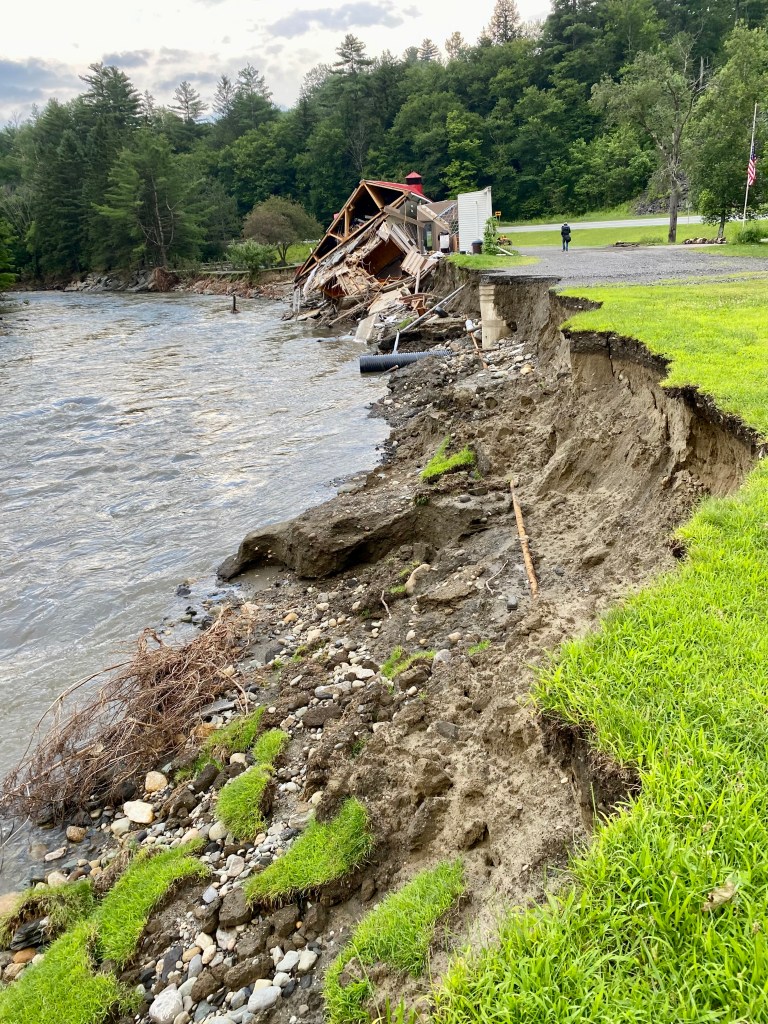
Sunday, I walk along the Lamoille riverbanks, silty and sandy where the river rose far above its usual path. Red metal lies in twisted sheets, remnants I’m guessing from the motel that tumbled into the river. Twisted towels and clothing, tires, a stepladder are jammed into tree trunks and roots. Cassette tapes of bible stories lie in a puddle, oddly more or less intact. Down the river, smoke churns into the sky where a flooded sawmill has burned debris for days.

There’s an odd kind of quiet hovering around here. What I’ve witnessed is shock and disbelief, a heady kind of euphoria to fix and repair, and now a sodden dullness, the earth as drenched as I’ve ever seen it. My pink poppies have blackened before they’ve bloomed.

We keep on, of course. Our beloved capital city, Montpelier, hoes and bleaches. Word goes around and around about passable and impassable roads, who needs helps, who’s yet marooned by great rifts in the earth.

In the late afternoon, I buy poppyseeds at the co-op and pay off my tab. The staff is out-of-sorts there, too, grousing about a broken cooler and the mud we’re all tracking in. Rain falls, quits, but the day doesn’t cool. I bake a cake and listen to someone on VPR talk about the Buddha. In the evening, that fat woodchuck darts among my gardens. A flock of starlings scatter on the lawn. Robins and rain. The daylilies are brilliant, the flowers poet David Budbill called coarse and beautiful.

As I said, it’s coarse and ordinary and it’s beautiful because
it’s ordinary. A plant gone wild and therefore become
rugged, indestructible, indomitable, in short: tough, resilient,
like anyone or thing has to be in order to survive.

David Budbill

Putting the World Back Together, Again.

By Thursday, I’ve lost track of days. A kind man stops by the town office with plates of cookies, still warm from the oven. I’ve been up for hours and hours by then, some working, some staring out the window at the dawn pushing up over the mountain, a spill of pink that widens into gold.

I haven’t been flooded. I know no one who’s injured. Yet, all around, the torn-up world, the folks who are seeking dry shelter, clean clothing, the next meal. The roads are our arteries, and slowly, gravel load by excavator sweep, the world is being put back together.

Thunderstorms and flash floods are in the forecast. Through all this, there’s the subtle underlying sense of how quickly the world turns.

Stores warn of early closings. We’re in this place I recognize immediately, almost giddy, slightly horrified, where people let down their guard, laugh at things that maybe aren’t that funny. Slowly, wrapping order around chaos.

“Water symbolizes the whole of potentiality – the source of all possible existence.”

— Mircea Eliade

Water, Water.

These days, I’m working in a town clerk’s office, Greensboro, Vermont, population approximately 827. With summer folks, the population swells to three times.

Yesterday, the phone rang all day. We propped the door open, and people wandered in with questions.

Can I get to Craftsbury? Which roads are out? I have a dump truck; want me to haul fill? I’ve lost everything; do you have extra clothes, shoes, blankets?

Selectboard members set up a triage system to patch roads where anyone was stuck. Farm roads were prioritized for milk trucks. All day long, Vermont Public Radio updated us. Montpelier, beloved capital city, is underwater, threatened by a dam where waters rose precipitously.

Late afternoon, the selectboard chair rummaged for leftover potato chips from the July 4th celebration. By then, the sun had emerged. The July day was hot, redolent with blooming roses. I had my own petty worries: my car was low on gas, and I’ve kicked a front brake repair too far down the road, and I’ll need to find a mechanic stat, and who I’ll find isn’t yet clear to me. Later, I’ll call my brother and talk about my parents while weeding my neglected garden. For some time, though, we stood in the parking lot, breathing in sunlight, waiting for a contractor to look at one of the town’s paved roads that’s severed in multiple places, the asphalt broken into multiple chunks. When could he get here with an excavator and put that back together?

A friend drove up and told us about mutual friends in a nearby town. They had been out in the stormy night. Travelers on I-89 had been diverted off the interstate and wound up driving through the backroads of a rural town they didn’t know. By flashlight and headlamp, in a driving rain, water roaring down hillsides, the residents directed the strangers to a safe haven, where they weathered the night.

Vermont Floods.

Remains of the Inn by the River, Hardwick, VT

My friend who lives near a dam takes shelter with us. While she gathers her things in her house, I wait in my car, staring up through the closed sunroof in my Subaru, mesmerized by the rain, the rain, the rain.

Shortly before nightfall, we walk downtown where the water flows around houses, through the community gardens, and drowns the t-ball field. A crowd gathers beside the Lamoille River. At first, I think the storm has turned to thunder, a booming and smashing, and then I realize the roiling river is filled with boulders and tree trunks. I’ve been following and watching the rise and fall of rivers for years now, lived on back roads that have washed out, cautioned my daughters never to drive over running water.

But this.

The river is alive. The river rises like a wave, brown and frothy, taking precisely and entirely what it wants.

Home again, safe in our house on the hill, the rain pours down. Hope you’re all well and safe out there, too…. More info about my state can be found on VTDigger.

The 10,000 Things.

The last night I am in New Mexico, I can’t sleep, so I slip on my sandals and walk. The moon hangs over my parents’ house, luminescent as a giant drop from a sun-shot waterfall. It’s dark yet, a cool-nearly-cold breeze stirring the desert. No human wanders at this early hour. It’s just me and the singing crickets and birds, the sun pushing a golden curve over the black mountains, the desert stirring in a language I have no words for: the rush of lizards and hustle of rabbits, the sharp-eyed coyote and fox, the wild sunflowers silently bending towards the rising light.

So many pieces to this journey — from the shuttle driver who happily counsels a passenger not to rush as “we’re in the Land of Mañana,” to the flight to Chicago where the Brandeis student beside me whispers about her fear of flying, to the stunningly beautiful flight over the Great Lakes through voluminous white clouds. I keep thinking how unworldly, but that word is ill-chosen. Better said would be of this world. Then the brilliance ends as we fly into the soot of the Canadian wildfires. All through this day, I read Lily Brooks-Dalton’s The Light Pirate (the novel Ben Hewitt told me read), this novel about a family and the collapse of our world, and the brutal irony doesn’t escape me for one moment that as I’m mourning and fearing those sooty clouds I’m entirely part of this 21st century….

In Vermont, my daughters greet me with their 10,000 stories and cheerfully announce I’ve missed the two good kayak days through the lily pads. The humid night air stinks of diesel exhaust. In the parking garage, I strip off my leggings. My youngest drives out of Burlington, along the river through the Winooski Valley, and through the state capital. The girls tell me sunflowers are blooming around the statehouse, and my daughter’s dog fell off a dock into a lake (what clumsy dog does that?) and the swimming has been stunning in Caspian, the water perfectly clear.

My youngest tells me about exploring Burlington with her sister. She says she can’t believe how lucky she is to move there this fall.

In this dew-soaked morning, I realize I haven’t missed the hollyhocks’ bloom. Lucky.

…. Seriously, can’t recommend The Light Pirate enough.

Because everything is changing…. We should all be curious about it, because the way we live has to change, too.

— Lily Brooks-Dalton

Lonesome Trails, Amazing Views.

New Mexico is scorching hot. I’m visiting my parents for a few days, and even at nine, ten o’clock, the desert day hasn’t shifted to cool evening. The heat lies thickly. In Vermont, my daughter and a friend head to swim, as heat has moved into Vermont, too, bringing humidity and hail. In the hot desert, I think of the pond where they’ll swim, the cool clean water, the blooming lily pads like buttery jewels on emerald saucers. By dawn, though, a cool breeze rushes over the desert, under the moon.

I’ve spent nearly my whole adult life in Vermont, learning the names of wildflowers and trees, the rhythms of the seasons, how loons dive and surface, the brilliance of the Milky Way in January. In New Mexico, I know far fewer of the plants’ names, but the scent of the desert — the unmistakable piñon — is intimately familiar to me. My youngest years were in this country, so many hours spent in the red sand, collecting pebbles, white quartz. The scent — always near mystical with so much life in this vast space, from lizards to jackrabbits. Add to this, the sweep of the wind in the piñons and sage, that ancient breath.

“May your trails be crooked, winding, lonesome, dangerous, leading to the most amazing view. May your mountains rise into and above the clouds.” 

— Edward Abbey