Thin Ice.

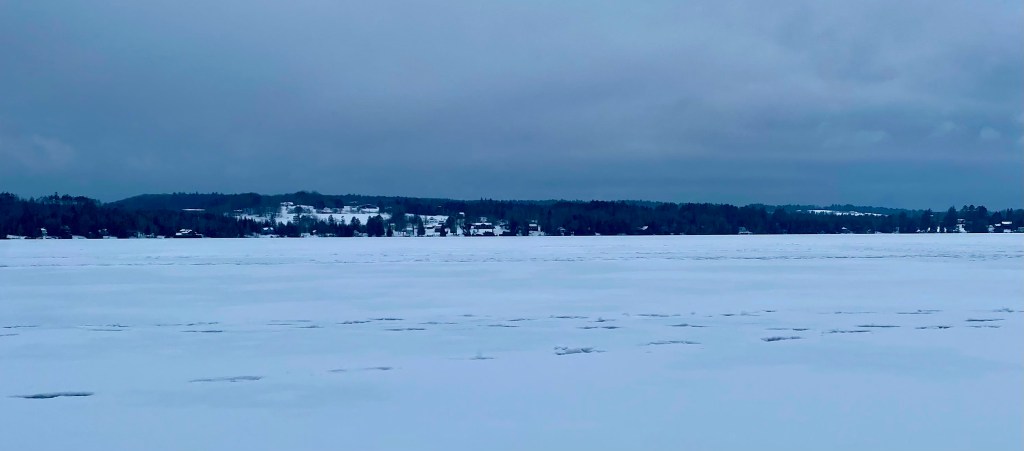
On my way home, I walk down to the lake and stand at its edge. Such a warm winter this has been. There’s not a single ice fishing hut on the lake. Across the middle, two people walk, talking intently, their hands gesturing. As they stroll south, I head towards the center of the lake.

At the beginning of any year I’ve walked or skated on lakes, there’s an always initial angst, a discombobulation about the deep water beneath, the zone where I’ve kayaked or swam. Midwinter, the summer folks are faraway on beaches or cities. The walking pair disappears, and then it’s just me and a lone crow making its steady way across the sky. This winter has clouds and clouds and clouds. Out on the ice, however, the sky spreads wide, its permutations of blue dazzling.

Twenty-five years ago, I was descending into labor with my first daughter, a period when dawn and twilight intermingled, a space where time had no meaning for me. Near the labor’s end (and she came into this world courtesy of a surgeon’s scalpel), all light had vanished from my world save for a distant circle, like a full moon gleaming on still water at the bottom of a well. I saw my right hand reaching down, fingers outstretched, seeking that gleam.

In each of my daughters’ births, the world’s illusions were ripped back. The rawness of blood and tears, of the ineffable power of a newborn’s gaze, filled my world with sacred might.

The ice groaned, shifting. I was certain of its strength for no real reason at all. In my thin jacket, I stretched out on the ice, let the cold hold my bones and flesh, and that vast sky steal my breath.
Roadside View.

In these tail-end days of January, I’m alone midafternoon when I stop by the edge of the road. We’ve endured a cold for days that’s not so much bitter but a raw damp that my brother says reminds him of the ocean. The kind of weather for wearing wool sweaters all day, that make you wrap your hands around cups of coffee. So many years ago, I lived for a winter in an apartment on a brick Main Street building in Brattleboro. The building was heated by radiators, clanging and spewing steam all over that large building, in a heating design where I was mere witness, the grateful recipient.

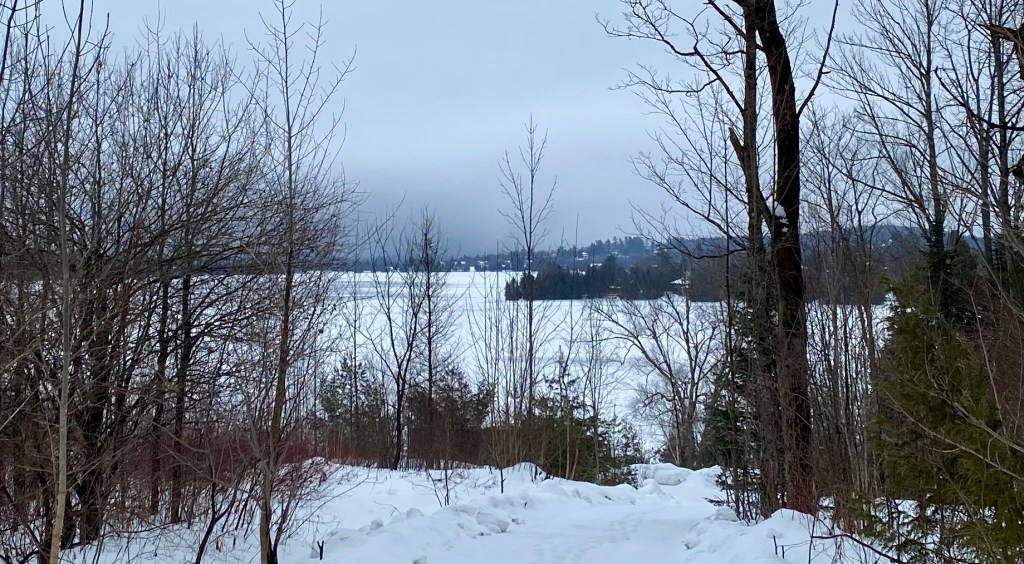
This dreary afternoon, I follow three-toed turkey tracks down a driveway. In the snowy field, the large birds set up a clanging holler when they spy me, ruffling feathers and jostling. It’s just me, I’d like to tell them, a small woman who’s forgotten her mittens and hat. I stand for a bit. Down the hillside, the frozen lake spreads immensely around the spits and coves of the shoreline: breathtakingly awesome.

After a bit, the turkeys seem to care little about my dull presence, gleaning through the thin granular snow.

January: wonder & diligence.

Twenty-five years ago, on a frigid January night, I went to a birthday party and ate chocolate cake. I would have my first baby in a week, and I had gone at that pregnancy with wonder and diligence, heavy on kale and broccoli, scant on refined sugar. The cake was marvelous.

In this warm January, a friend lingers with me over coffee. Melting snow drips from the porch roof as we talk about travel, making art and making a living, parenting. I’m reminded of a line from Raymond Carver that the mightiest force in his life was his two children, Carver who wrote brilliantly about laundromat hours. Wonder and diligence. Our conversation winds around to The List, the eternal draft of chores and visions, the crossing off and adding on, the drafting and revising, the diligence that strings our days together, a crude framework of parenting.

End of January: the weather is slushy and icy, sunbeams a rarity, hardly the season of wonder. My firewood holds the month’s damp, as if resistant, too, to the lousy weather. I lay chunks of wood beneath my stove, drying them a little before I chuck them in, burn the wood to ash.

My little cat flicks his tail. A cardinal nestles in the mock orange’s bare branches, crimson feathers in the muted world. I lay my hand on my cat’s silky back, murmuring, “Well, what do you know….”

And a Raymond Carver poem:

“Happiness”

So early it’s still almost dark out.

I’m near the window with coffee,

and the usual early morning stuff

that passes for thought.

When I see the boy and his friend

walking up the road

to deliver the newspaper.

They wear caps and sweaters,

and one boy has a bag over his shoulder.

They are so happy

they aren’t saying anything, these boys.

I think if they could, they would take

each other’s arm.

It’s early in the morning,

and they are doing this thing together.

They come on, slowly.

The sky is taking on light,

though the moon still hangs pale over the water.

Such beauty that for a minute

death and ambition, even love,

doesn’t enter into this.

Happiness. It comes on

unexpectedly. And goes beyond, really,

any early morning talk about it.

Are you for real?!

The other night, I’m leaving a meeting in the high school library devoted, more or less, to hashing out what community means (nothing to be solved in a few hours). In the parking lot, a woman says Goodbye, Brett — and quicksilver, I shout, Are you for real?!

As the other folks empty out of the school into the spitting snow, she and I talk beneath the ghostly streetlamp. Very quickly, it’s clear to me how utterly wrong I am about this woman. What I believed was true was not. I once ate chocolate covered strawberries in her house with my youngest daughter. The woman packed up a bowl of these delicacies for one sister to give to another.

In ten minutes, we are speaking animatedly of matters of our hearts. We’re both shivering by then in the damp snow. We hug and head to our homes.

I don’t know what’s happening in the rest of the country, and I surely can’t speak for anyone else, but how glad I am that I called out in anger. And how much more grateful I am that she took the time to listen to me, to lend me her shoulder, and I could do the same for her. Indeed: real.

A community… is the knowledge that people have of each other, their concern for each other, their trust in each other, the freedom with which they come and go among themselves.

— Wendell Berry

The true religion, the religion of snow…

I stand at my kitchen’s glass door devouring blood oranges and watching the sifting snow. Blood oranges — could I choose a less local delight? I open the door and cast out the peels for the birds.

The cat Acer sits on my feet, listening to the morning radio news, too. Just over the river, my home state New Hampshire revels in the Presidential primary. Meanwhile, Vermont prepares for its March Town Meeting Day, with the calculations and passion of budgets and petitions. Close an elementary school? Pledge to become a pollinator-friendly town? So much of January in my state is devoted to public meetings and discussion/debate, to a reckoning of the way forward, a jostling for who’s running for what seat — and what seats might remain empty.

Meanwhile, snowy winter has finally arrived, spare and elegant. Fearsome and enchanting. As the days deepen in cold, the light hours increase: no stasis in this world.

A fan of local chicken, bacon, milk, my cat stares at my orange-sticky fingers with disdain. I crunch the orange seeds, too, devouring this sunlight sweet.

Here’s Billy Collins’ poem about shoveling snow with the Buddha:

[Shoveling snow] is so much better than a sermon in church,
I say out loud, but Buddha keeps on shoveling.
This is the true religion, the religion of snow,
and sunlight and winter geese barking in the sky,
I say, but he is too busy to hear me.

The sound of one hand clapping, revisited.

This week, I unexpectedly find myself waiting for someone I don’t really know and end up reading a copy of Ken Wilber’s collected writings. Winter has finally come. The purest and loveliest of snowfalls fills up our world. I wait much longer than I had guessed. A woman comes in to sweep the floor, and we talk for a bit. Sunlight pours through enormous windows.

Here’s some Ken Wilber I soaked in:

You know the Zen koan, “What is the sound of one hand clapping?” Usually, of course, we need two hands to clap – and that is the structure of typical experience. We have a sense of ourselves as a subject in here, and the world as an object out there. We have these “two hands” of experience, the subject and the object. And typical experience is a smashing of these two hands together to make a commotion, a sound. The object out there smashes into me as a subject, and I have an experience – the two hands clap together and experience emerges.

And so the typical structure of experience is like a punch in the face. The ordinary self is the battered self – it is utterly battered by the universe “out there.” The ordinary self is a series of bruises, of scars, the results of these two hands of experience smashing together. This bruising is called “dukkha,” suffering. As Krishnamurti used to say, in that gap between the subject and the object lies the entire misery of humankind.

On my way home, I do something I’ve never done in the winter. I park along the edge of an unfamiliar road. I’ve forgotten my hat. The wind is wild, as if I’m on a stormy sea. My hair tangles over my eyes. Oh sun, oh wind, oh endless snow.

Midwinter, here.