A little Madness in the Spring.

Post-eclipse, rain moves in, balmy tinged with cold. Rain will force spring’s green. Our lives spin on — of course, of course — but the eclipse and all its radiant glory trails us, the collective experience of the cosmos’ unflinching steadiness and how the heavenly bodies align, majestically moving in their infinite complexity. No stasis in this life.

Someone recently asserted to me the caliber of her character — I’m a good person — and the phrase lingers with me, far more a reflection of my wavering self than of the speaker. We’re so unlike the celestial bodies, our mortal bodies driven by gravity and time, but our actions dominated by our uniquely strange brew of our jumbled lives, passions, weaknesses.

The eclipse’s profound beauty for a few moments swept away the pettiness of our thin ideas, our nattering chatter about so much that, in reality, amounts to scant little. Perhaps the eclipse unified us not only by its luminescent beauty, but tugged out the finer strands of us, too.

For a day or two, Vermont was jammed with visitors from so many places. Vermont’s not unique with much that’s happened in recent history — floods and wildfire smoke, the pandemic, and division and division and division. My state also has some of the greatest privileges on the planet: absence of warfare, significant wealth. Let the eclipse bloom last long, carry us through a muddy spring and into summer, keep us questioning what our own goodness might mean, and how goodness transmutes into action.

Last, not least: my giddy joy of gold crocuses. Chionodoxa, AKA glory of the snow, scattered over muddy hillsides, last year’s dull lawns.

A little Madness in the Spring
Is wholesome even for the King,
But God be with the Clown—

Who ponders this tremendous scene—
This whole Experiment of Green—
As if it were his own!

— Emily Dickinson

Awe.

Photo courtesy Molly S.

Just about a year ago, my daughter and I climbed multiple stone steps in the Cathedral of Santa Maria del Fiore in Florence, the stunning cathedral finished before Columbus set sail on a journey that changed the fate of the globe. As we climbed, the organ played. The windows were holes in the stone, and wind washed in. Suddenly, we stepped out onto a narrow ledge where we could see down into the giant cathedral. I knew myself part of this ancient building — alive in the most beautiful structure, in a time that flew back to medieval Europe.

Awe. I’ve participated in so many radiant experiences, but peak awe? It’s a rarity. Right? We couldn’t live if we were always in awe: the Florence Duomo, childbirth, a night of the constellations and some psychedelics….

For those of you not in the know, northern Vermont has been amping up anticipation for the total eclipse. For once, the weather cooperated absolutely perfectly. The state shut down. Go home! Enjoy! We sprawled over the wet grass with neighbors. As the moon and sun began to cross, traffic sounds ceased. Did the wind pick up, or could we simply hear better? I had expected a few moments of the lovely night sky in the middle of the afternoon. But no, no. Instead, a radiant world abruptly glowed. Along the mountains where the sun rises scarlet these mornings, the sky was heavenly blue, rimmed with the purest gold. There were no three minutes of totality. No time at all. It was simply us — all of us — breathing and gasping with great joy.

‘Eat all the plums from all the iceboxes. Apologize to no one.’

Not a spoiler alert — an eclipse is headed our planet’s way — and we live in the path of totality. Over the past few years, it feels like the state has prepared for so many things: snowstorms and windstorms, floods. Now, a river of people streaming in for The Awesome.

Meanwhile, lives churn on. I spend a pleasant and snowy afternoon writing a spreadsheet, followed by a ranting email which I (wisely) delete before I send. I write and write. A short excerpt of my novel is picked up for publication in May. I’m given a green folder and a white folder of old letters and documents and site map for an article I’m writing. The housecats twitch at the juncos in the feeder.

Ryan Champan’s advice on writing a novel:

56. If you’re struggling with revision, print out the draft. Cut each sentence into individual strips and papier mâché them into a sculpture of your head, scaled 2x. Once it’s dried, place the sculpture over your head—create eye holes at your discretion—and just sit like that.

And another:

15. Llosa again, on writing one’s first novel: “Those writers who shun their own demons and set themselves themes because they believe their own aren’t original or appealing enough are making an enormous mistake. In and of itself, no literary theme is good or bad. Any themes can be either, and the verdict depends not on the theme itself but rather on what it becomes when the application of form—narrative style and structure—makes it a novel.”

Read the whole 1oo here. Surely a few gems for anyone…

On Gaslighting.

Via email, my daughter’s school sends me a survey. The survey poses a question about what I desire for my student. The question is phrased in a way that reminds me of a question I was recently asked, by someone I hardly know. The question was unique; the questioner asked specifically about me and my life, and how I saw my life in the wider context of the town.

I’ve been thinking of that question since that conversation, returning to it in odd moments while opening my post office box or washing the oatmeal pot. It’s a question we might all want to be asking ourselves — not just what would improve our individual lives, but how do we understand ourselves in the landscape of where we live. Or maybe this is simply April musings, cusp of a storm that could go either way, rain or snow or perhaps simply wind, sweetened with the scent of thawing soil.

Here’s a few lines from a New Yorker article that seem contemporarily apt….

Gaslighting essentially turns its targets against themselves, she writes, by harnessing “the very same capacities through which we create lives that have meaning to us as individuals,” such as the capacities to love, to trust, to empathize with others, and to recognize the fallibility of our perceptions and beliefs. This last point has always struck me as one of gaslighting’s keenest betrayals: it takes what is essentially an ethically productive form of humility, the awareness that one might be wrong, and turns it into a liability.

Leslie Jamison

Your own darkness.

An old friend from years ago sends me a message. She’s persistent, wearing down through my imposed or self-imposed hermitage, whatever this thing is I’m doing, and I drive myself out on muddy roads. She has such a lovely little girl, I’m smitten immediately. I sit down on the floor and chat up the child, and eventually remember my good friend and how much I enjoy her world. She’s funny, with boundless good will and cleverness, in a life that’s had her share of lemons.

End of March, nearly Easter, my perennials spike up further every day. How the earth desires green. I’m far enough along now in my own life that I know the cupboard of my mortal life will always hold certain grooves and scars, its beaten shape, the way the material in my life has shaped me. Aren’t we all that way, though? Maybe this is why spring is the dearest of seasons, that from mud and ice emerge tender shoots, the improbable made manifest every year.

Beginning

The moon drops one or two feathers into the field.   
The dark wheat listens.
Be still.
Now.
There they are, the moon’s young, trying
Their wings.
Between trees, a slender woman lifts up the lovely shadow
Of her face, and now she steps into the air, now she is gone
Wholly, into the air.
I stand alone by an elder tree, I do not dare breathe
Or move.
I listen.
The wheat leans back toward its own darkness,
And I lean toward mine.

— James Wright

“Writing is about breaking down…”

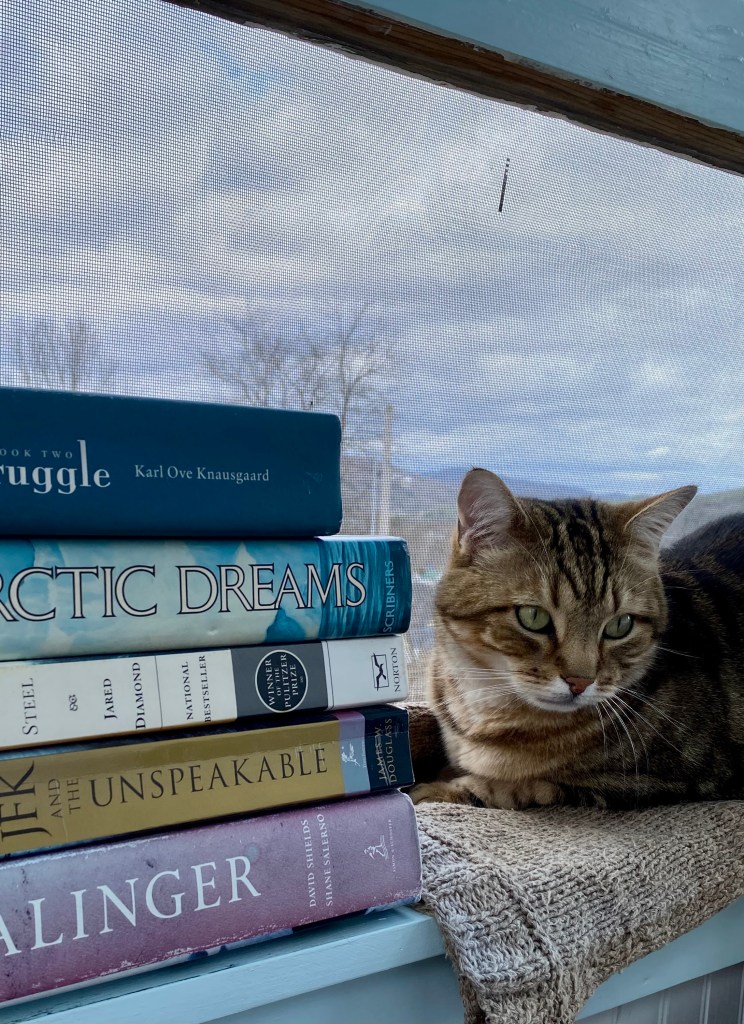
A book of Knausgaard’s essays makes its way into my house. On a snowy day, the cats and I finish putting together my taxes, then read. The snow piles and drifts. The next day, the snow melts and melts, running in sun-sparkling rivulets. Readers either love Knausgaard or despise him, like readers understand Halldór Laxness, or don’t, much in the same way that I have never understood Jane Austen. When I began reading Knausgaard’s Struggle books, a neighbor read at my breakneck pace, loving his words. She and I have long since traveled our own different lives. But reading these essays reminds me of her, how profoundly she believed in beauty as a force. Whichever way she’s traveled, I wonder how that’s worked out for her.

Writing is about breaking down what you can do and what you’ve learned, something that would be inconceivable to a craftsman, a cabinetmaker, for instance, who can’t possibly start from scratch every time.

— Karl Ove Knausgaard