Whose Baby Are You?

Searching through my younger daughter’s baby pictures the other day, gathering a handful of images for her sixth-grade graduation ceremony, I sometimes wondered, is this her? Or her sister? Once upon a time, I couldn’t believe parents might confuse their children’s baby photos; now I join those ranks of beleaguered – and, admit it, lame –parents.

In her face now, I see her woman’s visage emerging: my brown eyes, her father’s thin shape. As a writer, I’m trained to note specifics, like the way she regularly trims her own bangs these days. But details are only bits of her story, keyholes for my curious eyes.

These early wet May days, wildflowers bloom profusely – trilliums, bellflowers, spring beauties, Dutchman’s breeches – each day seemingly a new variation, every stalk and petal one tiny voice in the overall chorus of spring. The symphony rages mightily. So, too, with my daughter, in this spring.

I find myself listening to the symphony-in-the-creation of her.

In writing, you can always change the ending or delete a chapter that isn’t working. Life is uncooperative, impartial, incontestable.

Ariel Levy, The Rules Do Not Apply

FullSizeRender


Lounging on the Lawn of the Loony Bin

When my older daughter was a babe-in-arms and all through her toddlerhood and young childhood, she and I delivered tiny bottles of maple syrup for wedding favors, usually tied up with ribbon or raffia, with a small slip of colored paper with the couple’s names and wedding date, and a cheery phrase, like Eat, drink & be merry! Or A Sweet Beginning.

With my little kid, goldfish crackers and the Vermont Gazetteer, we met people in  Price Chopper’s parking lot, tony lakeside resorts, or – one of my favorites – outside the Vermont State Asylum for the Insane in Waterbury. The hospital then had locked wards, and the purchaser of maple syrup bottles came down and met us on the grass. She was on her lunch break and had time to chat. I offered that my mother is a RN, and had amused us as children with her nursing school stories of the woman in the state asylum who swallowed spoons.

My daughter, who was four, looked up at me, completely puzzled. Why?

The woman and I laughed.

Of all the people who bought my wedding favors, this woman is the one I wonder about. We lingered on the grass that day, the sheer expanse of tended lawn a novelty for my child and I. This woman was happily getting married in a few days, and I took my child to a playground that afternoon. There were not enough playground trips in that girl’s childhood. Maybe that’s one of my few pieces of advice to young parents: more playgrounds. Linger barefoot on the grass. The strangeness of people who devour spoons doesn’t disappear.

The American way of life has failed – to make people happier or to make them better. We do not want to admit this, and we do not admit it. We persist in believing that the empty and criminal among our children are the result of some miscalculation in the formula (which can be corrected), that the bottomless and aimless hostility which makes our cities among the most dangerous in the world is created, and felt, by a handful of aberrants, that the lack, yawning everywhere in this country, of passionate conviction, of personal authority, proves only our rather appealing tendency to be gregarious and democratic. We are very cruelly trapped between what we would like to be, and what we actually are. And we cannot possibly become what we would like to be until we are willing to ask ourselves just why the lives we lead on this continent are mainly so empty, so tame and so ugly.

– James Baldwin

FullSizeRender

Waterbury, Vermont

Kid Chat

The May my younger daughter was born, rain fell every day, from May 1 to May 31. At the beginning of June, cornfields sprouted shoots of green, and the summer turned sweltering. We are yet in the rainy phase. Everyday, my daughter, now nearly 12, claims the apple tree leaves unfold their leaves noticeably wider. Fragrant blossoms and pollination are imminent. This girl changes, too, on the tender cusp of childhood and adolescence, past the why stage of toddlerhood and wondering at the pieces and people in her life.

The other morning, she asked about a church’s billboard sign: Jesus was a low-wage worker. She asked what Jesus did; I answered he was a carpenter, not a low-wage job in our town. Then what does the sign-writer mean? We wonder, who’s telling this story, anyway? The story of Jesus? The story of our town?

Then we were at her tiny school, the handful of graduating sixth graders wild about their trip to Maine, nearly trembling with excitement. On my way to work, I stopped again at that sign, pondering its existential statement. Rain fell lightly, and I sank my fingers into the church lawn’s soil, glad to see grass for the first time this year, long as my fingers.

….art and ideas come out of the passion and torment of experience; it is impossible to have a real relationship to the first if one’s aim is to be protected from the second.

– James Baldwin

FullSizeRender

Hardwick, Vermont


What Is

When I was in graduate school and teaching an intro creative writing course, I was walking down the library steps one afternoon and suddenly realized I knew almost nothing about writing. Why nouns and verbs, for instances? Why anything for that matter?

I stood there in the rain pondering the difficulty of creative work. I also guessed it would always be hard for me.

That, at least, decades later I now see, was one thing I was right about in my life. Since then, maybe I’ve gleaned one or two things: sometimes less is stronger, and sometimes you need to push and push, going for broke.

Here’s a poem from David Budbill’s lovely posthumous collection.

Say what you see.
Get it down right.

Accuracy is plenty.

What’s here
is good enough.

FullSizeRender

Craigslist Adventure, Again

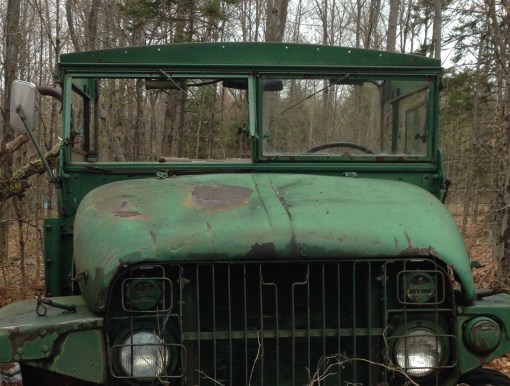
After 10 pm last night, in the rain and profuse dark, a stranger with one eye appears, wanting a military truck I’d posted on Craigslist. My teenager grabs a flashlight and insists on coming, too.

By his car headlights, he examines the huge beast – drivetrain, winch, cab, engine – noting with disapproval the Glock bullet holes. What he’s looking for, precisely, I don’t know, but I have a real sense he knows.

The rain lets up, and we stand in his headlights, my tall daughter just behind me, his car packed with three men and the engine running. He reeks of cigarette smoke and sweat, and he’s panting for breath. We talk a little about money and about his cancer; he’s likely telling the truth. Wheezing, he says, “I keep telling the doctors you can’t kill the devil.”

He says he’ll take the pile of mangled gutters for scrap metal, and then I offer more: an old plow, tire rims, twisted fencing. He’s a scavenger. But I see more, too, as I can’t help but stare at that loose pocket of flesh where he once had an eye. When I became a single mother, I began toeing a line where I slip sometimes over into grifting, needing childcare, a car repair, property tax money: a place of needing assistance I find incredibly to my dislike. In his drooping flesh, I see a dimension of my own self mirrored back.

We part ways. Walking back through the sweet-smelling, wet spring woods in the dark, my daughter agrees I might have lost that transaction, although I have one less problem and grocery money in my pocket. More: I have two eyes. She laughs at the night’s oddness as she heads to bed; we mutually agree to let this one go.

And that vehicle, built long before I was born, witness to what I can’t imagine, heads to its next chapter.

There are moments when the heart is generous, and then it knows that for better or worse our lives are woven together here, one with one another and with the place and all the living things.

– Wendell Berry

FullSizeRender

Soil Writing Exercise

In a writing workshop I attended years ago, a professor grilled another student about a field she had recently driven by. What emotion did the field evoke in you? Older than me and not a close friend, the student was a woman I admired. A single mother, she was simultaneously brassy, insecure, funny.

The professor kept asking questions: Any moon or starlight? Rock piles? Did a river or trees border any edge?

The woman paused and finally said one word: sad. The emptiness of the harrowed up field evoked a sense of waste. The conversation might have ended there, but the professor pushed a little further, probing, and the woman said she thought the sorrowful emptiness was just one long snapshot of the field’s story.

That evening, we were not in our usual seminar room, clumped awkwardly instead in a half circle of chairs with writing desks attached. The overhead fluorescent lights made the windowless room uglier than it needed to be.

Every now and then, I find myself wondering what happened to this woman, and which way her story bent.

In the end you should probably know your characters as well as you know yourself. Not only what they had for breakfast this morning, but what they wanted to have for breakfast.

– Colum McCann

thumbnail_FullSizeRender-3