Hardwick Sign of Spring #3

A dozen turkey vultures circled overhead, spiraling on wind currents, silently following us on a walk. They’re back, my daughter noted.

A day of serious wet: cold rain, rivers running high with melt-off, black mud thawing.

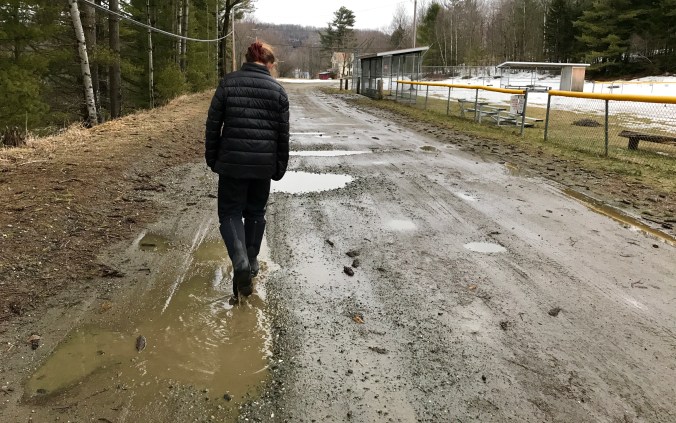
We walked in no particular hurry, talking, my daughter awkward in her sister’s too-large boots, pausing to study the vultures circling low, their wing feathers black against the clouds. As our path turned, the circling birds followed us.

I’m fascinated by the landscape around us of junco and robin, hawk and vulture, vegetable garden and cemetery. My daughter zipped her jacket against the raw spring. Those vultures are following us, she said. Creepy.

To pretend that all is right with the world when it is not, to use art as a pair of rose-colored glasses to distort the reality of the world, to paint over the agonies of our time, is to misuse art. Any light and life, joy and ecstasy we can derive from art in our time must be paid for with the admission that this joy and goodness comes to us out of the barbarous darkness all around us.

— David Budbill in Yvonne Daley, Vermont Writers: a State of Mind
IMG_1437.jpg

Hardwick, VT, Sign of Spring #2

A sign of spring, I suppose, is small-talking with the other parents on a slushy soccer field, watching our kids in a nordic ski relay. Sure, that’s spring in Vermont, borne with the usual good-humor of nordic ski families, and well compensated by an eclectic and unbelievably delicious potluck. At how many potlucks do you find a wedge of homemade sheep’s milk blue cheese?

But a more heartening sign is breaking out the lawn chairs for afternoon in plein air studying. Note snow.

Stop acting so small. You are the universe in ecstatic motion.

— Rumi

IMG_1429

Hardwick Sign of Spring #1

My daughter sunk above her knees into the snow over my garden. Somewhere, deep down, lies my garlic. Are you stirring, little white cloves? In your tender hearts, are green shoots stretching?

Bit by bit, the world changes. Starting with the soil, I’m searching for ten solid beacons of spring. How much better does the world get for children than mud?

The soil is the great connector of lives, the source and destination of all. It is the healer and restorer and resurrector, by which disease passes into health, age into youth, death into life. Without proper care for it we can have no community, because without proper care for it we can have no life.

— Wendell Berry, The Unsettling of America

IMG_1413.jpg

Barre, VT, Courthouse

A retired Barre police officer sat beside me while I was waiting outside a courtroom in the Washington County Criminal Court, and he mentioned he thought he knew my former husband. He suggested that clearly I didn’t know my former husband all that well, and he told me some wrongdoings he knew my former spouse had committed. I protested that the man he referred to wasn’t my former husband.

The officer persisted. Listening, I began to wonder how much I knew about anyone, really, in the end. In my bag, I had a copy of Janet Malcolm’s biography of Sylvia Path, The Silent Woman, which I had read with enormous interest many years ago, right before I was married. In this book, Ted Hughes is quoted as writing, “I hope each of us owns the facts of her or his own life.”

I knew when I entered that courtroom, again, as I had before, that I would need to relinquish some of the darkest facts of my life. Just the facts, ma’am, and yet the facts seem so much. The reality is, of course, none of us own the facts of our lives. We’re hardly discrete entities, spreading into each others’ lives messily as we do.

Just the facts. Granite photos, the trio of a judicial panel, bailiff, what must be an endless of stream of adults coming and going through the security at the door. Outside, robins sang in the maples behind the courthouse. I’d been there so frequently, I knew the way out of the one-way streets.

IMG_1406.jpg

A $5 Rainbow-Bright Kickball

My cheerful kids returned yesterday with a bright pink blow-up beach ball they found on a back road. The older daughter, driving, had pulled over, so the 12-year-old and her friend ran back along the ice-rutted road for the garish pink ball. At home, they mended the gash with silver duct tape.

Vermont’s March palette lies heavy on variations of white — the pureness of fresh snow, the near-gray of thawed ice refrozen with dirt particles — dark green pine, the black of gravel roads where the town crew has strewn sand, the crimson patches on redwing blackbirds.

Full of spring energy with the lengthy daylight after dinner, the girls and I walked around the neighborhood. The younger splashed through a puddle and noted she stepped over the moon’s reflection. I bought the girls a $5 kickball, striped in rainbow colors. Deep into twilight, so cold we kept blowing on our bare hands, the girls and I played four-square, that brilliantly-colored ball bouncing through the thickening dusk.

And then the girls took the ball inside and played in her bedroom, confusing the cats.

Here’s the artwork from the newest issue of Taproot, with an essay I wrote about our house. The artist’s creation is a remarkable likeness, both in architecture and emotion, although the blossom season hasn’t yet returned…..

TaprootHEAL-16_preview

Our Lives, Seen and Unseen

A few minutes early to collect the 12-year-old and her friend from track practice, the 19-year-old and I take a walk around a neighborhood circle near the high school, passing a house I considered buying but didn’t.

Full of excitement about her morning, my daughter talks on and on, her happiness as visible as red-breasted robins in a bare-branched maple tree. We pause for a moment before the three-story house, with large original windows on the first and second floors, bordered at the top by ornate stained glass. The owner confessed the windows leaked air profusely but couldn’t bear to replace them. The house is no longer for sale; my daughter and I speculate the family still lives there.

We walk by another house flanked by five sugar maples, the trees young enough to live for many more decades.

Robins, both visible and hidden, sing.

My daughter and I pass these houses and these possible lives our family might have taken but didn’t. Then we’re back at the high school, still in the cold and clear March sunlight, beside a maple filled with robins fluttering their wings, chorusing in the beginning of spring.

I know that I love the day,
The sun on the mountain, the Pacific
Shiny and accomplishing itself in breakers,
But I know I live half alive in the world,
I know half my life belongs to the wild darkness.

— Galway Kinnell

IMG_1393.jpg